The empty corner is not always the right place for a floor lamp. If the missing light is on a book, a lamp across the room may brighten the wall without helping the reader. If the room already has enough reading light but feels stark after dark, another concentrated beam can make it worse. Decide what is missing before finding somewhere for the base.
Choose the job and the kind of light together
For a reading chair, an adjustable head or arm lets you direct light onto the page. A translucent shade can provide broader light around seating, but it may send too little toward a particular book. An uplight can brighten a pale ceiling and indirectly fill the room; its effect changes with the ceiling and wall surfaces. An arc lamp reaches over furniture, but its large base and projecting arm require room that a straight pole lamp does not.
For accent light, aim an adjustable head toward a wall texture, a bookcase or a display that disappears after dark. This draws attention to that surface rather than supplying general reading light. Keep the bright source out of nearby seated sightlines, check any reflection in glazing or the television, and maintain the lamp maker’s clearance from books, leaves, curtains and other materials. If you cannot light the feature without glare or crowding it, move the lamp or choose a different feature.
Choose one primary job. A lamp can help with more than one activity, but a position that serves the sofa’s end seat may not serve someone at the other end. If the floor lamp is expected to solve every dark spot, first consider whether the room needs two modest sources of light in different places.
Reading-chair case: follow the page and the hand
Imagine an upholstered chair beside a wall outlet, with a small side table on the room-facing side. You read with the book in your lap, sometimes making notes. Start an adjustable floor lamp beside and slightly behind the chair, on the side opposite the writing hand. This is a useful trial for writing, not a rule that every reader’s lamp belongs on that side.
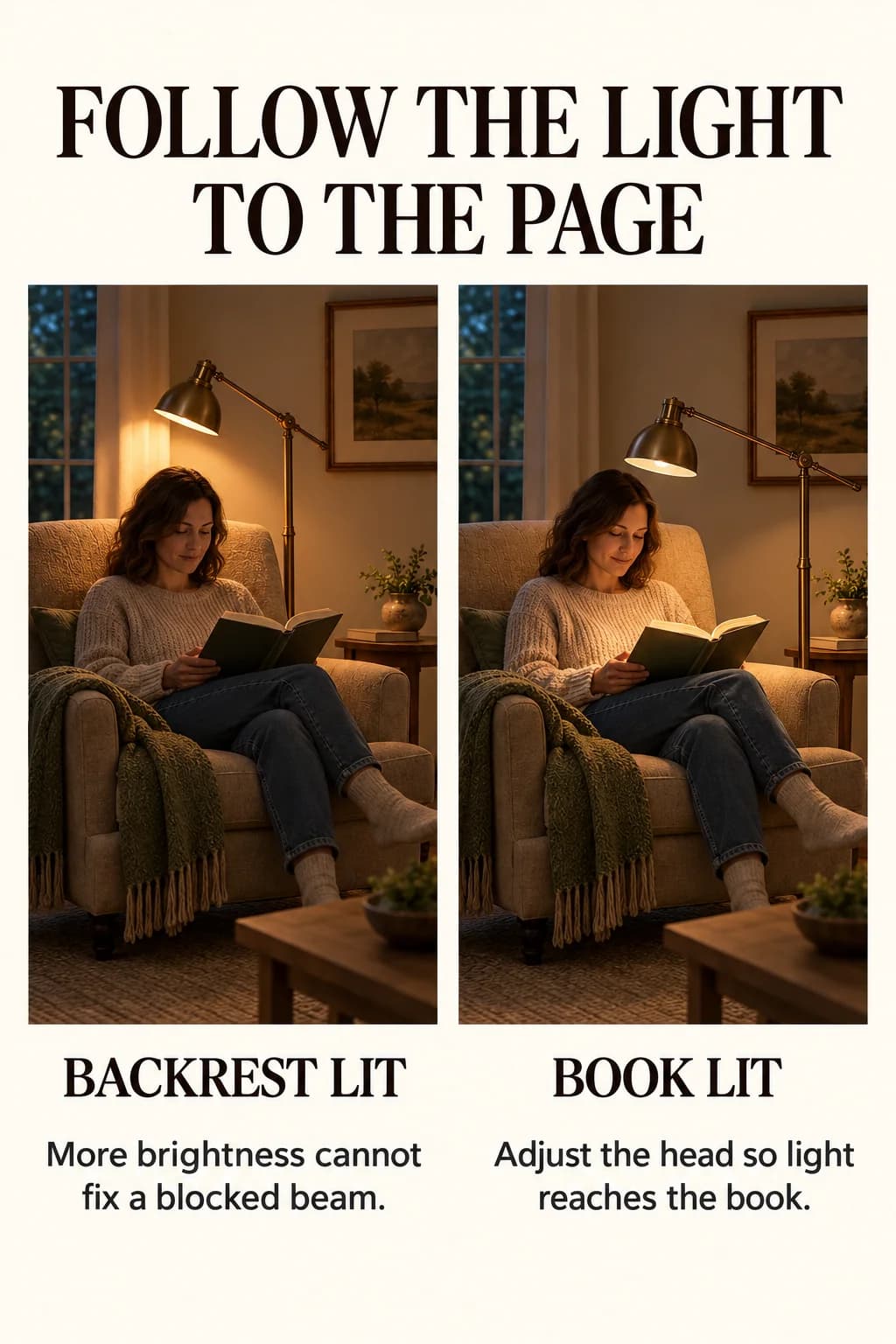
Keep the base beside the chair where you will not step on it when standing. Bring the shade forward enough that its light reaches the open book rather than only the chair back. Sit in your usual posture, including the cushion or footstool you actually use. Turn a page and write a line. If your head or hand casts a heavy shadow across the working area, shift the lamp sideways or adjust the head until the shadow moves away.
In a failed first trial, the lamp stands far behind the chair: the backrest is bright but the lower half of the page remains dark. Increasing brightness mostly lights the backrest more. Move the head’s aim forward and, if necessary, move the base slightly alongside the chair so the beam clears your shoulder. If the lamp cannot reach without putting its base in the walking route, choose a different lamp or rearrange the chair.
Check the switch from the seat. A foot switch trapped behind the chair is less useful than it appeared before the chair was occupied. Keep the control reachable without an awkward twist or a cable across the place your feet land. Route the intact cord to the nearby outlet along the wall with slack, outside the chair’s feet and any reclining mechanism.
Separate a shadow from direct glare
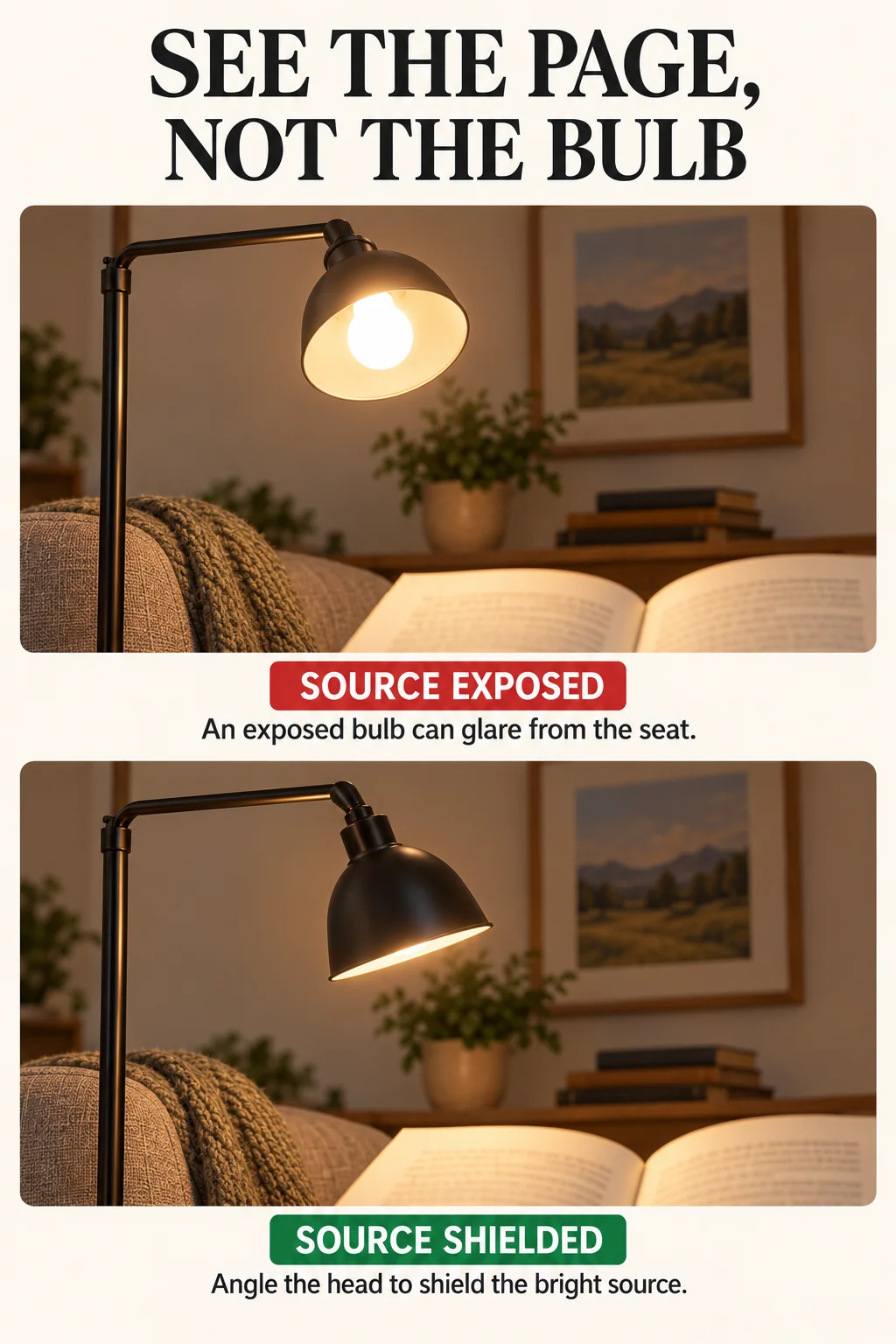
A dark patch on the page is a shadow problem. Seeing an exposed bright bulb is a direct-glare problem. They need different tests. Look toward the lamp from your reading position and from the chair opposite. The shade or head should shield the source from those normal sightlines while the page remains illuminated.
With an adjustable head, tilt or reposition it and repeat the test. With a fixed shade, moving the whole lamp or choosing a more suitable shade may be necessary. Raising a lamp is not automatically the cure; from some seated positions it exposes more of the underside. Check what the person actually sees. Our lampshade guide covers the separate relationship between shade, fitting and lamp body.
Sofa-and-TV case: test the reflection from every seat
Now imagine a sofa facing a television, with an outlet near the sofa’s left end and a route into the room on its right. You want gentle evening light for conversation and occasional reading at the left seat. Begin with a shaded lamp near the left sofa arm, its base outside the place where someone steps down from the cushion. A diffuse shade can soften the dark corner, while a directional reading arm may be needed if the main shade cannot adequately light a book.
Turn the television off so the screen acts as a dark reflective surface. Sit in the left, middle and right positions and look for the lamp’s reflection. A placement that looks fine from the center can reflect directly toward the end seat. In a failed trial, the illuminated shade appears as a bright patch on the screen from the right seat. Move the lamp farther toward the side wall or change its fore-and-aft position, then check all seats again. The useful direction depends on the screen angle and room geometry; there is no single distance that removes every reflection.
Turn the television on as well. If moving the lamp cannot remove the distraction without blocking the walkway, relocate it or use a different lighting arrangement. Dimming may reduce the reflection’s intensity, but it does not change its position. The guide to decorating around a TV helps keep the surrounding objects from competing with the screen once the lighting works.
Test reading separately at the left seat. A warm glow behind the sofa does not prove that the page is adequately lit. Add a localized reading source if needed instead of making the whole shade intensely bright to serve one small task. Make sure the lamp’s control remains accessible from that seat, with the cable reaching the wall outlet without tension.
Allow for everything that moves around the base
Open nearby doors, pull the side table to its usual position and fully extend any recliner. Check the route while someone is sitting down and getting up. A base that fits behind an empty sofa may obstruct feet or a moving mechanism. An arc lamp also needs a stable base and clearance for its entire arm; do not judge its footprint from the hanging shade alone.
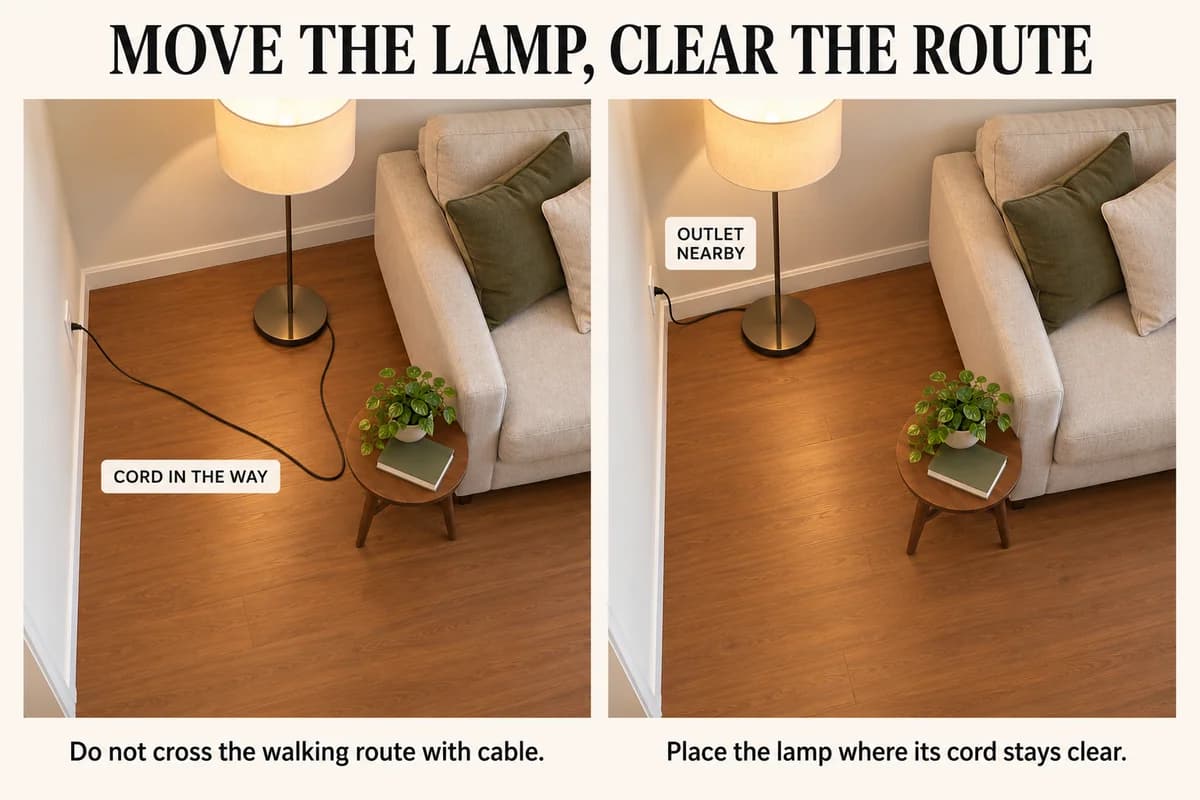
Keep cords outside walking paths and clear of pinching by furniture. Do not run them under rugs, across doorways or beneath heavy furniture to hide them. Extension cords are not a substitute for permanent wiring. If the intended position cannot reach a suitable outlet safely, move the lamp or have a qualified electrician assess an appropriate outlet location. Follow the lamp’s bulb, clearance and assembly instructions, especially near curtains and other materials.
In a room used by children or pets, also consider whether the base can be knocked and whether a loose loop of cord invites pulling. Stability and access may rule out an otherwise attractive location. Reassess after dark with the other lights in their normal settings. The successful position gives the right surface usable light while the bulb, reflection, base and cord stop demanding attention.