A neckline gives earrings a setting, but it does not assign them a compulsory shape. A square neck can look good with round hoops or angular drops; a high neck can take a substantial stud as easily as a long earring. What matters is the effect you want and whether the jewelry has room to move.
Make two separate decisions: clearance and attention
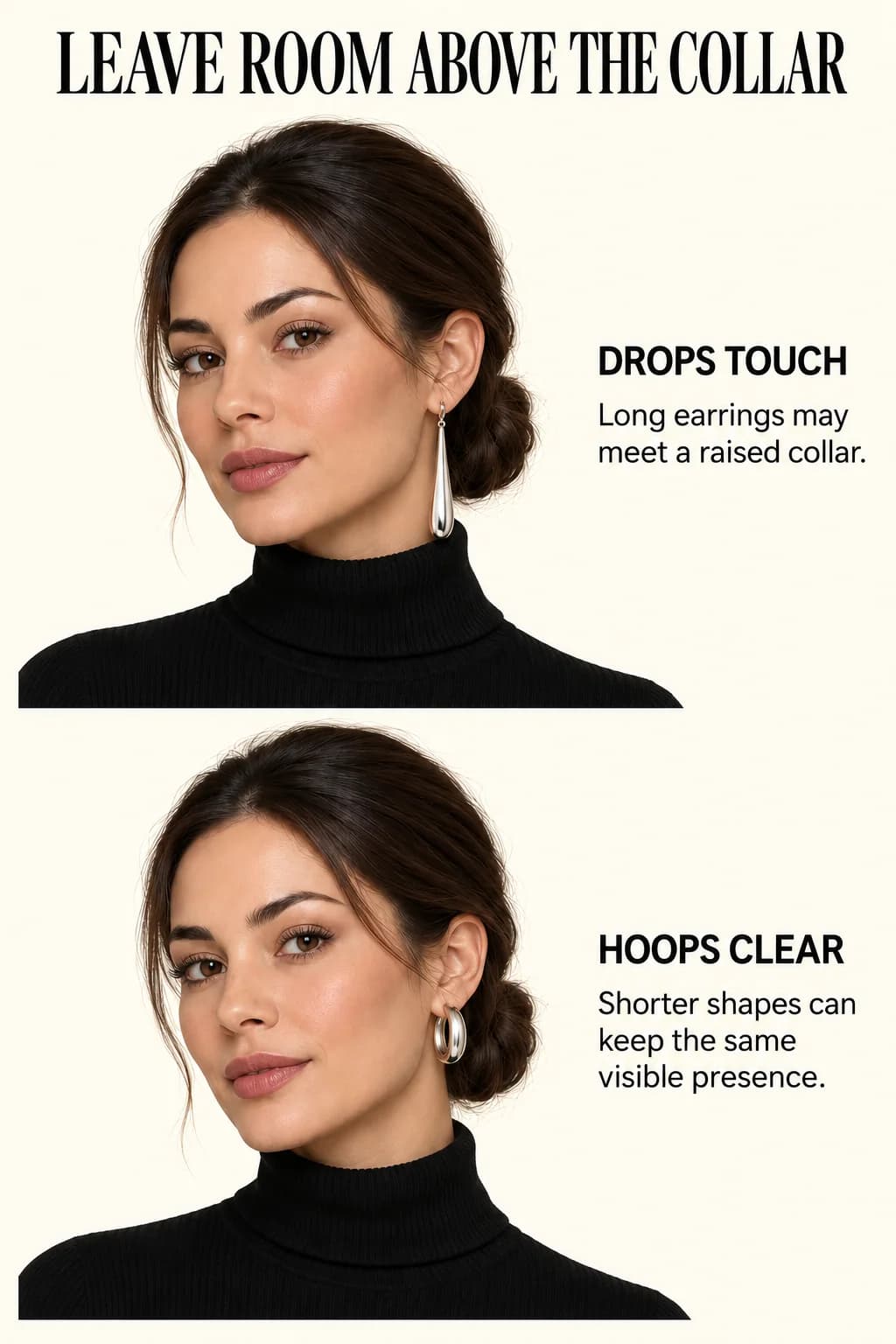
First, check the physical space. Turn your head with the actual top on. An earring that touches a stiff collar, catches a knit or lands against a raised shoulder detail may be frustrating regardless of how well its shape matches the neckline. A shorter drop or compact hoop can remove that contact. Width alone does not tell you how far an earring hangs below the lobe.
Then decide where you want the detail. Earrings can provide the main accent beside your face, share attention with a necklace, or sit quietly above a striking neckline. These are alternatives, not a scale from underdressed to correctly dressed. Consider your hair as part of the setting: a small earring may be intentionally discreet behind it, or you may want a wider surface that remains visible.
Retail size names are only a starting point. Monica Vinader's hoop guide illustrates several diameter ranges, but a hoop's visual presence also depends on its thickness and shape. Check actual dimensions and the earring on your ear when possible. A light-looking outline is not proof that a piece will feel comfortable for hours.
Three pairings, with room to change your mind
A high neck: make the earring visible without touching the knit
For a casual office day, wear a charcoal fine-knit turtleneck, dark straight trousers, black loafers and medium silver hoops with a smooth, rounded surface. Sweep your hair behind the ears or into a low ponytail. Leave off the necklace for this version so the silver is the main bright detail against the charcoal.
The hoops give the covered neckline a visible companion without adding another line across the front of the sweater. Choose a size that clears the rolled neck when you turn. A compact, wider hoop can give more visible metal than a very thin long drop while occupying less vertical space. If the collar is thick or stands high, a sculptural stud is another way to keep that presence close to the ear.
For an evening version, change to a broader silver stud, black tailored trousers and a dressier flat or low heel you find comfortable. The change comes from the surface and finish of the jewelry, not a requirement to make it longer. If you prefer a necklace over the knit, keep it: smaller hoops can let the necklace take the lead. Our turtleneck styling guide considers the rest of that outfit.
An open V or square neck: choose what occupies the space
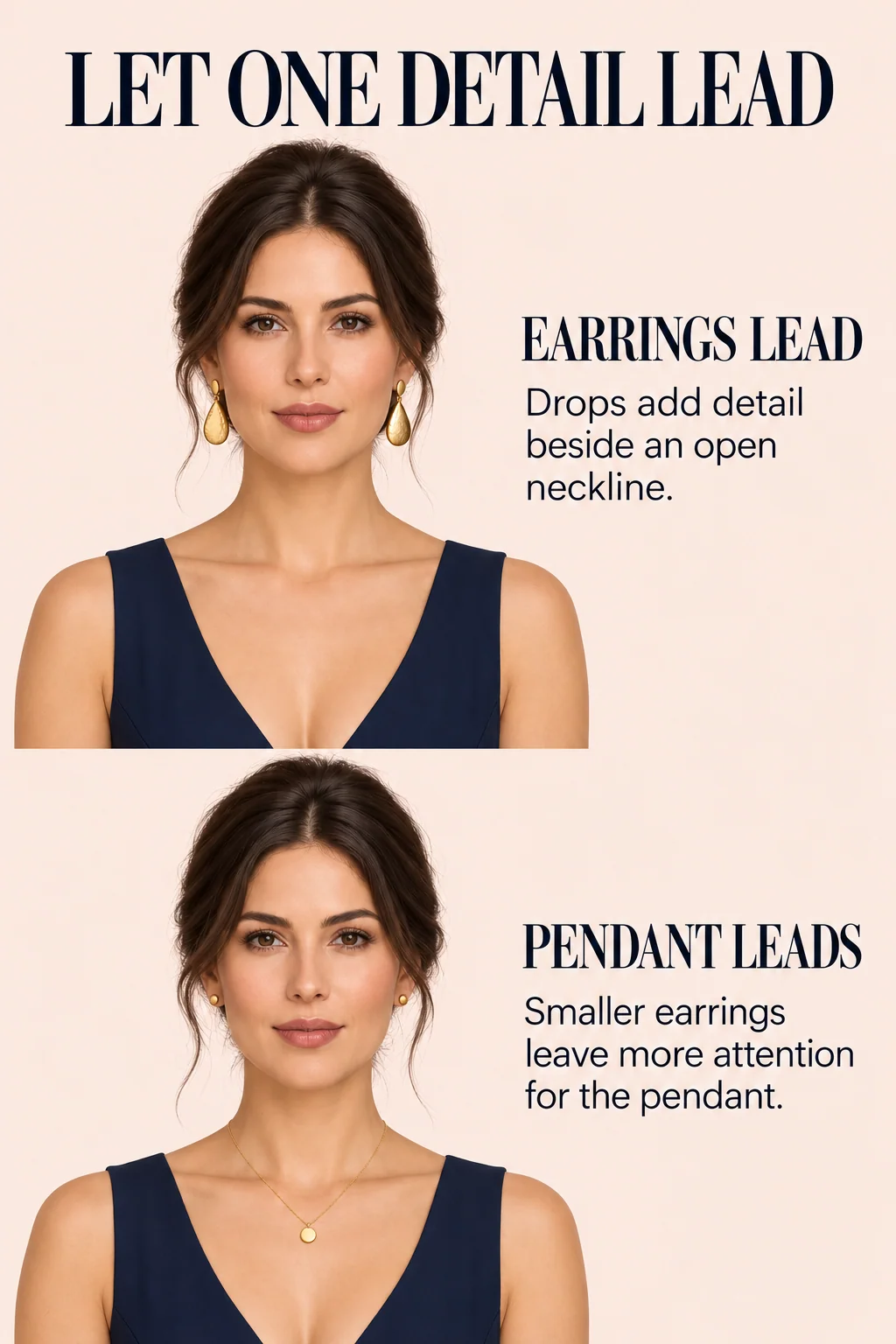
For dinner, try a navy V-neck blouse, cream straight trousers, navy or metallic flats and slim gold teardrop earrings. Wear the hair in a low bun or tucked back, and omit a necklace initially. The drops echo the blouse's downward direction, while the cream trousers keep the full outfit from becoming one dark block. Choose a drop that remains clear of the collar edges as you look down.
You can make the same blouse feel quieter with small gold studs and a fine pendant sitting inside the V. That is a change of focal point, not a correction. If you want both the drops and pendant, look at their spacing together: distinct areas of detail can work, whereas pieces that visually merge into one busy cluster may need a shorter drop or simpler necklace.
A square-neck dress offers another useful contrast. Try a black square-neck midi with pearl studs, black flats and a neat shoulder bag for a daytime event. The rounded pearls soften the angular setting without copying it. Change to short geometric silver drops for a sharper evening interpretation, leaving the necklace off to let the square edge remain visible. Neither round nor angular earrings are mandatory for a square neckline.
For strapless or off-the-shoulder clothing, there is more open skin, but long earrings are still optional. A statement necklace with compact earrings can fill that space just as deliberately. See which necklace to wear with each neckline when the necklace is the piece you want to build around.
A boat neck or asymmetric shoulder: respond to the actual detail
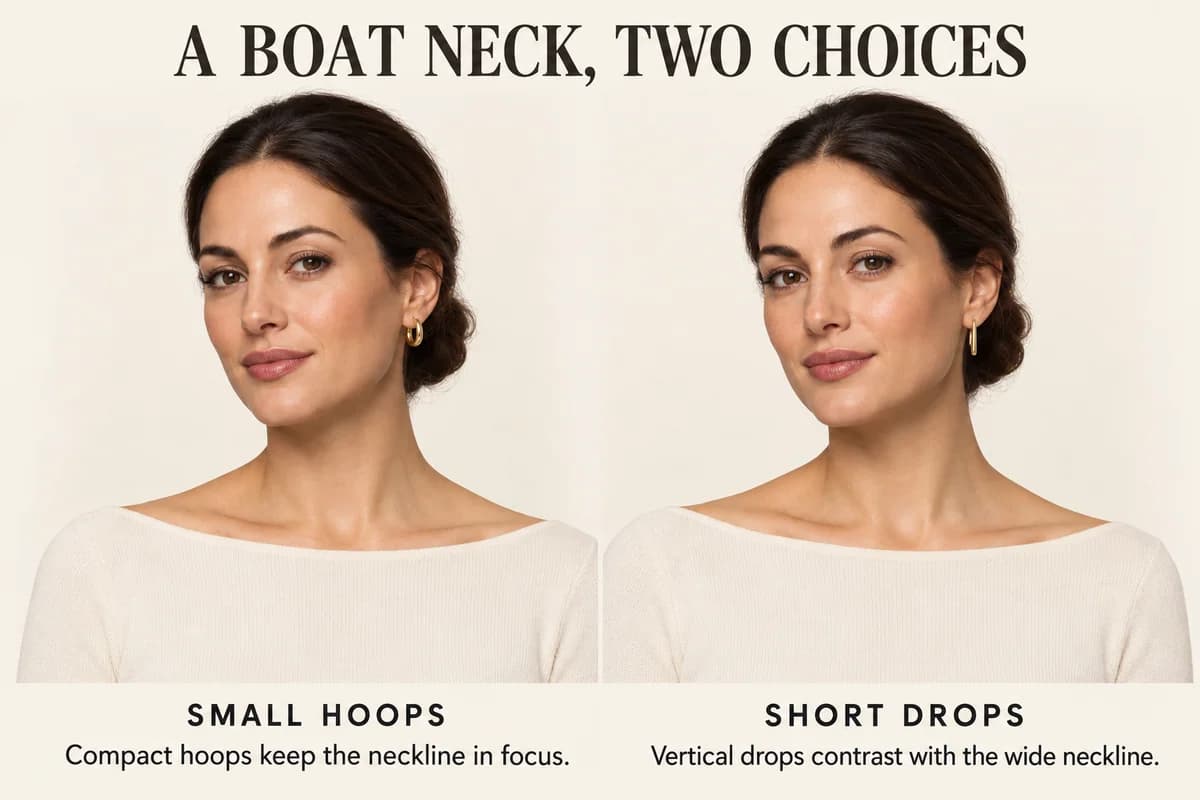
For a weekend lunch, pair an ivory boat-neck knit with dark indigo jeans, tan loafers and small gold hoops. Wear your hair half-up if you want the hoops visible and skip the necklace in this version. The broad neckline remains the strongest horizontal shape, while the earrings give a small warm accent that relates to the tan footwear.
For a more pronounced contrast, keep the entire outfit and change only to short linear gold drops. Their vertical line contrasts with the wide neckline. This can be an appealing choice, not something to rule out because the boat neck is already broad. Check that the tips do not touch the fabric when you tilt your head.
With a one-shoulder top, examine the raised side rather than following the boat-neck suggestion automatically. A ruffle or large bow may occupy the space where a drop would swing. Smooth studs or compact hoops keep clear of that feature. A plain asymmetric top may leave plenty of room for longer earrings. Halter straps deserve the same practical check: choose the length that moves freely beside the strap and any knot at the neck.
When the mirror pairing does not survive the day
Hair down can obscure earrings you liked with an updo. Before choosing something longer, try a wider stud, move one section of hair behind the ear or accept a subtler effect. Longer earrings can still disappear beneath hair, and may introduce more movement near collars.
If jewelry catches a knit or lace edge, try a smoother surface and less reach into that fabric. If a coat collar collides with the earring, assess the outfit with the coat fastened, not just with the neckline exposed indoors. Remove uncomfortable jewelry rather than expecting yourself to stop turning your head. Weight, fastening and individual comfort matter separately from visual scale.
Matching sets and mixed metals can both work. A shared finish or repeated shape is one way to connect pieces, but exact matching is optional; our gold and silver jewelry guide shows another approach. Start with the detail you enjoy, then choose the surrounding pieces to give it the amount of attention you want.