The necklace is lovely. The top is lovely. The pendant has chosen to sit half inside the neckline, where neither gets much of a chance.
Before changing the jewelry, check its position. Moving the same pendant above or below the fabric edge can do more than choosing a completely different necklace.
Start with where the necklace lands on you
A chain’s stated length is useful for comparison, but it is not a promise of where the pendant will sit. Your neck circumference and the pendant’s size affect the result, as Luxe Emporium’s necklace size guide explains.
Put on the actual top, then the necklace. Look at three things: the lowest point of the pendant, both visible sides of the chain, and the fabric edge closest to them.
For a pendant worn on skin, try leaving enough space that you can see its entire outline. For one worn over fabric, give it a clear place to rest below the edge. You are looking for a position that stays readable when you move, not a compulsory gap measured with a ruler.
Choose a starting position for your neckline
Use this as a try-on guide. “Short” means short enough to sit where you want on your body; it does not assign the same chain length to everyone.
| Neckline | First placement to try | What to check |
|---|---|---|
| V-neck | Pendant fully inside the V, above the fabric edge | Lowest tip clears the point and both chain sides remain visible |
| Scoop or open round | A chain or pendant within the exposed area | Pendant does not partly disappear as the neckline shifts |
| Square or sweetheart | A shorter chain or pendant above the central edge | Check the sides and any raised corners, not only the center |
| Crew, boat or high neck | A longer piece over the fabric, or a short piece that clears the edge | Necklace is distinct from the neckline and any collar fold |
| Open shirt collar | A pendant inside the opening | Chain clears collar points; pendant avoids the top fastened button |
| Strapless or off-shoulder | A collar-length piece or short pendant on exposed skin | Keep the complete necklace clear of the top edge during movement |
| Cowl, ruffle, embellished or asymmetric | Try the neckline without a necklace first | Add jewelry only if it stays clear and preserves the detail you like |
A necklace can echo the opening, such as a pendant dropping into a V. It can also contrast with it, such as a curved chain inside a square neckline. Once placement works, choose the shape you enjoy.
Scoop and open round necks: give the pendant a clear home
A scoop creates an open area in which a short chain or pendant can sit. Start there, then check that the pendant’s bottom does not just meet the center of the scoop.
When a pendant straddles the edge, part of it may disappear as the top moves. It can also look as though it belongs to the neckline trim rather than being a separate piece of jewelry. If you like that effect and it stays put, keep it. If it looks unsettled, change the position.
In the comparison below: the left pendant sits entirely on skin; the center pendant overlaps the fabric edge; the right pendant rests entirely over the top. The neckline, pendant size and chain style stay the same. Only the worn length changes.
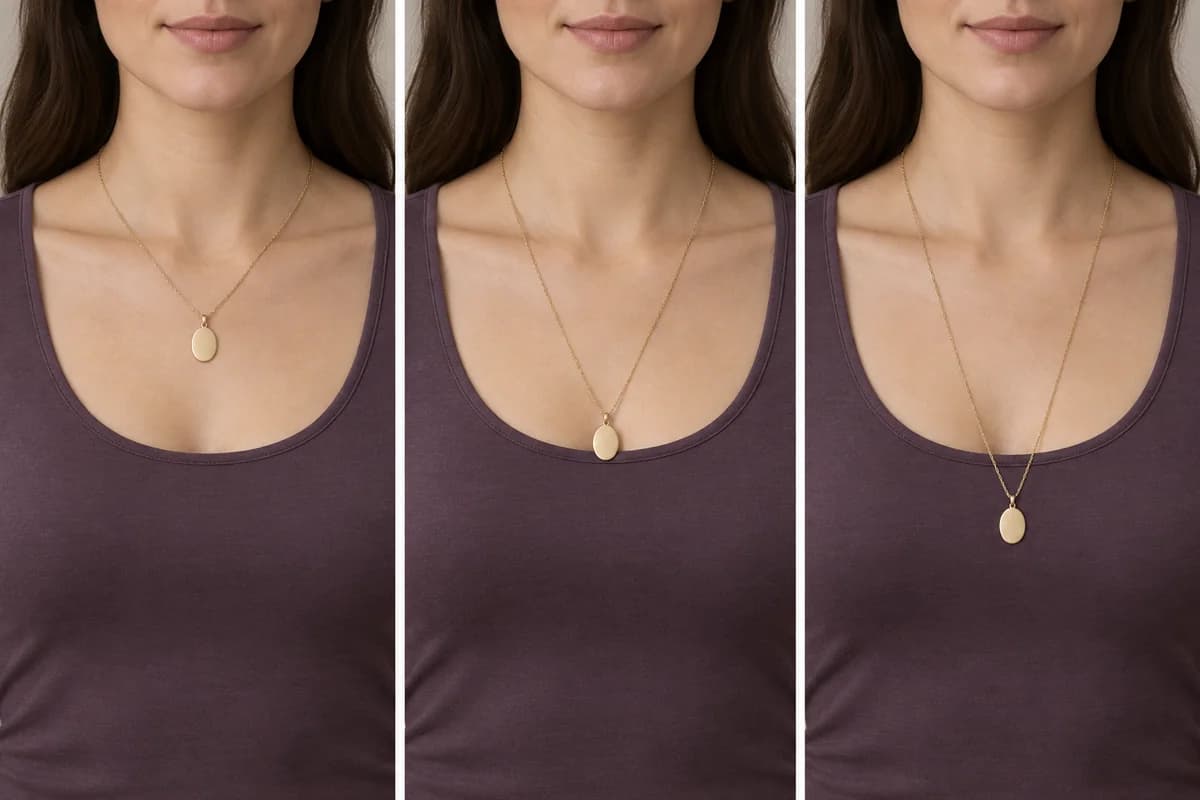
The over-fabric option is useful if you prefer a longer necklace. Its chain will cross the neckline on either side, which is normal. The aim is to keep the pendant from repeatedly catching or slipping underneath, not to eliminate every crossing line.
V-necks: check the pendant’s tip and both sides
A pendant inside a V repeats its downward direction. That makes it an easy starting point, especially when the pendant tip finishes clearly above the lowest part of the opening.
But the V’s depth matters. A necklace that sits comfortably inside a deep V may overlap a shallow one. A wide pendant can also reach the sloping sides before its tip reaches the bottom.
Compare left to right: pendant inside the opening, pendant meeting its point, pendant lower over the fabric. Keep an eye on the chain sides as well as the center.
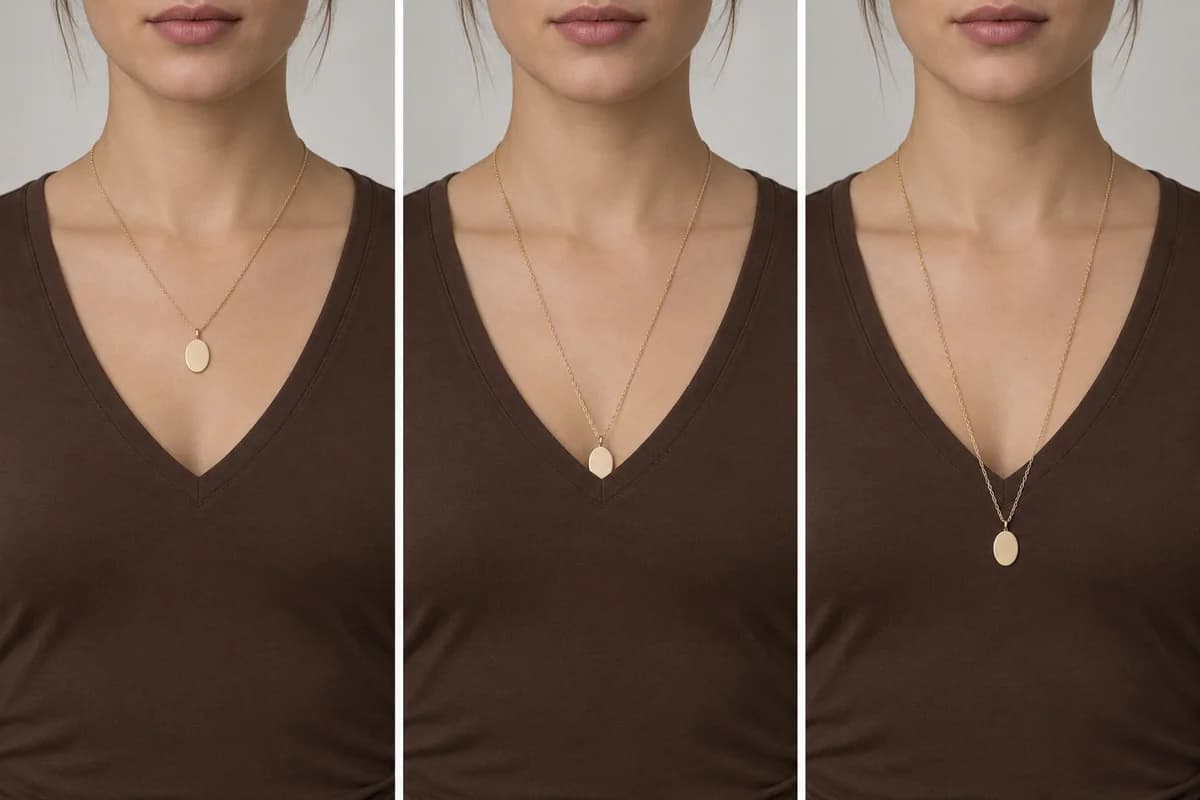
If you prefer a shorter plain chain across the upper part of a V, that is another valid choice. The necklace does not have to trace the top like a stencil.
Square, sweetheart and bare-shoulder necklines
With a square neckline, a shorter chain or pendant can sit inside the open space. Check the raised corners as well as the center edge: the necklace may clear one part and brush another.
A sweetheart opening adds a dip between two curves. Let the pendant settle, then move your arms and look again. If it repeatedly falls into the dip and disappears, a shorter setting may make it easier to see.
For strapless and off-shoulder tops, try a collar-length piece or short pendant on the exposed skin. A larger necklace can work, too, provided the fabric edge and jewelry remain separate in the way you want. No necklace is also a complete choice, especially when you want the neckline itself to be the feature.
Crew, boat and high necks: use the fabric as a background
There may be little or no exposed space above these necklines. A longer chain or pendant can instead sit over the top. Against a plain knit, the necklace adds a distinct shape without needing an opening to frame it.
Check where it falls relative to a collar fold, ribbed band or seam. If the pendant rests halfway on a thick fold, try moving it below that fold. On a textured top, notice whether the pendant remains visible and whether its edges catch as you move.
A short necklace can work above a boat neck if there is room, or over a high neck if it sits comfortably and you like the collar effect. Longer is an option, not a requirement.
With an open shirt, treat the opening as a changing V. Let the chain sit clear of the collar points and check the pendant against the highest fastened button. One different button position can change the available space without changing your jewelry.
Adjust the piece you already own
Use built-in fastening positions first. Try one setting, let go of the pendant, and see where it settles. Holding it in the “right” place does not count as a successful outfit.
To lower the necklace, a compatible extender may help; Monica Vinader’s length guide includes extenders as an adjustment option. To raise it, use a shorter setting or a suitable shorter chain if the pendant is designed to transfer. Check that the clasp and pendant opening suit the parts you are using; do not force them.
Change the length in small steps, then sit, turn and reach. Recheck the lowest point after each adjustment. Adding two inches of chain does not mean the pendant will drop two inches straight down, because the extra length is distributed around the necklace.
Let a detailed neckline stand alone
A cowl, bow, ruffle or embellished edge already brings shape to this area. Try the outfit without a necklace before deciding that something is missing.
In the left view below, the pendant overlaps the cowl’s folds. On the right, removing it lets those folds remain the feature. The earrings stay the same, so the comparison shows what taking away one piece changes.
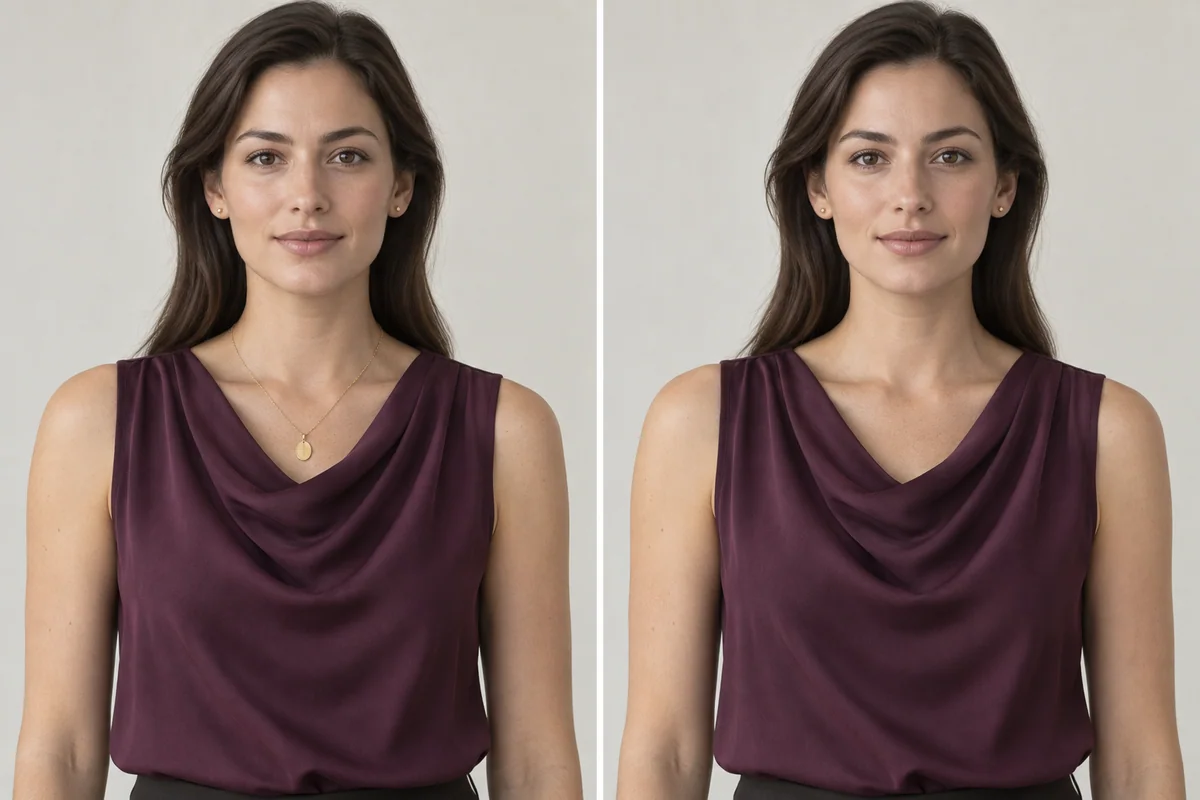
This is an option for asymmetric necklines, too. If you love the diagonal line, there is no need to interrupt it. If you want jewelry there, add it and judge the actual combination.
Frequently asked questions
Is a 16-inch or 18-inch necklace better?
Neither length has a universal landing point. Compare both against the top on your own body, including the pendant’s drop. A shorter setting may clear an open neckline, while a longer setting may place the pendant over the fabric. Use the observed position to choose.
Can I wear an angular pendant with a round neckline?
Yes. Echoing the neckline is one option, but a different shape can be an intentional contrast. Check that the pendant is fully visible and sits steadily, then decide whether you like the curved-and-angular combination.
Can I layer necklaces with a V-neck?
Yes. Put on the longest pendant first and check its lowest point against the V. Add a shorter chain with visibly separate space. Turn and sit to check whether the layers remain distinct rather than assuming a fixed length difference will work for everyone.
What if my favorite necklace is too long for the neckline?
Use a shorter built-in fastening position if the necklace has one. An extender adds length, so it will not solve this problem. A suitable shorter chain or a different neckline may work; avoid tying knots or forcing a clasp through links not made for it.