The midi dress looks right until you put your coat on. Now there are two hems to negotiate, and the coat you wear happily with trousers seems to have developed opinions.
Start with what changes: how much dress shows, where the outer layer ends, and whether the skirt has room underneath. Those are three separate decisions.
Find the waist, coat hem and dress hem
Put on the dress with the shoes you plan to wear. Notice where its waist seam sits, if it has one, and where its hem falls on you. For a loose dress without a waist seam, use your natural waist as a reference, without adding a belt just for the exercise.
Then add the coat. Look at its bottom edge and the amount of dress visible beneath it. A coat ending at the hip creates a different division from one ending near the knee, even though both are shorter than the dress.
Keep the shoes and dress unchanged while you compare. Otherwise, you can end up crediting the coat for a change the boots made.
| Coat length | With a straight midi | With a fuller midi | Check when closed |
|---|---|---|---|
| Cropped near the waist | Shows a long, mostly uninterrupted dress below | Leaves the skirt free to open out below the coat | Coat band and dress waist do not pull against each other |
| Hip length | Creates a distinct upper block above a narrow skirt | Covers the upper skirt and can make fullness start lower | Skirt is not trapped or bunched at the coat hem |
| Near the dress hem or longer | Makes a long outer outline with little or no dress showing | Works when the lower coat has space for the skirt | Fronts close easily; skirt and legs can move |
A cropped coat leaves the dress in charge
A coat ending around the dress’s waist leaves most of the skirt visible. With a straight midi, that gives you a compact upper layer above a long, narrow section of dress. With a fuller skirt, the coat can finish before the fabric starts spreading out.
Try: a warm camel cropped coat over a deep-teal midi, with chocolate boots. Keep the coat’s lower edge loose enough to sit over the dress without riding up.
The exact meeting point does not need to be perfect. If a thick coat band lands directly over a gathered waist, check whether the two layers bunch. A slightly higher or lower hem may sit more easily.
Cropped also means less coverage. Choose it when it gives you the coverage you need for the outing, as well as the outline you like.
A hip-length coat creates a deliberate upper block
A hip-length coat covers more of the dress and leaves a shorter skirt section showing below. On a straight midi, the combination can read as a neat jacket shape over a slim column.
Open, the coat also reveals a strip of dress through the middle. Closed, that strip disappears and the coat becomes a larger solid shape. Both views count if you will wear it both ways.
Try: your hip-length coat over a straight dress first. Let it hang naturally, then fasten it. If you like the open version more, identify why: can you see the waist again, or has a tight area simply stopped pulling?
Wearing it open is a styling option when conditions allow. It does not establish that the closed coat fits.
A longer coat makes a longer outer outline
A coat near the dress hem brings the two lower edges together. One that extends beyond it can hide the dress completely when closed. This is useful when you want the outer layer to form one continuous shape, particularly over a detailed dress.
The coat does not have to be longer to be polished. A knee-length coat with a midi skirt showing beneath it can make a purposeful layered outfit, too. The visible section is something to assess, not automatically conceal.
Compare the straight dress below: left to right, the coat finishes near the waist, at the hip and just beyond the dress hem. The top row is open; the bottom row is closed. Watch how much teal remains visible without changing the dress itself.
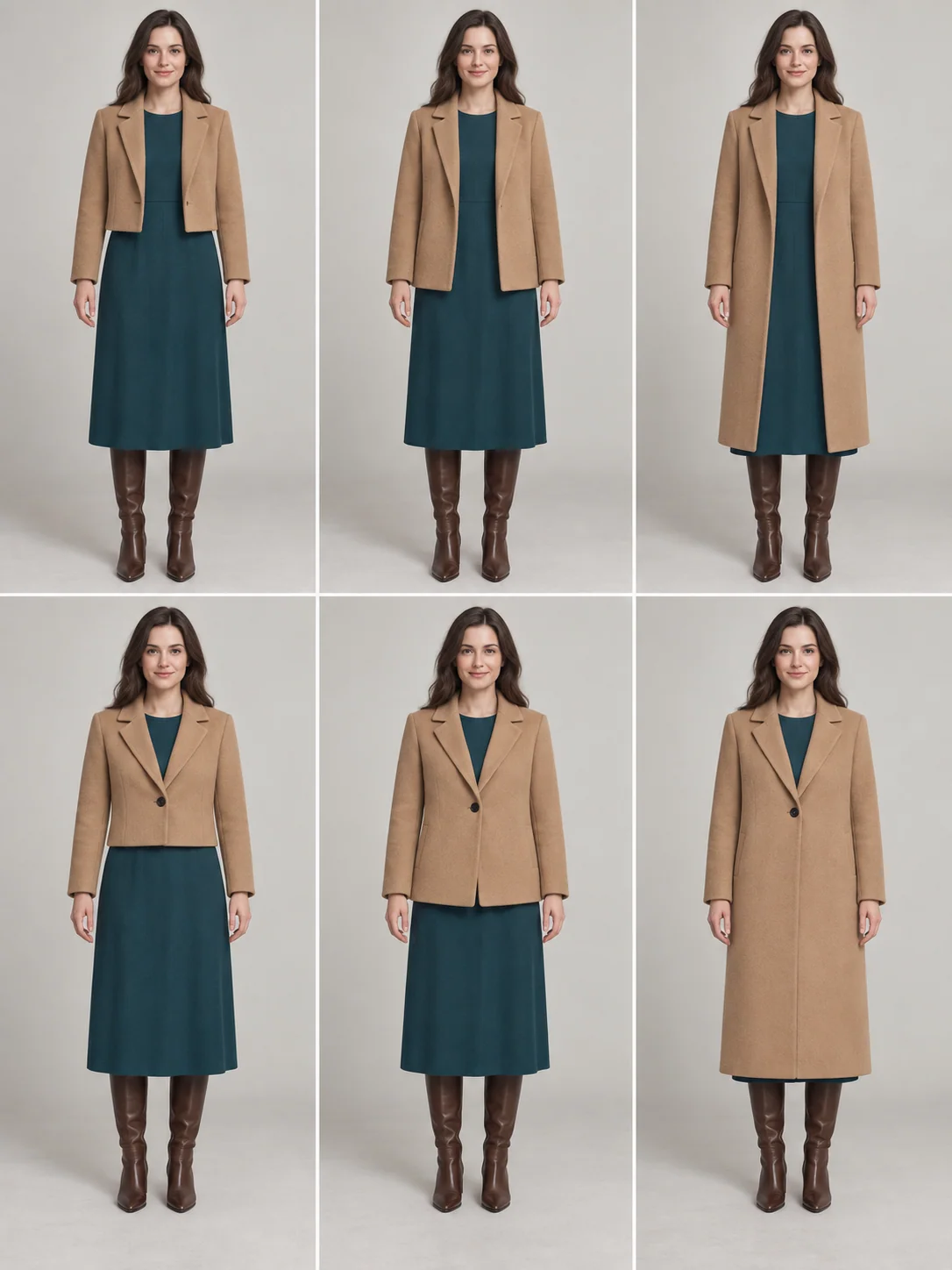
For the long option, check the back and side as well as the front. Keep the coat clear of the ground and check that it lets you walk normally in the shoes you chose.
Repeat the comparison with a fuller skirt
A fuller midi changes the question from “Where does the coat end?” to “Where can the skirt open out?”
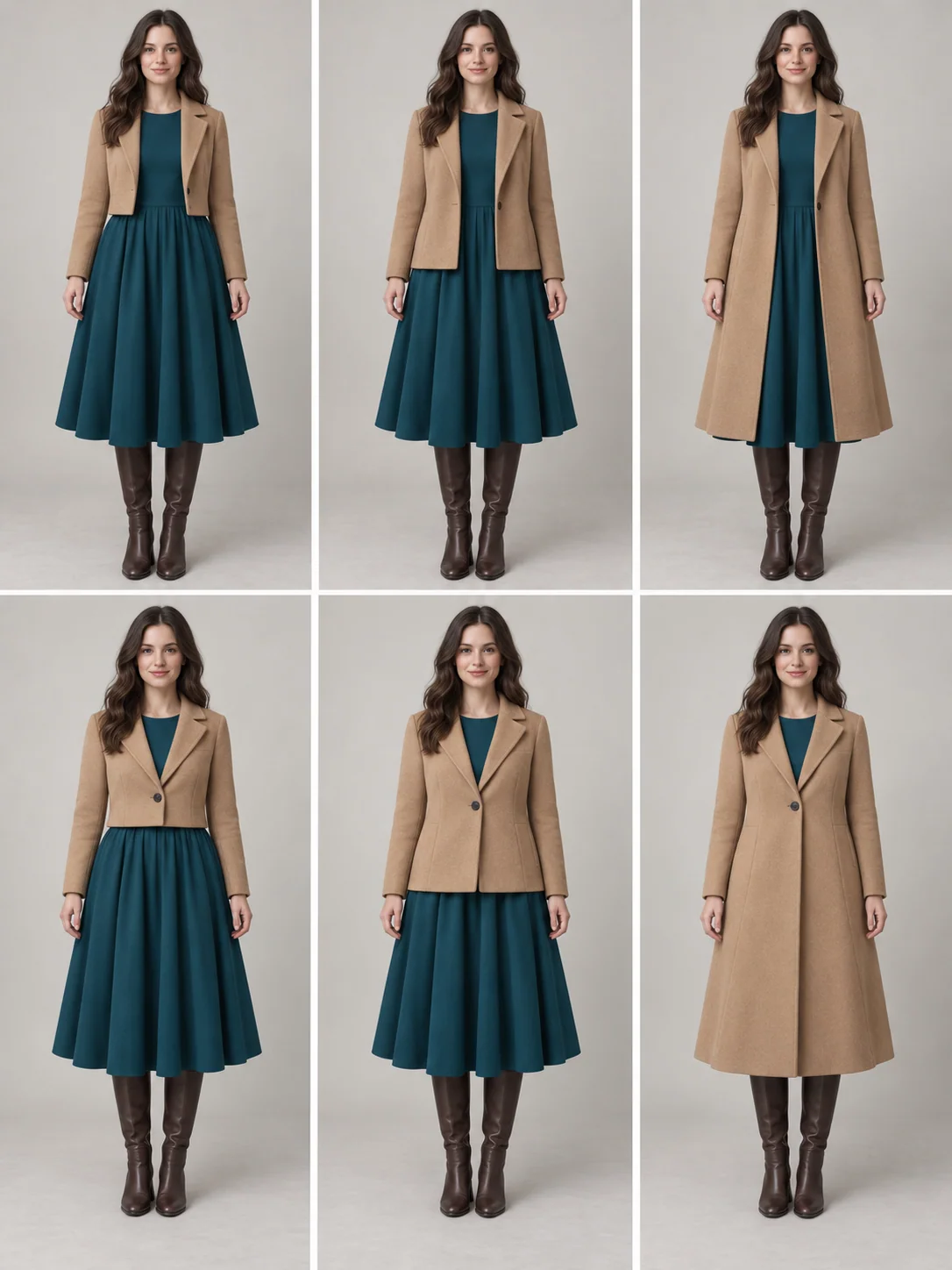
A cropped coat can leave the fullness below its hem. A hip-length coat covers the upper skirt, so the visible flare begins lower down. A long coat needs enough room through its lower half to accommodate the dress beneath it.
That room might come from a gently flared cut, a relaxed shape or a design that otherwise accommodates the skirt. A long, narrow coat is not automatically the answer simply because its hem reaches far enough.
Read the next comparison in the same order: cropped, hip-length, long; open above, closed below. The fuller dress stays identical in all six views. Notice the skirt’s outline, not just its bottom edge.
Diagnose the part that bothers you
Two hems form a narrow contrasting band
When only a small strip of dress appears below the coat, the strip can draw your eye across the outfit. If that is the part you dislike, try a clearly shorter coat to reveal more skirt, a longer coat to cover it, or a coat closer to the dress color to soften the boundary.
You can also keep the band. A visible dress hem is not a tailoring fault, and there is no compulsory number of inches between the two edges.
The skirt looks squeezed below the coat
First let the dress settle and check that its fabric has not caught on another layer. Then close the coat without pulling the fronts together by force.
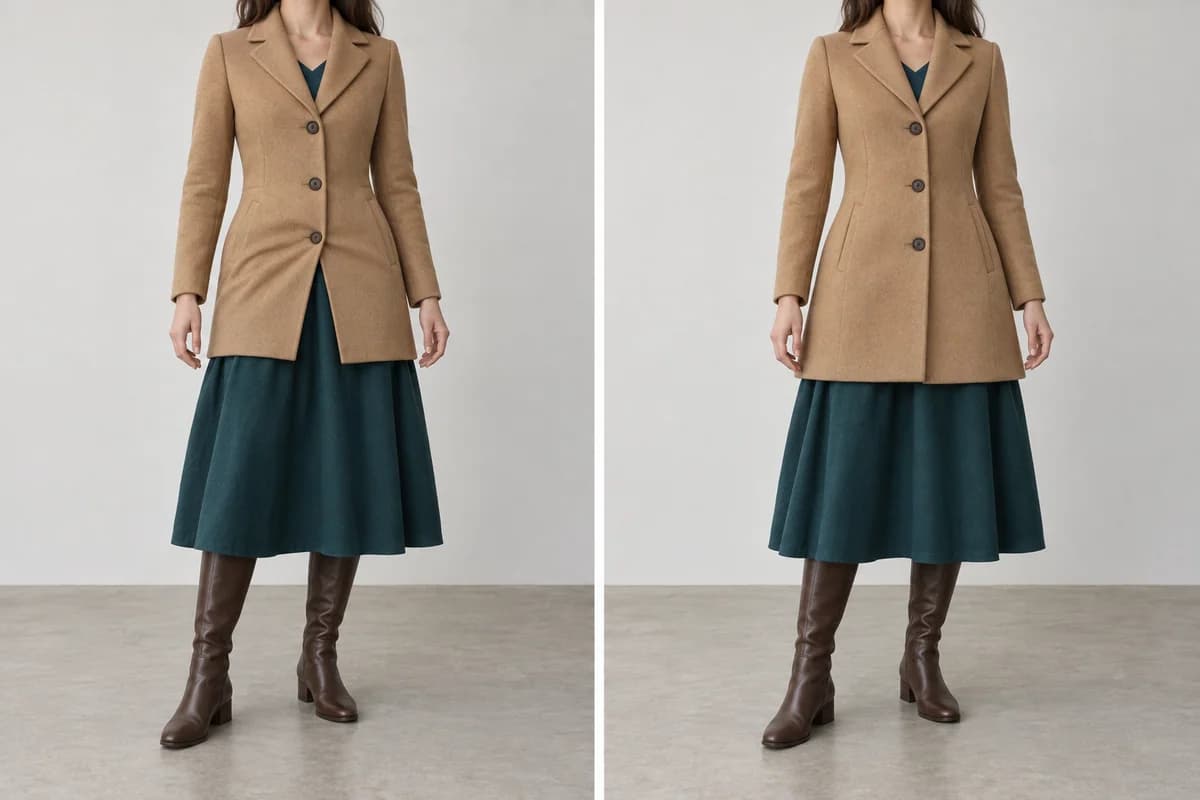
If the skirt is pushed inward at the coat’s hem, the coat fronts strain, or your stride feels restricted, you need more room for this combination. Try a coat with a wider lower shape, or a shorter coat that ends above the fullness. Simply choosing more length may leave the same problem underneath.
In this comparison, the coats end at the same point. The right-hand version has more room through the lower coat, so the skirt can fall freely. Length stayed put; space changed.
Choose the coat in the way you will actually wear it
Fasten it over the complete dress outfit. Reach forward, take a normal stride, and sit down if sitting in your coat is part of the plan. Check that the sleeves accommodate the dress sleeves, too. If the coat has a belt, fasten it as you intend to wear it and repeat the movement check; leaving it loose for the mirror can hide the squeeze.
Then look again with it open. Choose the coat that gives you a shape you like in the states you need, without requiring you to keep rearranging the dress.
If the occasion is a holiday meal, the Thanksgiving dinner outfit guide can help with the hosting-or-visiting decision before you add your outer layer.
Frequently asked questions
Can a coat be shorter than a midi dress?
Yes. A clearly shorter coat makes the exposed skirt part of the outfit. A cropped coat leaves most of it visible; a hip-length or knee-length coat creates a longer upper layer. Judge the resulting shapes and check that the coat does not squeeze the skirt.
Can I wear a puffer coat with a midi dress?
Yes. Compare where the puffer’s bulk ends with where the dress widens. A short puffer can leave a full skirt free below it; a longer one needs enough space around the skirt. Close it over your dress and take a normal stride before deciding.
What if my midi dress has an uneven hem?
Check its longest point as well as the front. You can cover the longest point with a longer coat or leave the uneven hem deliberately visible. A shorter coat will show more of the dress’s movement; there is no need to match every edge.
Do I need heels with a long coat and midi dress?
No. Keep the flats or boots you intend to wear on while comparing coats. Check that the coat clears the ground and permits your normal stride. Heel height does not decide whether the two garments work together.