The ring you never take off does not need to become a lifelong instruction for every earring you wear. Start with that familiar piece and build around it, rather than removing something meaningful to satisfy a matching rule.
Here, gold and silver describe the visible colors of jewelry. Appearance alone does not tell you the exact metal, plating or care requirements.
Keep the everyday piece fixed
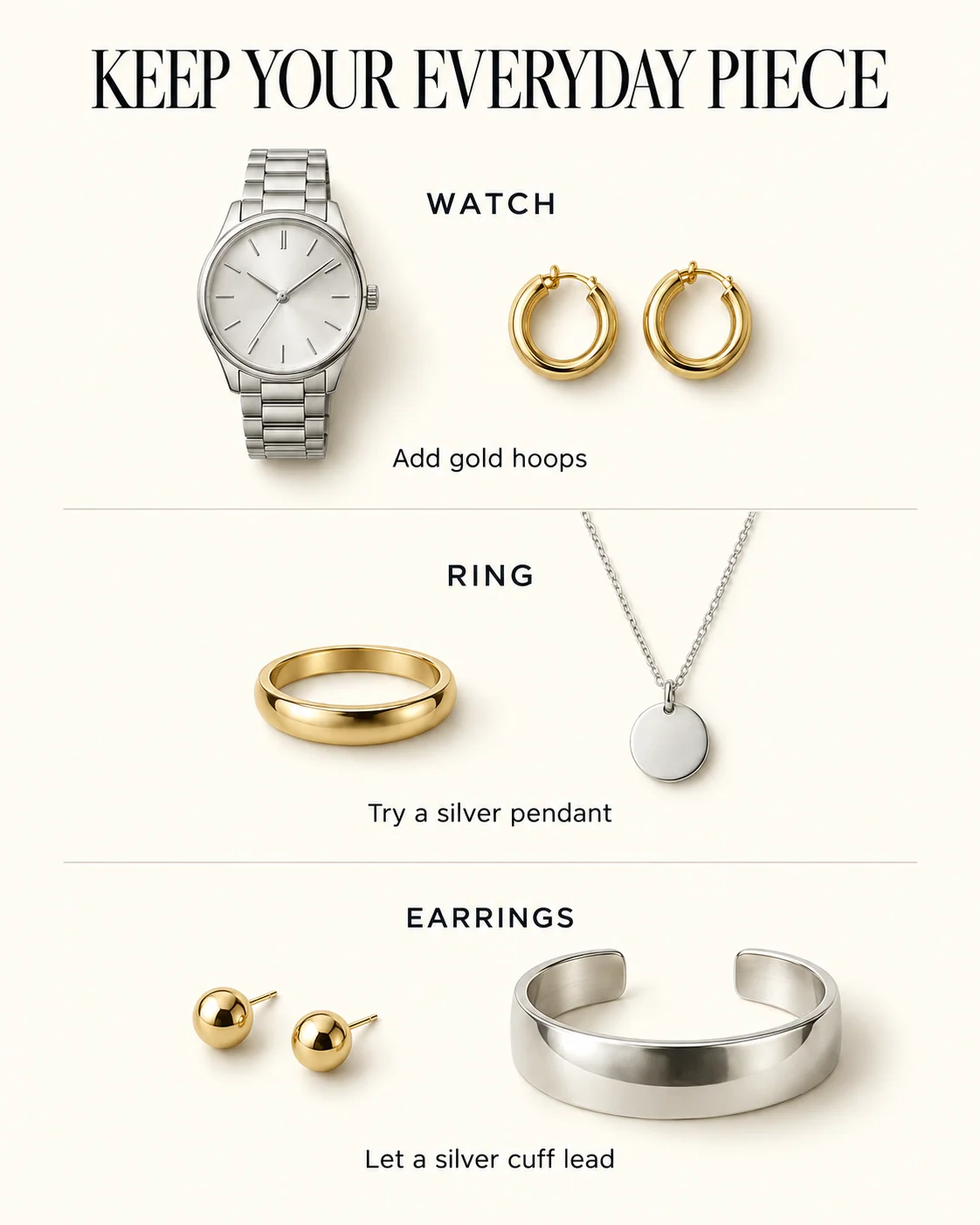
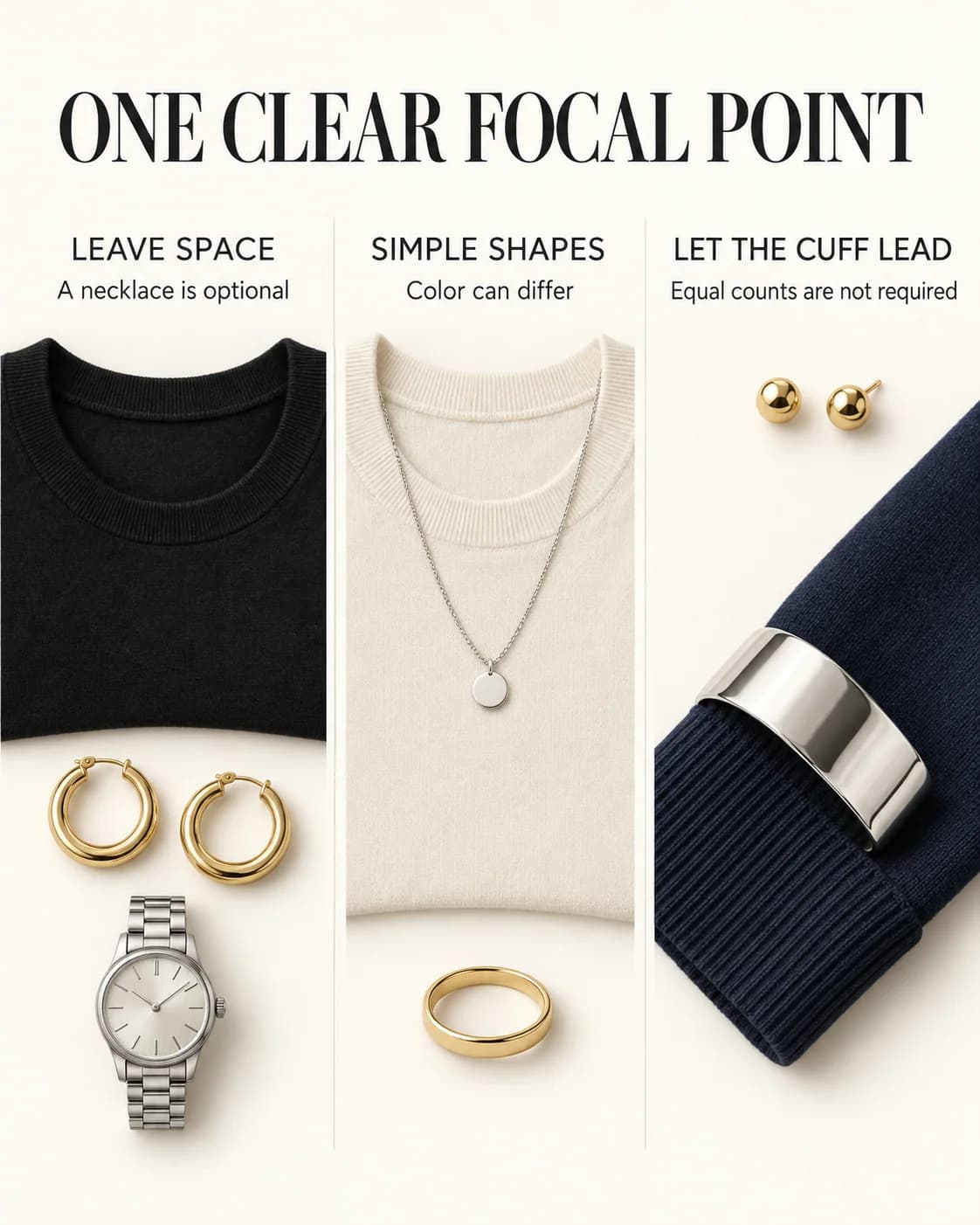
Put on the ring or watch you normally wear. Add one piece in the other metal color and stop there for a moment. A silver-colored watch with small gold hoops is already a mixed-metal outfit; it does not need a necklace to make it legitimate.
Stylist Bridgette Raes explicitly treats wedding rings and incidental accessory hardware as exceptions to strict matching. That is a useful starting permission, not a demand to mix everything. Bridgette Raes.
If you prefer a coordinated look, choose pieces with something else in common: rounded shapes, fine chains or a similarly quiet finish. Matching one visual characteristic can be simpler than matching the metal color.
Compare visual size, not a piece count
One broad cuff may be more noticeable than several fine rings. Counting two gold pieces and two silver pieces tells you very little about the finished balance.
Look at your outfit from a conversational distance. Which piece do you notice first? If that is the piece you want to feature, the balance may already be right. If every area competes for attention, remove one larger piece before adding a smaller one.
Retailer guidance often recommends choosing a dominant metal or repeating each color. Those can be useful experiments, but they are not requirements. Gabriel & Co..
Three small combinations to try
A silver watch with gold earrings
Keep a simple silver-colored watch and add small rounded gold hoops. Leave the neckline bare for the first version. The earrings and watch sit apart, so the contrast is visible without making a dense cluster.
If you want another piece, try a fine ring in either color. You do not need to repeat silver near the face to justify the watch.
A gold ring with a silver pendant
Keep a plain gold band and wear a small silver disc pendant with a solid crew-neck top. Both pieces have a simple rounded shape, although their colors differ.
Move the pendant to a length where it sits clearly against either skin or fabric, not directly on an awkward neckline edge. The guide to necklaces for different necklines handles that separate decision.
Gold earrings with one silver cuff
Try compact gold studs with a broad, smooth silver cuff. This is not equal visual weight: the cuff is intended to lead.
If the result feels louder than you wanted, replace the cuff with a narrower silver bracelet. Keep the earrings fixed so you can judge the change. That tells you more than replacing every accessory at once.
Make room between pieces
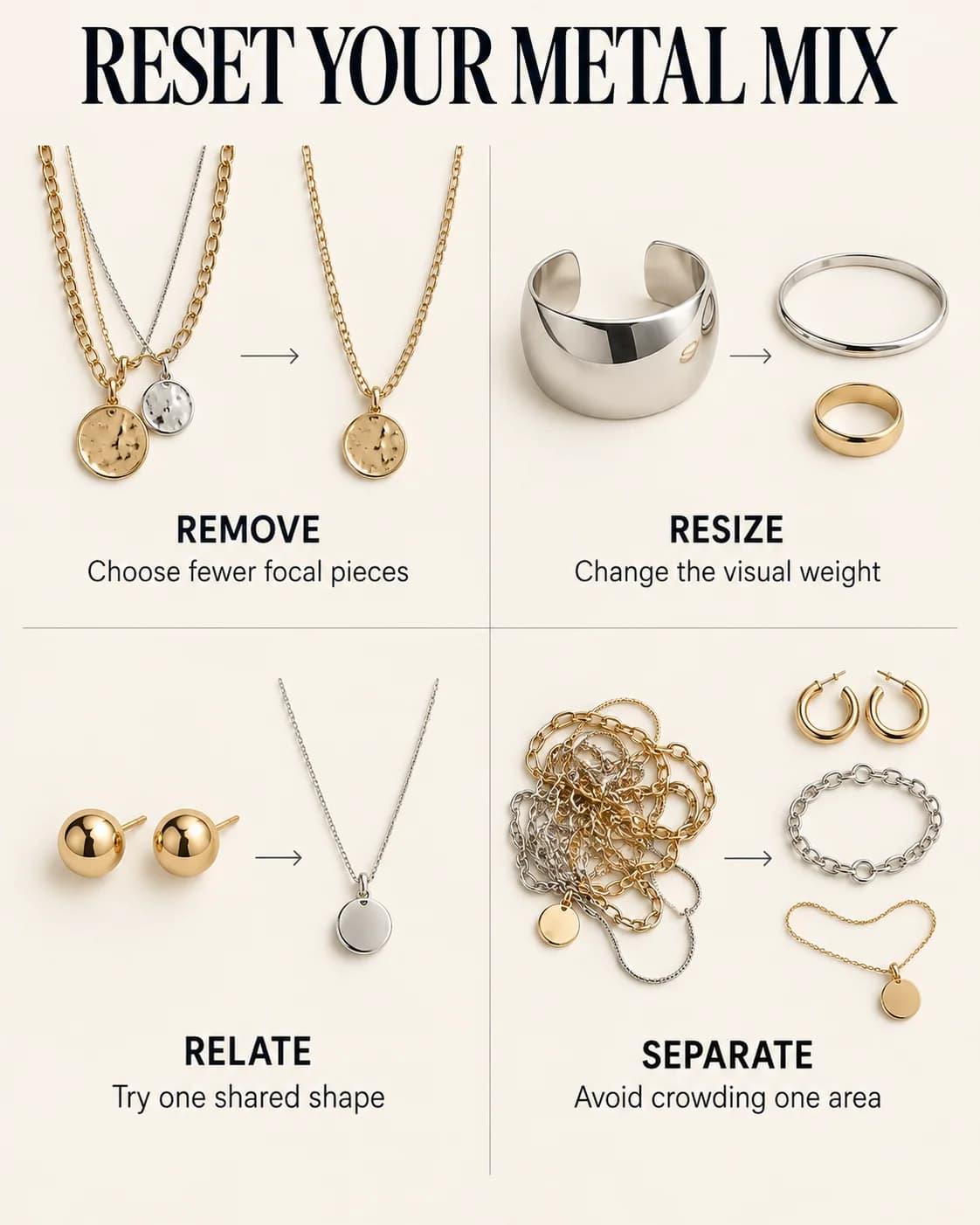
A layered necklace arrangement is optional. If you try one, start with two chains that sit visibly apart, then move normally and check whether they migrate or tangle. Different nominal lengths alone do not guarantee they will stay separated.
You can also distribute jewelry across different areas instead of stacking it. Earrings plus a bracelet may give you the color contrast you wanted without crowding the neckline.
For pieces that touch, styling advice is not a durability guarantee. Follow their individual care instructions. Precious, plated or delicate items deserve more consideration than simply whether their colors work together.
| If the mix feels | Look at | Try |
|---|---|---|
| Too busy | Several large pieces close together | Remove one focal piece |
| Uneven | Width and shine, not item count | Swap a broad piece for a finer one |
| Disconnected | Different shapes or styles | Try one shared shape |
| Uncomfortable | Colliding or tangling pieces | Move pieces to separate areas |
Test one change in width
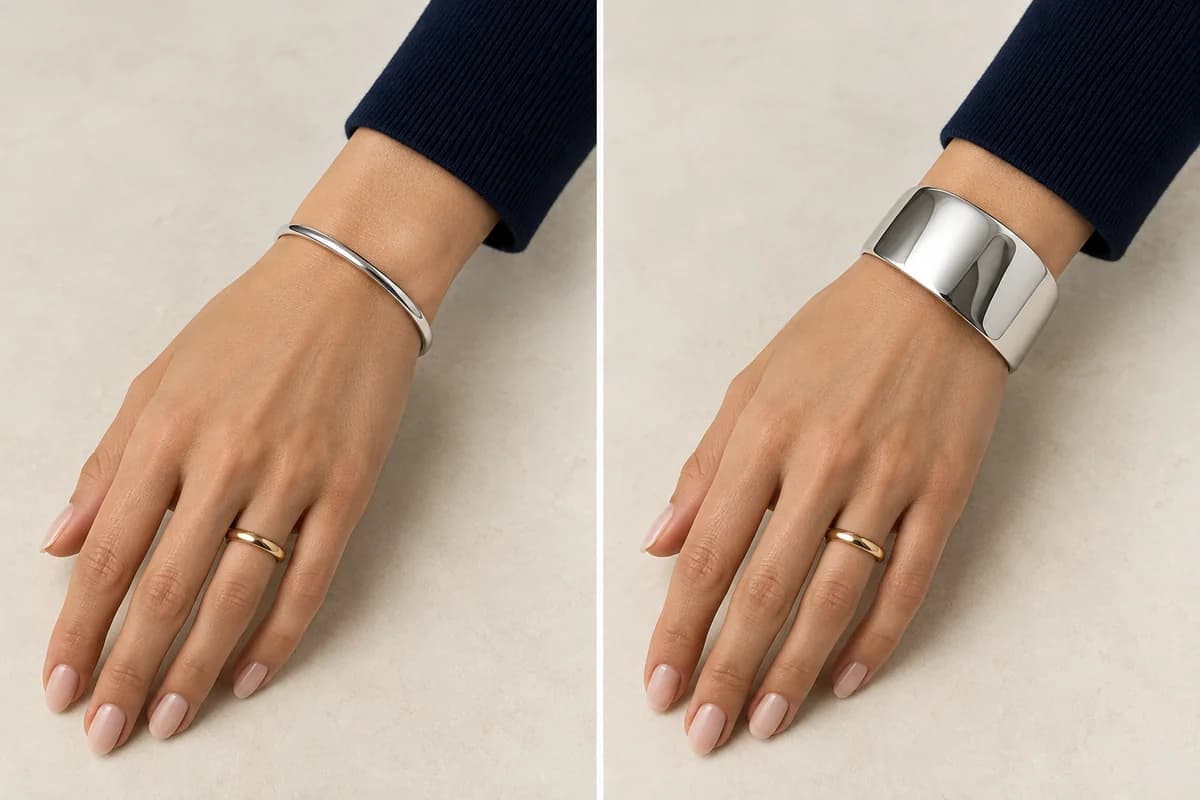
Keep a gold band and all clothing fixed. Compare a narrow silver bracelet with a broad silver cuff, one at a time. The second will usually be more visually prominent because it occupies more space, but whether you prefer that prominence is your choice.
Photographing both versions in the same light can help you see the difference. Do not judge one in bright sunlight and the other in a dim room, where reflections change the apparent contrast.
The finished combination can be quiet, asymmetrical or deliberately bold. It only needs to make sense to the person wearing it.
Frequently asked questions
Does my wedding ring have to match my earrings?
No. You can treat a daily ring as a fixed personal piece rather than using it to dictate every accessory color.
Do I need a two-tone necklace to mix metals?
No. A two-tone piece is one option, but separate gold- and silver-colored pieces can form the entire combination.
Can I stack different metals on the same finger?
They can look good together, but visual compatibility does not establish wear compatibility. Follow each maker's care advice and separate valuable or delicate pieces if you are uncertain about contact and abrasion.