A Christmas tree can fit between two pieces of furniture and still make the room impossible to use. The branches clear the sofa, but the presents take over the doorway. Suddenly getting a cup of tea requires choreography.
Choose the position with the room in use. You need somewhere for the whole display, including the bits that tend to arrive after you decide it fits.
1. Rule out heat sources, exits and door swings
Before measuring attractive corners, identify places the tree cannot go. The U.S. Fire Administration advises keeping Christmas trees at least 3 feet from heat sources, including fireplaces, radiators, space heaters, candles and heat vents, and keeping exits unblocked. Apply the distance to the closest part of the tree, rather than just its trunk. Follow any larger clearance specified for your equipment. U.S. Fire Administration holiday guidance
Open the room's doors fully. Include the route from the entrance to the seating, any onward doorway, and the space someone needs to get out of a chair. An empty patch behind an open door is still part of the door's working space.
Check outlets and switches too. You should be able to reach the plug without climbing over presents, and route the cord without crossing the walking path. Balsam Hill's placement guide also flags blocked doorways, switches and vents as practical problems. Balsam Hill placement advice
2. Measure the display, not just the stand
Measure the tree after its branches are fully spread. For a tree you have not bought, check the listed maximum width and stand dimensions rather than judging by the photograph. Include any outward-reaching decorations.
Project the widest branches onto the floor. Then add anything extending beyond that outline: stand feet, skirt, basket or gifts. You are reserving the space occupied by all of them together, so overlapping areas do not need to be counted twice. Access to water the tree or reach the plug may require additional clear space outside that display footprint.
| Part | Example measurement | What to mark |
|---|---|---|
| Spread branches | 48 inches at the widest point | Their full outline projected onto the floor |
| Stand and skirt | 24-inch stand; 36-inch skirt | Both fit inside this example branch outline |
| Gift area | 12-inch strip beside the branches | Adds to the display instead of disappearing under it |
| Complete display | 60 inches across × 48 inches deep | The reserved rectangle containing branches, base and gifts |
Here, a 24-inch stand does not make this a 24-inch-wide display. The branches double that width before a single present arrives. The 60 × 48-inch rectangle is a convenient conservative boundary around this example, not a claim that every corner of it contains branches.
Use floor-safe removable tape to mark the outer boundary. A second tape outline can mark the stand. Seeing the smaller base inside the larger display makes the missing space immediately obvious.
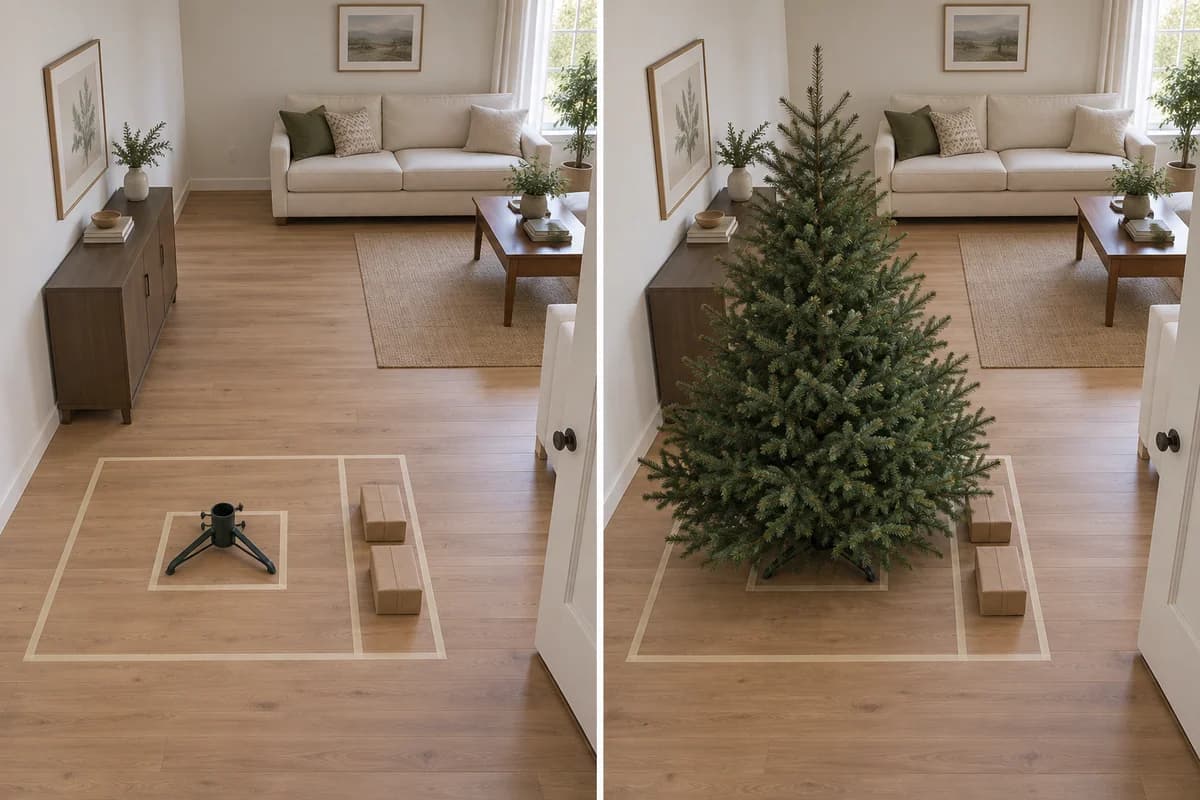
Illustrative setup: the outer tape reserves the branches and gifts; the smaller outline marks only the stand. Use your own measurements.
Also check height, including the stand, topper and any low ceiling fitting. A tree that clears the ceiling can still be too wide for the room.
3. Compare three positions in the same room
Take an example living room 12 feet wide and 13 feet deep. The sofa sits on the north wall, a shallow cabinet is on the west wall, and an occasional chair occupies the southwest area. The everyday route runs along the east side, between the southeast entrance and an opening at the northeast.
This household is preserving a 36-inch-wide route. That number belongs to this example; your household's movement and access needs may require more space.
| Trial position | Measured result | Decision |
|---|---|---|
| Near the southeast entry | Display reaches across 24 inches of the 36-inch east-side route and intersects the door sweep | Reject this position |
| Southwest chair position, chair moved out | 60 × 60-inch pocket holds the 60 × 48-inch full-tree display | Test access to the stand and remaining seats |
| South-wall pocket beside the chair | 42 × 72-inch pocket holds a 36 × 60-inch narrow-tree display, including gifts | Keeps the chair; use the narrower form |
Near the entrance: visible, but in the way
The first trial puts the full display near the southeast door. Its outer edge leaves just 12 inches between the display and the east wall, and it crosses the door's swing. It fails before decoration matters. Moving the presents alone would not solve the branch obstruction.
In the chair's place: a full tree with one furniture move
Moving the occasional chair to another room releases a 60 × 60-inch pocket. The example full display fits inside it, with the 12-inch gift strip beside the tree, away from the east-side route.
This works only if the chair has a proper temporary home and you can manage without that seat. Moving it into the hallway simply relocates the obstruction.
Beside the chair: a narrower tree preserves the seating
The separate south-wall pocket measures 42 × 72 inches after allowing space beside the chair. A tree with a 36-inch branch spread, plus a planned gift area making the display 36 × 60 inches, fits that pocket while keeping the chair.
The full 48-inch branch spread does not fit this pocket's 42-inch width. Choosing less width solves a specific problem; choosing less height might not.
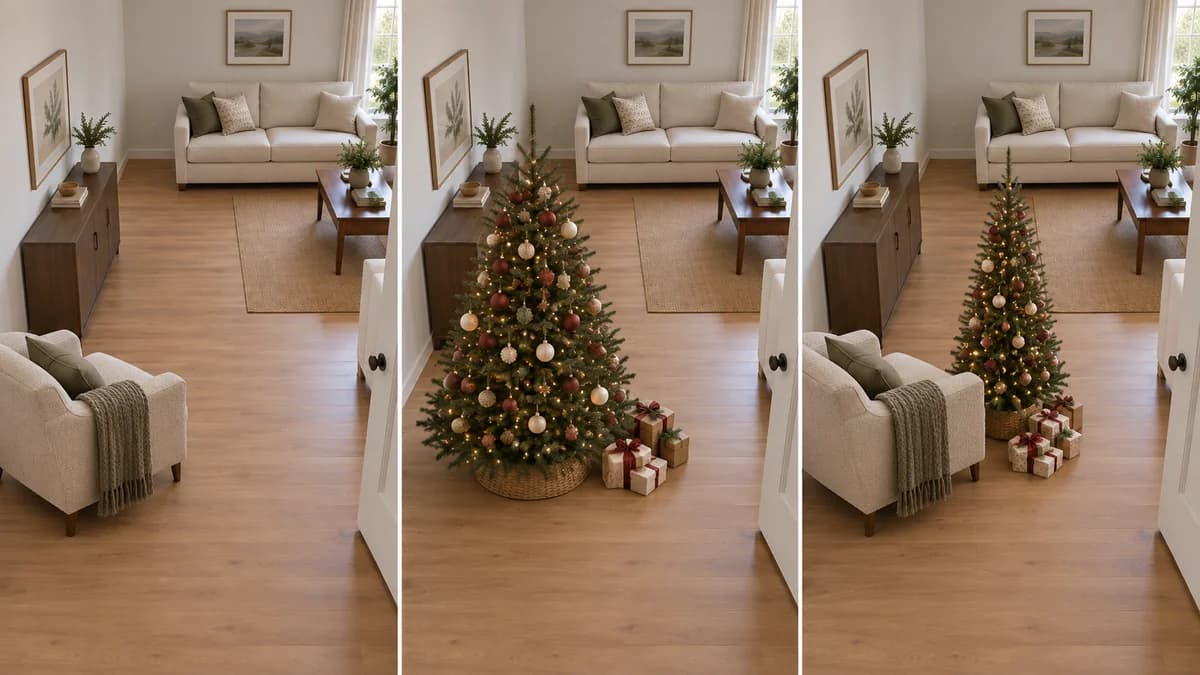
Conceptual comparison, left to right: the ordinary room, a full tree replacing the chair, and a narrow tree with the chair retained. The table gives the example dimensions.
4. Walk the taped layout before decorating
Run the trial with the room operating normally:
- Open every nearby door and cabinet to its usual full extent.
- Walk from the entrance to each seat and through to the next room, including with anything you regularly carry.
- Sit down, stand up and use any reclining mechanism.
- Check the branch outline at body height as well as on the floor. Do not count space underneath branches as a clear walking route.
- Reach the plug and stand without stepping into the gift area. For a cut tree, make sure daily watering remains easy.
Recheck after decorating and adding gifts. The U.S. Fire Administration recommends daily watering for cut trees, inspecting light strands for damaged wires, and following the manufacturer's connection instructions. Holiday fire-safety guidance
5. If no floor position works, change the form
A tabletop tree can put the display on an existing stable surface. Check the combined height, ensure the base is fully supported, and keep branches and cords out of the route. Adding a new table solely to hold it may use just as much floor space as the tree you ruled out.
You can also use another room or skip the tree in favor of a smaller seasonal display. Keep the same heat and exit checks wherever it goes. The living room still has to be a living room in December.
Frequently asked questions
Can a Christmas tree go in front of a window?
Yes, if the window area is clear of heat sources and the tree does not obstruct a needed exit or access to the window. Check radiators or heat vents below it, curtain movement and the route to open or close the window. Visibility from outside is a bonus after those checks.
Can I put the tree behind the sofa?
Only if the full branch and base footprint fits without pressing into the seating or occupying a route. Leave access to the stand and lights, and to the water reservoir for a cut tree. A narrow gap that hides a stand may still be too small for the branches.
Does a shorter tree automatically need less floor space?
No. Height and spread are separate measurements. Compare the actual widest branches, stand and complete decorated footprint. A shorter broad tree can use more floor space than a taller narrow one.
Where should presents go if they will not fit under the tree?
Keep them in a separate storage spot and bring them out when needed. Do not expand the gift area into a walking route or doorway. A clear path is more useful than keeping every present on display.