A rug can be the right size for the sofa and still look wrong under the chaise. That extra stretch of seating has a way of exposing a calculation made from one measurement.
Before choosing between an 8x10 and a 9x12, decide where the rug will start, which feet will sit on it and how far it will extend into the room.
Measure the sectional you have
Use outside dimensions, including the arms and back. Then look underneath. Upholstery can overhang the feet, so a rug that appears to touch the sofa may miss its supports entirely.
| Measurement | Where to measure | What it decides |
|---|---|---|
| Overall sectional width | Outside arm to outside arm, not cushion to cushion | Rug width and visible extension at the sides |
| Overall depth | Back of sofa to farthest chaise or return edge | Coverage of the long side |
| Support-foot positions | Actual feet along each seating run and chaise | Whether front-leg or all-leg placement works |
| Other seating and table | Foot positions in the arrangement you use | Whether the rug anchors the full group |
| Usable room area | Boundaries set by walls, doors, hearth and walking routes | Maximum sensible rug footprint |
Write rug dimensions with their orientation: 120 inches across the sofa, 96 inches into the room, for example. The label 8x10 does not tell you which direction to place it.
For a true corner sectional, measure both seating runs. For a U-shaped arrangement, include both returns. For a modular sofa, use the configuration you actually keep, not the smaller one from the product photograph.
Choose what the rug needs to connect
Two arrangements are useful starting points. Rugs Direct's sectional guide discusses both front-leg and all-leg placements; neither comes with a universal rug size.
Front legs on: connect the seating to the open floor
Slide the rug under the front support feet of the main sofa and the relevant feet along the chaise or return. Leave enough rug under each included foot that it sits fully on the surface, not on an edge.
This keeps more rug visible around the coffee table without needing to reach behind the sofa. Check every module: the phrase “front legs” is less obvious once seating turns a corner.
All legs on: put the entire group on one surface
Start the rug behind the back feet and extend it under every support. Decide how much border you want visible beyond the furniture rather than choosing a rug that only just catches the feet.
This can suit a sectional that floats away from the walls. It also uses more rug beneath furniture, so the same size may leave less visible rug in front.
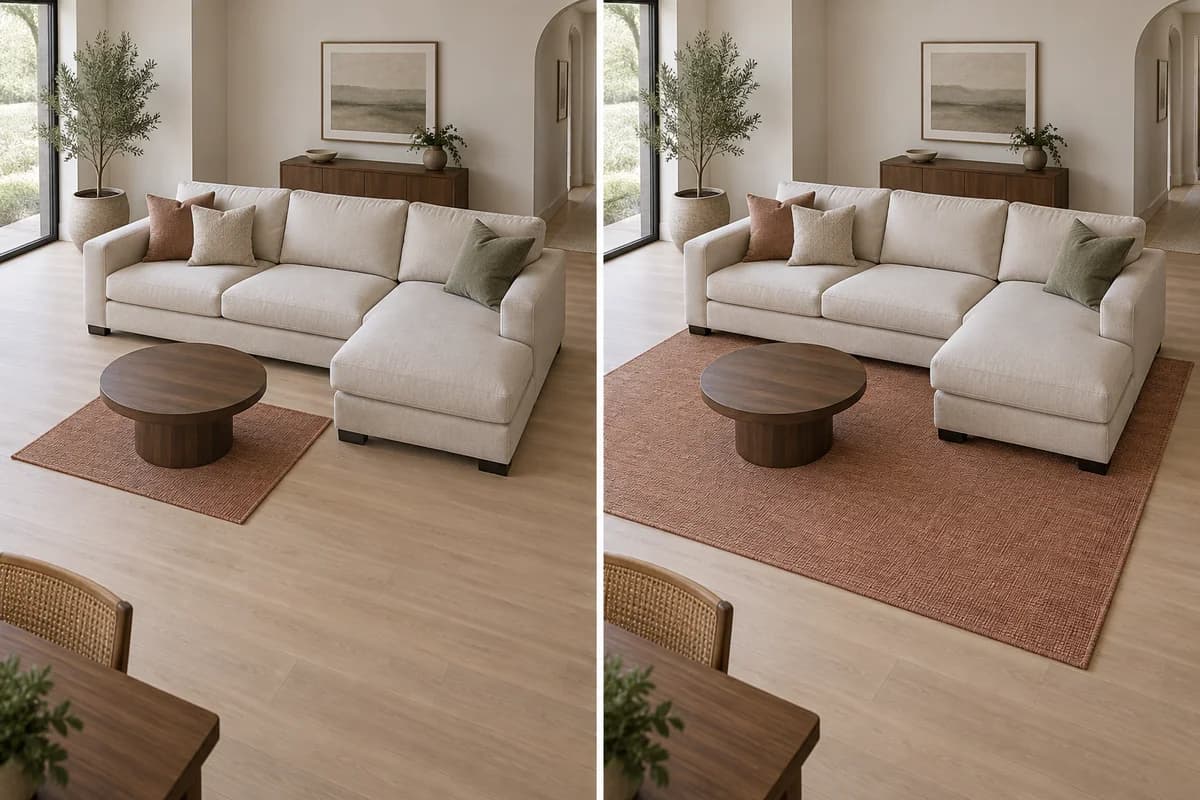
Conceptual comparison: the left rug belongs mainly to the coffee table; the right rug connects the sofa and chaise. Use the measured example below for dimensions.
Compare three placements in the same room
Here is a hypothetical room, with dimensions chosen to make the calculation easy to repeat:
- Room: 14 feet wide by 15 feet deep, or 168 by 180 inches.
- Chaise sectional: 108 inches wide, with a 36-inch sofa depth and 66-inch overall chaise depth.
- Position: centered across the room, with the sofa back 12 inches from the rear wall.
- Example support positions: rear feet are 4 inches forward of the sofa back, the main sofa's front feet are 32 inches forward, and the chaise's tip feet are 62 inches forward. All feet sit within the outer furniture footprint.
In the front-leg layouts, put the rug's rear edge 12 inches forward of the sofa back. Both example front-foot lines therefore land inside the rug. The sofa's rear feet remain off it.
| Layout | Rug rear edge relative to sofa back | Rug beyond each sofa side | Rug beyond chaise tip |
|---|---|---|---|
| 8x10: 120 in across, 96 in deep; front legs on | 12 in forward of sofa back | 6 in | 42 in |
| 9x12: 144 in across, 108 in deep; front legs on | 12 in forward of sofa back | 18 in | 54 in |
| 9x12: 144 in across, 108 in deep; all legs on | 6 in behind sofa back | 18 in | 36 in |
What the 8x10 gives you
The rug is 120 inches across a 108-inch sofa. Subtract, then divide by two: (120 − 108) ÷ 2 = 6 inches visible beyond each side.
Its front edge is 12 + 96 = 108 inches forward of the sofa back. The chaise ends at 66 inches, leaving 42 inches of rug beyond its tip.
This placement connects the feet in our example. It may be enough if the sectional and coffee table are the whole seating group. An extra chair could change the requirement.
What the 9x12 changes
With its 144-inch edge across the same sofa, the 9x12 adds an 18-inch border on each side. Keeping the rear edge in the same place leaves 54 inches beyond the chaise tip.
It occupies more of the room too. In this 14-foot-wide room, the centered 8x10 leaves 24 inches of bare floor at each side; the centered 9x12 leaves 12 inches.
Those are floor borders, not guaranteed walking clearances. An armchair, door swing or side table can occupy them.
What changes when you slide the 9x12 backward
Move its rear edge from 12 inches in front of the sofa back to 6 inches behind it. That shifts the rug back 18 inches, without changing its size.
Now the whole sectional footprint is on the rug, and the visible rug beyond the chaise reduces from 54 to 36 inches. The rug's rear edge is still 6 inches from the room's rear wall.
Same rug. Different coverage. This is why size and placement need to be chosen together.
Adjust the method for your sectional shape
For a chaise sectional, check the tip feet first. A rug can reach the main sofa perfectly and still stop before the chaise supports.
For an L-shaped sectional, check the inward-facing feet on both runs. Start with a rectangle that connects both sides, then test whether rotating it uses the room better. If the two runs are similar lengths, compare a square footprint too; check available sizes against the same foot positions.
For a U-shaped sectional, mark the support feet on all three seating runs before choosing a size. A rug fitting the empty center alone creates a separate island; one that extends under the seating connects the group.
For an ottoman used as a chaise, include the position where it normally sits. Check that moving it does not repeatedly leave feet straddling the rug edge.
If the room cannot hold the next size up, try a different rug position or furniture arrangement. Buying more rug cannot create more floor.
Tape the outline before ordering
Use floor-safe tape to mark the actual listed dimensions. Check suitability on your floor finish first. Keep the furniture in its normal position while you compare options.
Then walk through an ordinary evening: enter the room, open nearby doors, pull out the chair, put your feet down beside the chaise. Check that the rug edge does not land in an awkward turning point.
Record the orientation and rear-edge position with your measurements. Check the retailer's actual dimensions rather than assuming every nominal 8x10 is identical. Include rug and pad thickness when checking door clearance and stable furniture support.
Frequently asked questions
Is an 8x10 rug big enough for a sectional?
It can be. In this guide's 108-inch-wide example, the 10-foot side leaves 6 inches beyond each sofa side, and the chosen placement catches the front feet and chaise feet. A wider sectional, another chair or a different orientation can change that answer.
Should a rug be centered on the sectional or the room?
Start with the seating group. Centering on the whole room can leave the sectional poorly connected to the rug, especially in an open plan. Adjust for the chaise, chairs, coffee table and clear walking routes.
Can a rug be smaller than the sectional?
Yes, if you want a separate rug in the open area, but it will create a different effect from a rug that anchors the seating. Check the actual feet and chaise: a small rectangle under only the coffee table does not automatically connect the whole sectional.
Does the entire chaise have to sit on the rug?
Not in a front-leg layout, but the chaise feet you intend to include must land fully inside the rug. For an all-leg layout, include every support foot under the whole sectional. Check the manufacturer's support requirements, especially with thick rugs or independently supported modules.