The picture is the right size for the wall. Somehow it still looks as though it belongs to a different sofa.
Start with the furniture underneath it. Then measure the whole arrangement, including the frames and the spaces between them. Two medium pictures do not add up to one large picture until you include the gap.
1. Measure the sofa and the usable wall separately
Write down the sofa's width from outside arm to outside arm. Then measure the clear wall above it, noting window trim, switches, sconces and any sloping ceiling.
The sofa supplies a useful visual anchor. The wall tells you where the arrangement can physically go. They are not interchangeable measurements, especially when the sofa sits off-center.
Before choosing a frame size, decide whether you want the art to belong mainly to the sofa or to a larger wall composition. This guide starts with the sofa grouping.
2. Try a total span before choosing individual pieces
For a first paper mockup, try a framed arrangement around two-thirds of the sofa width. Treat it as a starting point to compare, not a required percentage.
With an 84-inch sofa, two-thirds is 56 inches. You could try paper spans of 54 and 60 inches to see how a slightly narrower or broader composition feels. Nearby windows may favor the narrower option; a bold frame may look substantial without using the full available width.
For the comparisons below, use a 60-inch total span. Centered above an 84-inch sofa, its outside edges sit 12 inches inside each end of the sofa: (84 − 60) ÷ 2 = 12.
Those numbers describe this example. You do not need to buy a custom frame just to hit them exactly. Dark frames or dense artwork can look heavier than pale pieces with the same outside measurements, so compare the actual work as well as its paper outline.
3. Add the outside frames and the gaps
Use finished outside dimensions, rather than print dimensions. A 24-inch print in a wide mat and frame occupies more than 24 inches of wall.
For a pair, the arithmetic is simple:
Overall width = first outside frame width + gap + second outside frame width.
For a gallery, measure the leftmost and rightmost edges of the entire layout. In a tidy grid, calculate one complete row. Do not add the frames from the second row to the first row's width.
| Arrangement | Width calculation | Overall width × height |
|---|---|---|
| One landscape frame | 60 | 60 × 30 |
| Two equal frames, each 28.5 × 30 | 28.5 + 3-inch gap + 28.5 | 60 × 30 |
| Six 18 × 12 frames, in two rows of three | 18 + 3 + 18 + 3 + 18 per row | 60 × 27; height is 12 + 3 + 12 |
These arrangements cover the same horizontal span, but they do different things visually.
- One piece gives you one uninterrupted image. It is useful when you want a clear focal point with little visual activity around it.
- A pair adds a pause in the middle. Similar frame weights and a consistent alignment help the two pieces read together.
- A compact gallery breaks the space into smaller moments. Keep the pieces close enough that you see a group before you notice individual gaps.
The 3-inch gaps in the examples are a trial. Framebridge suggests close, consistent spacing, typically 2 to 3 inches, when arranging a gallery. The right gap still depends on the scale and weight of your frames. Framebridge gallery-wall guidance
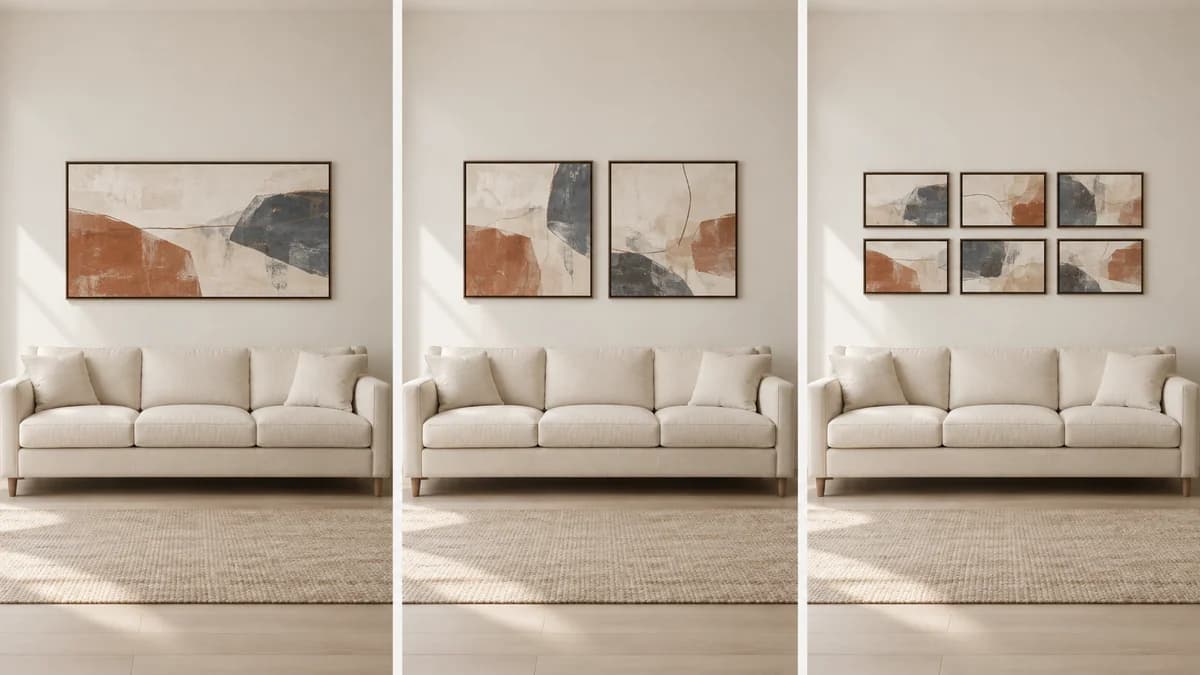
Conceptual comparison: one frame, a pair and six smaller frames occupy the same overall span. The table supplies the exact example sizes.
For an irregular gallery, lay out the actual frames on the floor and measure the outermost edges, including any row that is shifted sideways. The overall height also matters: a group can be the right width and still climb awkwardly toward the ceiling.
4. Set the bottom edge in relation to the sofa back
Begin with the lowest frame about 8 inches above the sofa back in your paper trial. Framebridge's furniture-relative guidance offers a 7-to-10-inch starting range, separately from its guidance for a bare wall. Framebridge hanging guidance
Then sit on the sofa. Check cushions, where heads rest and how the furniture moves in normal use. Increase the gap or reconsider the location if people would contact the frames.
Do not make an eye-level rule fight the sofa. Here is why:
| Example | Bottom edge above floor | Art or group center |
|---|---|---|
| 34-inch sofa back; 8-inch gap; 30-inch-high frame | 34 + 8 = 42 inches | 42 + 15 = 57 inches |
| 34-inch sofa back; 8-inch gap; 27-inch-high group | 34 + 8 = 42 inches | 42 + 13.5 = 55.5 inches |
| 42-inch sofa back; 8-inch gap; 30-inch-high frame | 42 + 8 = 50 inches | 50 + 15 = 65 inches |
With the taller sofa back, forcing the center of that 30-inch-high frame to 57 inches would put its bottom edge at 42 inches, exactly level with the sofa back. The arithmetic works; the arrangement does not leave the intended gap.
Start with the furniture relationship, then step back and compare. If a tall back leaves little wall for the piece, test a shallower landscape format or a shorter gallery arrangement.
5. Center on the sofa when the sofa is off-center
Imagine a 144-inch-wide wall with an 84-inch sofa starting 12 inches from its left edge. The sofa's center is 54 inches from the left, while the wall's center is 72 inches from the left.
Centering the art on the wall shifts it 18 inches away from the sofa's center. That difference is large enough to make a deliberately placed sofa look accidentally misplaced.
| Element | Left edge | Right edge | Center |
|---|---|---|---|
| 84-inch sofa | 12 inches | 96 inches | 54 inches |
| 60-inch art centered on sofa | 24 inches | 84 inches | 54 inches |
| 60-inch art centered on whole wall | 42 inches | 102 inches | 72 inches |
| Nearby window trim starts | 108 inches | Not needed for this calculation | Not the sofa’s center |
In this example, centering the 60-inch art over the sofa leaves 24 inches between the art's right edge and window trim beginning at 108 inches. Check the curtain's actual resting position too; trim is not necessarily the last thing occupying that space.
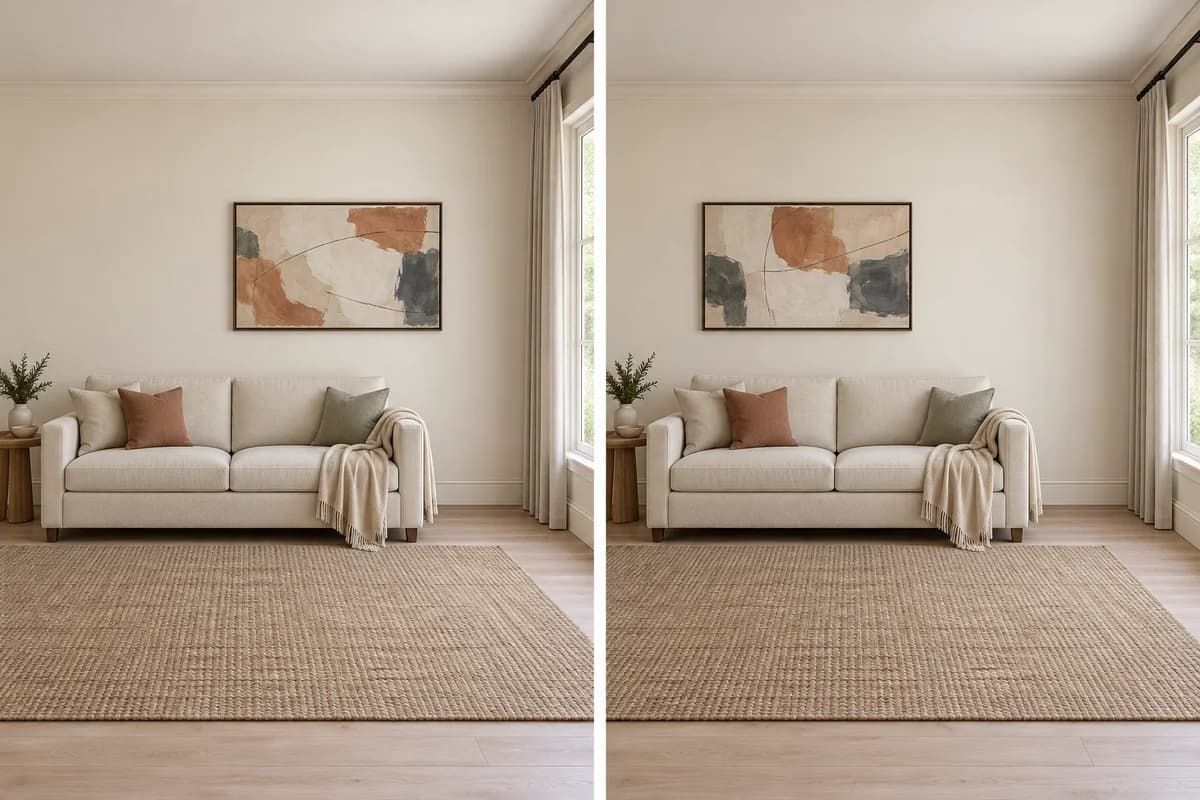
The sofa stays in place. Left: art centered on the full wall. Right: the same art centered on the sofa.
For a sofa grouping, that second position is the clearer starting point. If you prefer a broader wall composition, arrange all its elements together rather than sliding one picture toward the wall center and hoping the sofa catches up.
6. Use paper templates before making holes
Cut paper to the finished outside frame sizes. Mark the sofa center with a removable marker suitable for the wall, position the templates, and measure the actual gaps between them.
Look from the doorway and from your usual seat across the room. A phone photo can help compare layouts, but physical templates keep the scale honest. Leave them up long enough to notice whether a lamp, curtain or sofa cushion interferes.
When you choose the layout, translate the frame-edge positions to the actual hanging hardware. The hook is not necessarily at the top of the frame. Use mounting hardware suitable for the frame's weight and your wall, following its instructions.
Frequently asked questions
Should I measure the print or the frame?
Use the finished outside-frame dimensions for the wall layout. The print size does not include the mat and frame around it. If the seller lists only the image opening, obtain the finished dimensions before making paper templates.
Can art be wider than the sofa?
It can be a deliberate choice, particularly for a larger wall composition. But it will read as part of the wall rather than a compact group anchored just to the sofa. Check nearby windows, lamps and other furniture before extending the group past the sofa ends.
Should two pictures be top-aligned or center-aligned?
Equal-height frames can align at both top and bottom. For different heights, try a shared centerline first, then compare the lowest edges above the sofa. Judge the pair as one composition and keep the gap close enough that they read together.
Does a high ceiling mean I should hang the art higher?
Not automatically. If the art belongs to the sofa grouping, keep that relationship clear. You can use taller art or a taller group when it suits the wall, but raising a small picture far away from the sofa often separates the two visually.