The floor came with the home. The chest came from someone you love. The side table came from a perfectly reasonable purchase that now looks less reasonable beside the chest.
You do not have to turn them into a matching set. First, work out which relationship bothers you. Then change one thing around it.
1. Separate color from grain and shine
Before calling something a mismatch, look at the pieces in daylight and again under the lights you normally use. Compare the actual surfaces together when possible. A phone photo is useful for remembering the arrangement, but it is not a reliable exact color sample.
Describe what you see in four parts:
| Property | What to compare | Useful response |
|---|---|---|
| Lightness | Pale, medium or dark relative to the other pieces | Test whether stronger light-dark separation makes each piece clearer |
| Undertone | Golden, reddish, muted gray-brown or another visible cast | Compare in the room; move the closest competitors apart |
| Grain | Large sweeping marks versus small, quiet marks | Let one prominent grain pattern stand out |
| Sheen | Glossy reflections versus a matte-looking surface | Check whether reflection, rather than color, draws your attention |
A pale golden floor and a dark brown table may share a warm cast while differing strongly in lightness. Two medium-brown pieces can be closer in lightness yet have noticeably different reddish and grayish casts.
That distinction matters because the fix changes. Moving a glossy piece out of a strong reflection may reduce its prominence. Buying a different brown would not address the reason it was catching your eye.
Use plain descriptions such as pale golden, reddish medium brown or muted dark brown. You do not need to identify a wood species to decide whether its visible color works in this room.
2. Decide which pieces are staying
Start with the large fixed finishes: flooring, built-ins or substantial trim. Then name the furniture you want to keep. Their appearance sets the conditions for the experiment.
Studio McGee's design guidance likewise begins with dominant finishes and discusses both shared undertones and deliberate contrast. These are useful ways to organize a room, not a requirement that every surface match. Studio McGee on mixing woods
For our example, keep a pale golden floor, a reddish-brown inherited chest, a muted dark-brown side table, a light golden coffee table and a cream sofa. The chest and floor stay exactly as they are throughout.
The first question is not which piece to replace. It is whether the awkwardness comes from two pieces touching visually, one color sitting alone, or the furniture merging into the floor.
3. Try moving the closest competitors apart
Start with the dark side table immediately beside the reddish chest. At that distance, the two large brown surfaces invite an edge-to-edge comparison.
Move the side table beside the cream sofa, leaving the chest in place. Now the table meets upholstery, and the chest has some clear wall around it. The same finishes can look less competitive because they are no longer being compared at their shared edge.
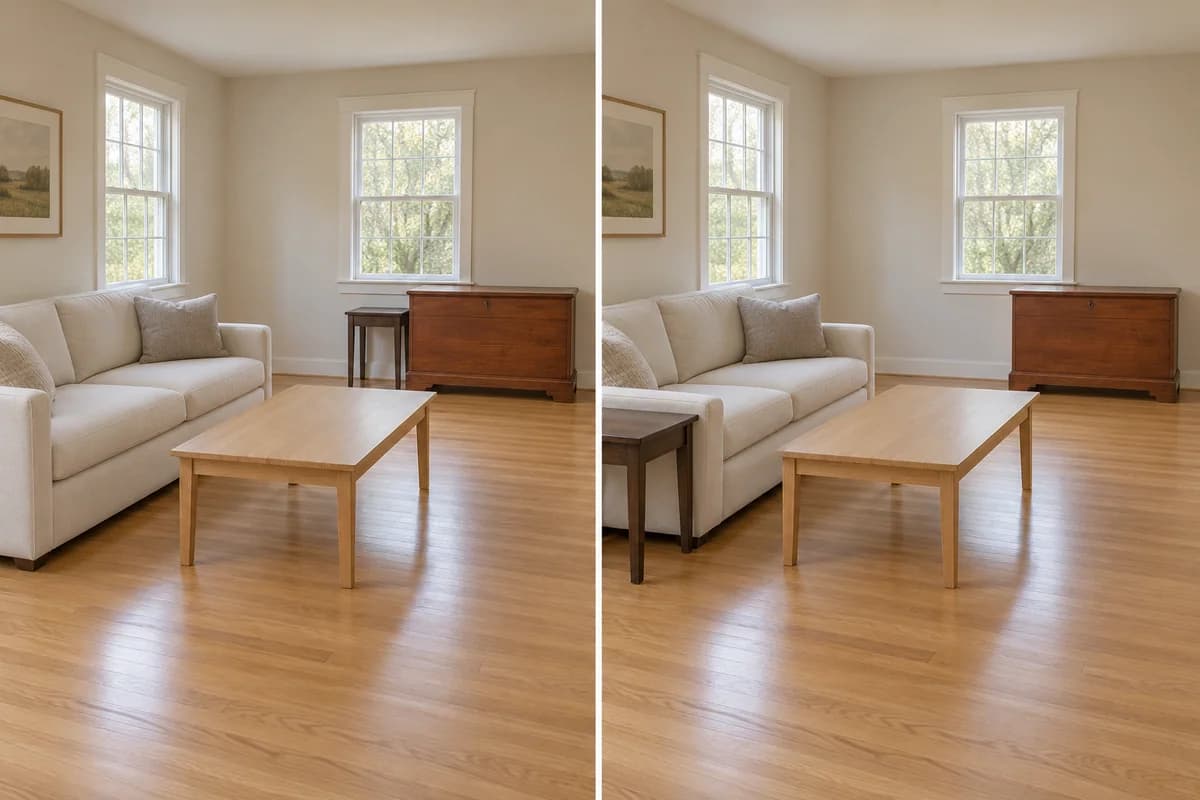
Only the dark side table moves. The floor, chest, wall color and lighting remain the same in both views.
Check the ordinary use of the room before keeping the move. A better color arrangement is not useful if the table blocks a drawer or ends up beyond reach of the seat.
This test is especially useful when two pieces are almost the same lightness but noticeably different in undertone. It lets each piece read on its own terms without requiring a new finish.
4. Give an isolated tone a small connection
If the reddish chest still looks alone, try a small object in a similar visible tone elsewhere in the room. A wooden bowl or frame you already own can be enough. Place it where you can see both it and the chest from the usual viewpoint.
Room & Board recommends repeating wood tones to help connect a room. Treat that as an experiment, not a shopping quota. You do not need a second chest, or an exact species match, to test whether a modest repeat helps. Room & Board's wood-tone guidance
Compare the view with and without the object. If it adds clutter, remove it. A strong standalone piece can be deliberate, and one more brown object is not automatically an improvement.
Keep the other accessories still during this trial. Otherwise you will not know whether the repeat helped or the general tidy-up did.
5. Use a textile where furniture meets the floor
The light golden coffee table has a different problem: its legs and the pale golden floor are similar enough that their edges look indistinct.
Test an oatmeal rug underneath, with the table's feet fully supported on the rug. The textile places a quieter surface between the two wood finishes. It changes what sits beside the table; it does not change the wood color.
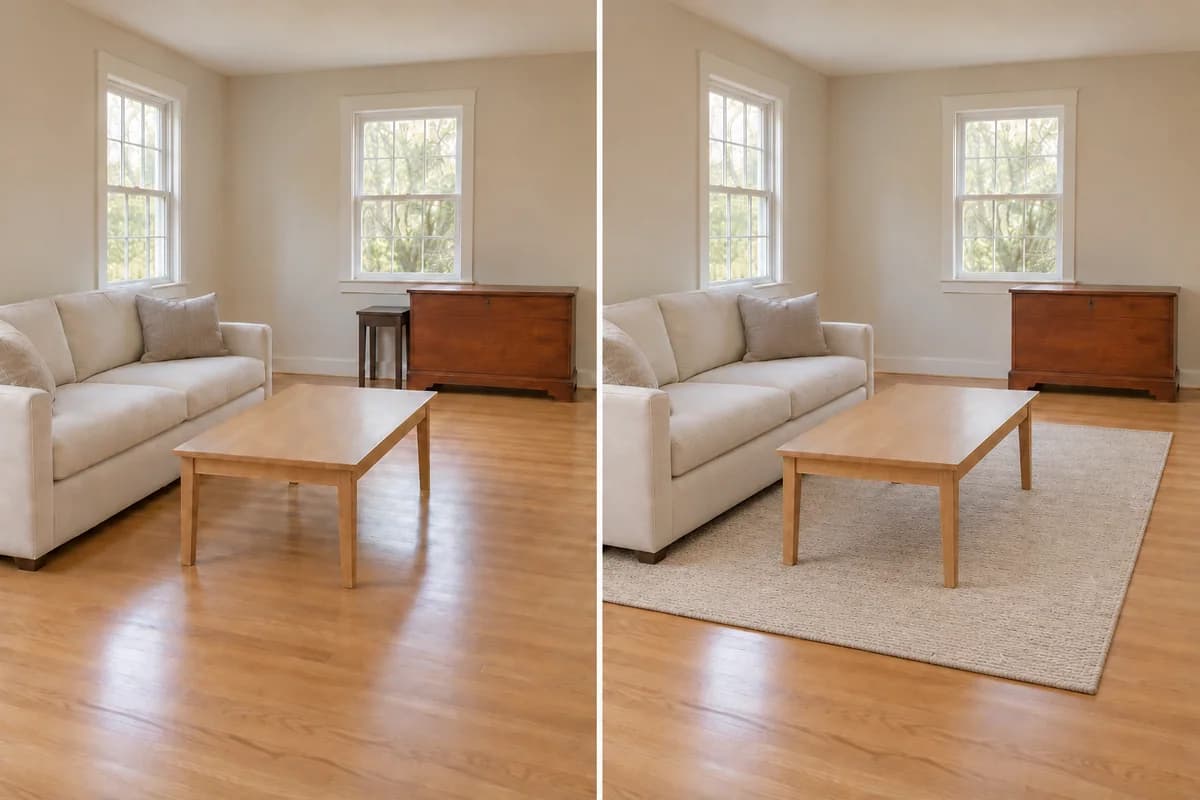
The table and floor keep their original colors. The textile is the only addition in the second view.
Try an existing rug if its size and condition suit the position. Keep edges flat and routes usable. Where a rug is impractical, upholstery near the piece or a simple runner across a tabletop may soften that particular junction, although it will not separate the furniture legs from the floor.
Choose the textile for the effect you want. A quiet color keeps attention on the furniture; a busy pattern adds another thing to compare. If you use the small reddish-brown object from the previous trial, leave it out while testing the rug so you can judge the textile on its own.
6. Compare the three trials before buying anything
| Trial | What changes | What stays fixed | What to look for |
|---|---|---|---|
| Move the side table | Dark side table moves from beside the chest to beside the sofa | Floor, chest, table finish and other furniture | The two finishes stop competing edge to edge |
| Repeat the chest tone | One small reddish-brown object appears across the seating area | All furniture positions and finishes | The chest color has a quiet connection elsewhere |
| Add a textile at the floor junction | An oatmeal rug separates coffee-table legs from the golden floor | Every furniture position and wood finish | The table outline becomes easier to read |
Photograph each trial from the same spot under the same lighting. Test the changes individually, returning the room to its starting arrangement between comparisons, then combine only the ones that help.
If the room still feels unsettled, cover one small accessory temporarily or remove it from view. Sometimes the floor and favorite furniture are already working; several minor finishes make the arrangement feel scattered.
Warm and cool woods can coexist too. Try placing a muted gray-brown table near cream upholstery rather than directly against the room's most golden cabinet. Judge the whole view, including lightness and grain, before deciding the undertones are the problem.
7. When the piece still does not work here
Try another position or another room if that is practical. A sentimental chest does not have to sit at the center of the busiest wood grouping to earn its place in the home.
If you eventually consider refinishing, make that a separate decision based on the actual construction and existing finish. This visual test cannot tell you whether a piece can be safely sanded or whether changing it is worthwhile.
For now, take one photo, move one thing, and take the same photo again. That comparison can tell you more than a shopping tab full of nearly identical browns.
Frequently asked questions
Can warm and cool wood tones work in the same room?
Yes. They create a stronger contrast, so start by changing the relationship around the piece: move it away from the most competing wood, or use upholstery or a textile between them. Compare the actual finishes in the room. Undertone is one part of the decision, not a ban on a combination.
How many wood tones can I mix?
There is no fixed maximum. Start by assessing the large visible surfaces, then see whether small pieces feel connected or scattered. You may find that removing one minor accessory helps more than reducing the number of furniture finishes.
Should the dining table match the floor?
It does not need to match. Compare the tabletop, legs, chairs and visible floor together. A distinct lighter or darker table can read clearly against the floor, while upholstered seating or an appropriate rug can reduce direct wood-to-wood comparison.
Can I identify the wood species from a photograph?
Do not rely on a screen image for exact identification. Stain, finish, lighting and the photograph can change its appearance. For decorating, describe the color and grain you see; for species or refinishing decisions, seek reliable information about the actual piece.