The awkward statement necklace is often sitting in two places at once: half against the top, half against skin, with its lowest bead repeatedly catching the neckline. Moving it a little can do more than changing the whole outfit. First give the piece a surface on which it can settle.
Decide what belongs behind the necklace
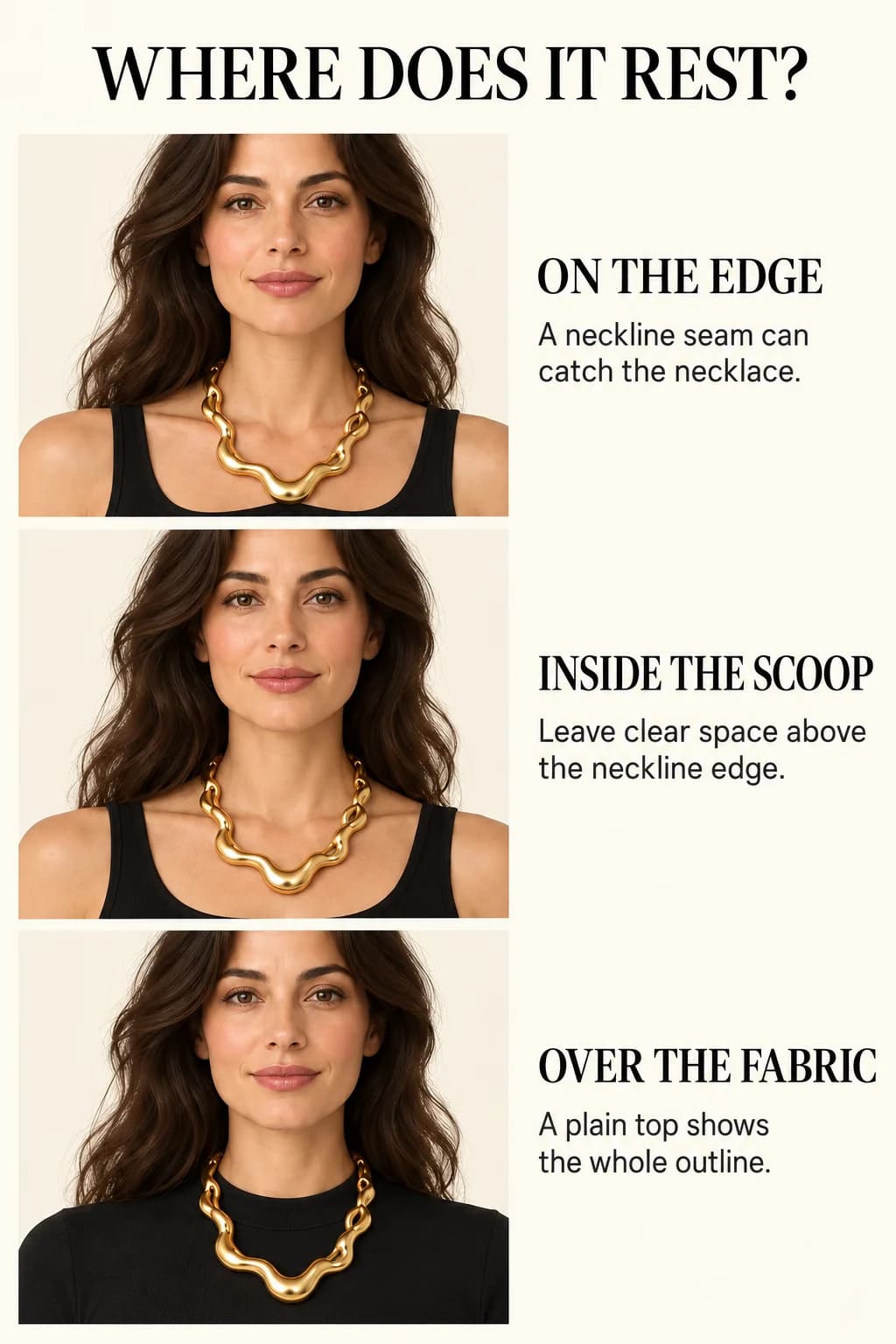
Put on the top and necklace together. Look at the necklace's full footprint, including the lowest pendant or outermost beads. A piece that fits comfortably inside an open scoop can be outlined against skin. A longer necklace can lie entirely on a plain top. The unstable arrangement is one whose lower edge keeps landing directly on the neckline seam.
If the clasp has adjustment points, try a shorter position that leaves a visible gap above the neckline. Alternatively, let the necklace fall clearly below the edge onto fabric. Neither needs a universal number of inches: bust shape, chain shape and neckline depth change where the same piece rests. Check the position while seated as well as standing.
A rounded collar necklace can echo a scoop; a pendant can follow an open V. You can also make a deliberate contrast, such as a sculptural silver curve against a high black crew neck. The important question is whether the whole outline is readable and stays put. Our necklace-by-neckline guide gives more options for the space your top leaves.
Build the rest of the outfit around the kind of statement
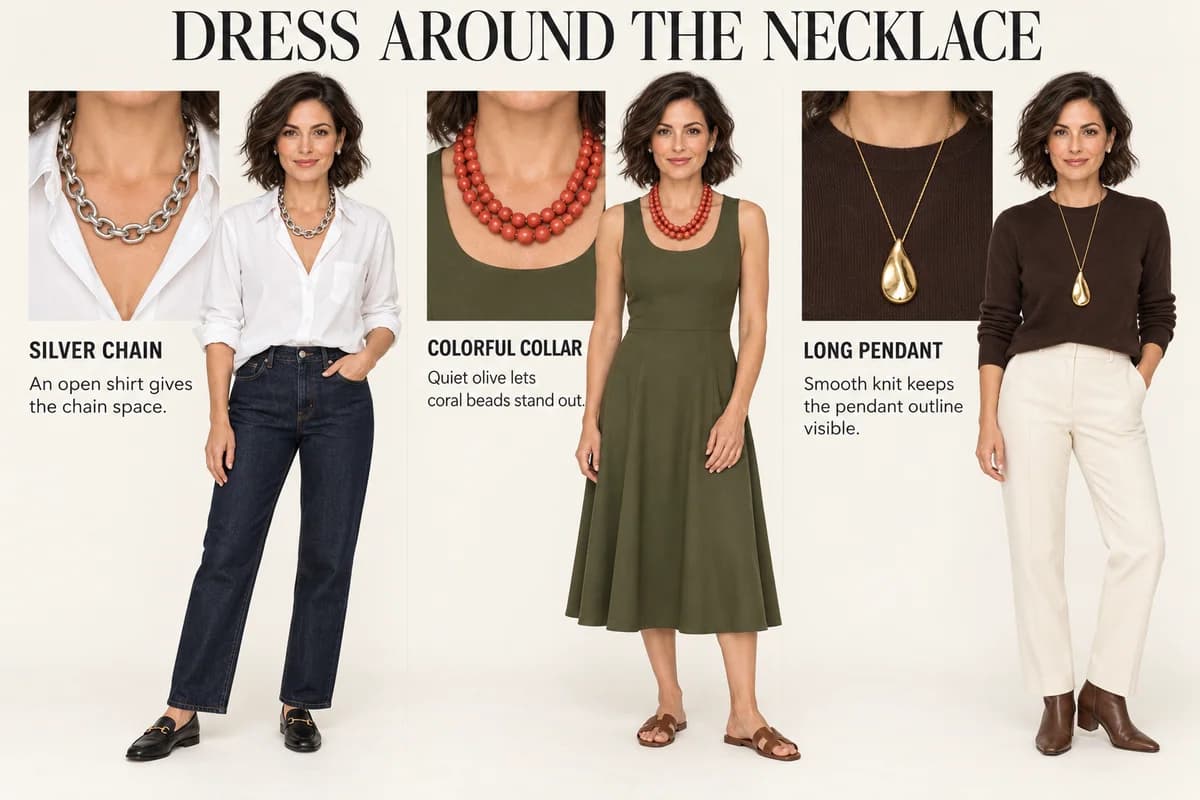
A chunky silver chain with an open white shirt
Wear a substantial silver chain inside the opening of a white cotton shirt, with dark straight jeans and black loafers. Leave enough of the shirt open for the chain to sit on skin without catching beneath a collar point. Small silver studs repeat the finish while letting the chain remain the more noticeable piece. A plain black bag keeps the outfit useful for lunch or a casual evening.
The white shirt provides a clear boundary and the dark denim makes the silver feel crisp rather than ceremonial. If you prefer more chest coverage, button the shirt higher and let the chain lie completely over the fabric below the collar, if its length permits. Otherwise, choose a plain crew-neck top; do not force a short chain to straddle the button placket. A chain that feels heavy after ten minutes needs a lighter alternative, not a tighter neckline holding it up.
A colorful collar necklace with a quiet dress
Try an olive scoop-neck midi dress, a coral-colored beaded collar necklace and dark-brown flat sandals for an outdoor lunch or an informal celebration. The warm beads create a distinct shape against the quieter olive. Position the collar entirely inside the scoop, with space between its lowest row and the fabric. Keep the sandal and bag simple so the color near the face has room to register.
For a more covered version, choose an olive high-neck dress and a necklace long enough to rest fully on that fabric. Check that the beads still stand out against the cloth. If the necklace is also green, a cream background may show its shape more clearly. In cool weather, brown closed shoes and a plain coat preserve the palette; remove the necklace before fastening the coat if the beads or fittings catch its lapels.
A long sculptural pendant over a fine knit
A large gold-tone pendant on a long chain works over a chocolate fine-knit crew neck with cream straight trousers and brown ankle boots. The knit supplies an uninterrupted background, while the pendant creates a vertical detail above the light trousers. This is a useful dinner outfit when you want coverage at the neck without leaving the upper half visually empty.
Choose a pendant weight the knit can support without pulling into a funnel. If the chain sinks into a chunky knit, switch to a smoother top or a bolder chain whose outline remains visible. For daytime, replace the boots with brown loafers and keep the other pieces. If a long pendant repeatedly touches the table when you lean forward, shorten it at a designed adjustment point or select a shorter necklace for that meal.
Add earrings and pattern with a clear intention
“One focal point” is an easy starting method, not a ban on enjoying jewelry. With several rows of colorful beads, small studs leave the necklace's outline easy to see. With one smooth metal shape, a stronger earring may still feel balanced because there is less detail inside the necklace itself. Compare the actual pieces together; size alone does not describe how busy they look.
A print can support the necklace when the piece remains distinct from it. Try a wide, simple chain over a fine stripe, then compare it with the same chain over a large multicolored floral. If the chain disappears among the shapes, choose a plain area of clothing or a necklace with a clearer contrasting color. You do not need to abandon pattern everywhere: a printed skirt can carry it farther from the necklace.
Matching every metal is optional. Repeat one finish elsewhere if you want the mixture to feel connected, or use a mixed-metal piece as the connection. The gold-and-silver jewelry guide goes further into that choice. Avoid adding a new necklace simply to explain the metal on a tiny bag buckle.
Solve movement problems before adding more accessories
If a bib necklace flips, see whether its edge is resting on a neckline seam or a stiff fold. Change the length or background first. If it continues to twist on a clear surface, the necklace's construction may be the problem. Damaged clasps or rough settings need attention from a jeweler; a styling adjustment is not a repair.
If a pendant drags a thin knit, use a lighter piece or firmer fabric. If beads catch loose loops, avoid that pairing rather than pulling them free repeatedly. A large statement can be visually bold without being physically heavy: hollow-looking forms, cord-based designs and lightweight materials offer different possibilities, but judge the actual piece's comfort.
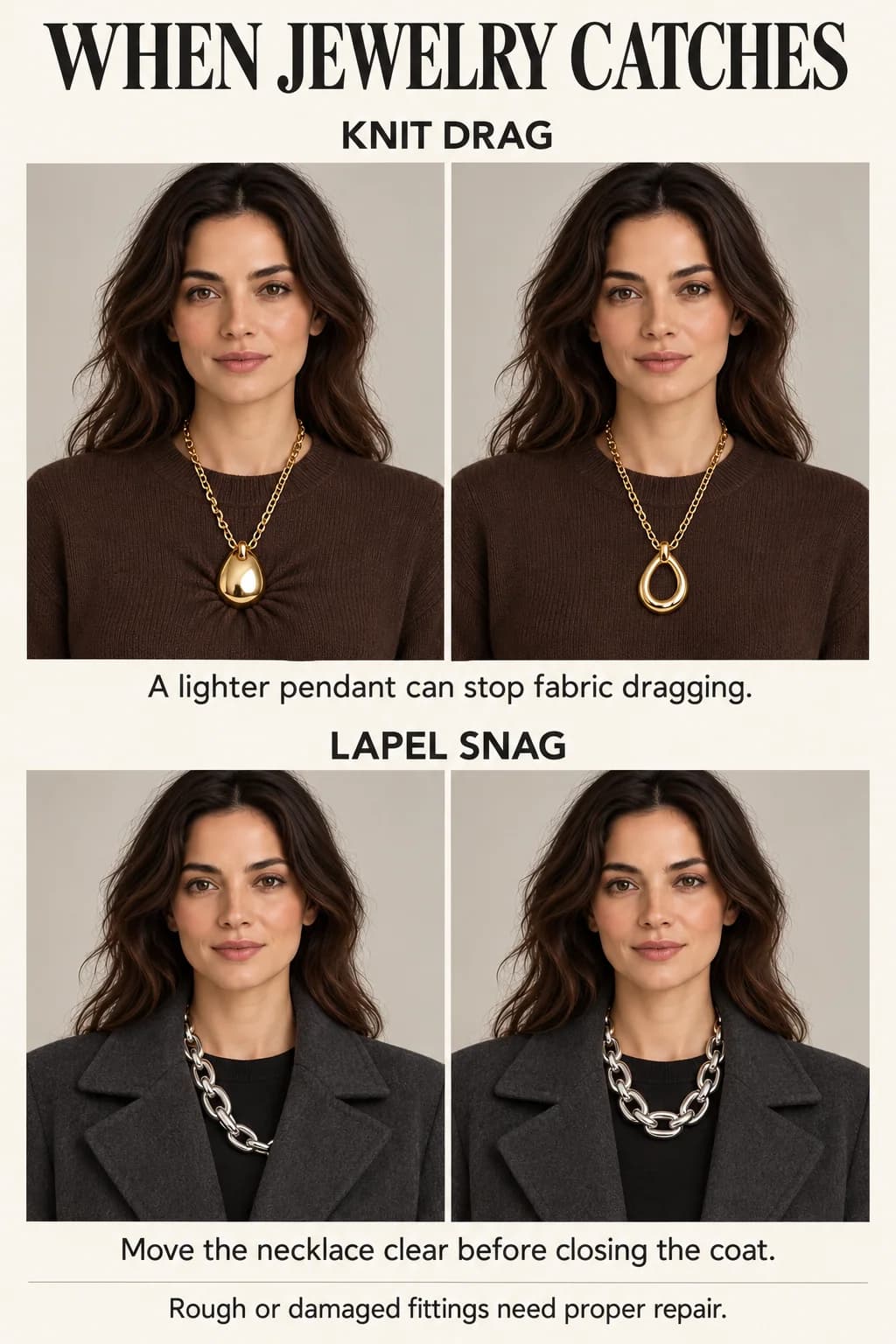
Put the coat on last and turn your head, reach for your bag and sit. Check that the strap does not push the necklace sideways and that a lapel does not trap its end. It is entirely reasonable for a necklace to appear only after the coat comes off. It should simply be a choice you have made, rather than a piece you spend the evening untangling.