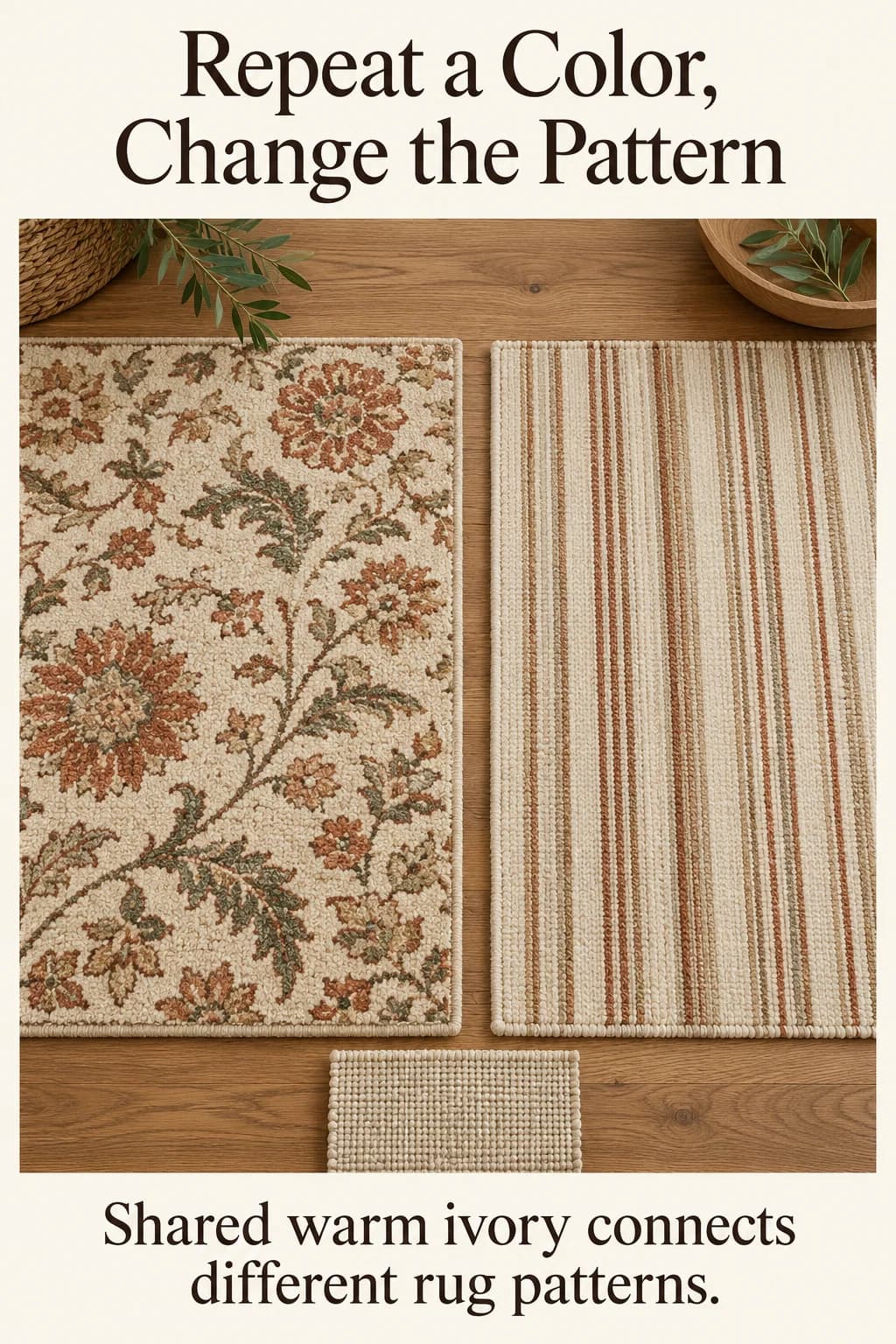
Start with the rug you most want to keep or the one that carries the strongest pattern. Its partner needs a clear relationship to it, but not the same design. A shared warm ivory, muted blue or earthy red can connect two zones while their patterns do different work.
Map the furniture before pairing the colors
Tape both proposed rug footprints on the floor. In the living zone, place the sofa and chairs where conversation works, then check that the rug supports that arrangement. In the dining zone, pull every chair out as someone would to stand. A rug that fits under the table while the chairs are tucked in can still catch their back legs during use.
Ruggable recommends allowing at least 24 inches beyond the table on each side as a sizing starting point. Test your actual chairs because their shape and pullout distance can demand more. Our dining rug sizing guide develops that measurement; the sectional rug guide tackles the different footprint of an L-shaped seating group.
Keep the floor between the two taped rectangles visible. This is where the relationship between zones becomes clear, and it may also be a walking route. A decorative gap and a usable passage are not interchangeable. Move through it with the chairs out before deciding either rug is the right size.
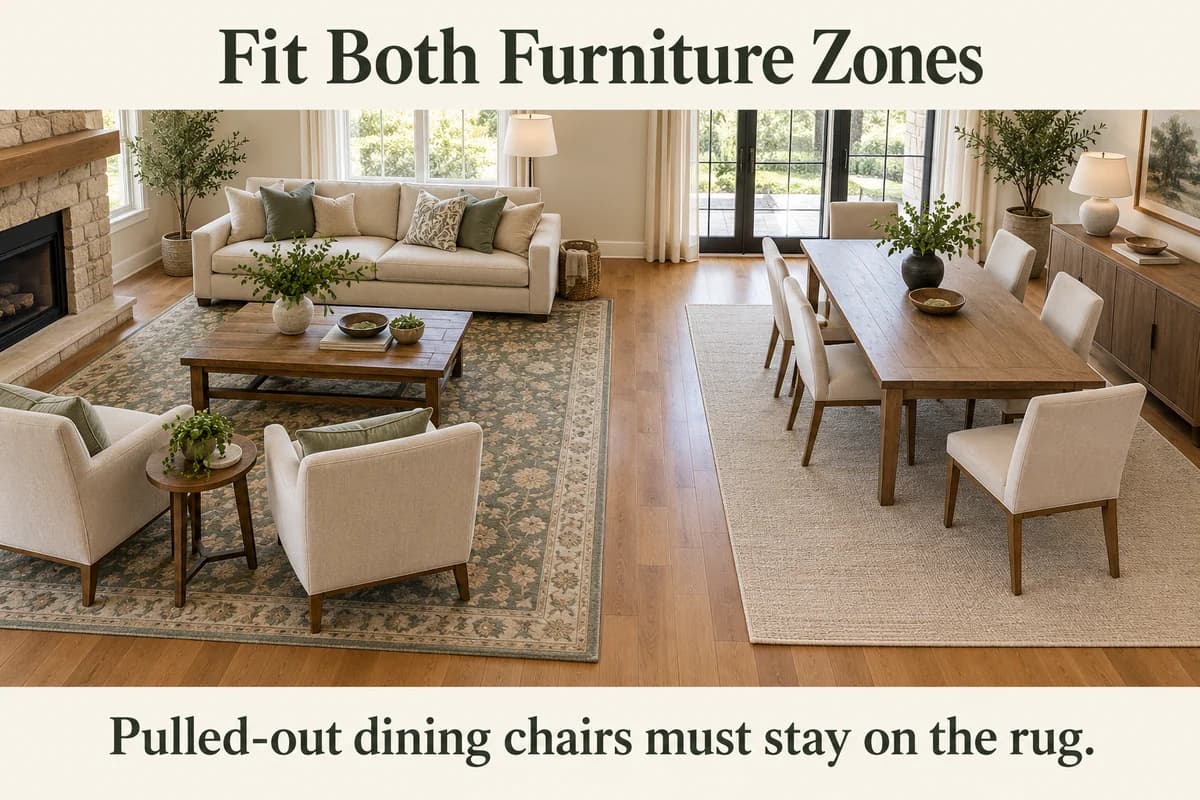
Warm oak, a patterned living rug and a quiet dining rug
Picture a 14-by-15-foot living zone next to a 12-by-13-foot dining zone, with a separate strip of floor between them. An 84-inch oatmeal sofa and two chairs sit on a 9-by-12-foot living rug, with their front legs supported. The rug has a large, faded rust-and-olive botanical pattern on warm ivory. It is the visual anchor.
In the dining zone, a 72-by-38-inch oak table sits on a 9-by-12-foot low-pile rug. Orient the 12-foot side along the table's length. The resulting allowance is 36 inches at each end and 35 inches along each long side: the rug is 144 by 108 inches. Those generous margins are useful only if they survive the actual chair test and leave the room's paths workable.
Choose a fine oatmeal-and-rust stripe for this second rug. The stripe repeats the anchor's warm background and one muted accent, while its smaller pattern reads almost as texture from the sofa. Warm oak supports that relationship. A bright white-and-black checkerboard would create a new high-contrast focal point, which may be more competition than this particular room needs.
In this illustrative layout, leave a 36-inch clear floor strip between the rug edges and verify that pulled-out chairs do not invade it. That is a layout choice, not a universal clearance rule. If the dining chair backs occupy the strip, shift the table and rug together or revise the furniture plan. Shrinking the dining rug until the chairs fall off would solve the photograph while worsening daily use.
A compact blue-gray room with a round dining table
A second scheme uses an 11-by-12-foot living zone and a 10-by-10-foot dining zone. Place a 72-inch charcoal sofa and a compact armchair on an 8-by-10-foot rug. Choose a broad, soft blue-gray geometric design with a cool off-white background. Keep the sofa's front legs on the rug and check that the chair does not sit awkwardly across an edge.
Beside it, center a 42-inch round table on an 8-foot round low-pile rug. A 96-inch rug leaves a 27-inch radial allowance beyond the table: 96 minus 42, divided by two. Pull the chairs out to confirm that this is enough for the actual seating. The round footprint makes the dining area distinct without introducing a second competing rectangle.
Give this rug a tiny charcoal fleck on cool off-white, rather than another large geometric. The two rugs share temperature and a dark accent, but only one makes a strong pattern statement. Keep a 30-inch strip between their nearest edges if it is merely visual separation and the main route runs elsewhere. If that strip must become the main route, reassess it with the real household movement; the example's gap is not an accessibility specification.
In a tighter version of the room, keep the properly sized living rug and leave the dining zone bare. The table and pendant can define dining without a rug. Two adequate furniture zones matter more than forcing two undersized textiles into the plan.
Check samples together on the floor
Place both samples beside the floorboards and existing upholstery in daylight, then repeat under evening lights. A cream that looked neutral online may turn noticeably yellow beside a cool gray rug. Choose whether to repeat that warm cast intentionally or replace it. Do not judge the rugs in different rooms and rely on memory.

If both rugs compete, change the partner's pattern scale or contrast before abandoning the shared palette. If they look unrelated, repeat one visible accent in the second rug rather than adding many accessories to manufacture a connection. Atlanta Designer Rugs similarly recommends building around an anchor and varying pattern scale; the two schemes here apply that principle to specific footprints.
Care requirements can differ across the zones. A softer living rug does not require a similarly plush dining rug. Favor a surface that lets dining chairs move cleanly, and follow each rug's cleaning and pad instructions. For an existing rug, keep it as the anchor only if its size works first. Sentimental value can guide the palette; it cannot make chair legs land on fabric that is not there.