A coffee table gives you a firm shared surface. An ottoman gives you an upholstered place to rest your feet, and some designs add storage or seating. A tray can help an ottoman hold objects, but it cannot make every soft top behave like a table. Choose for what happens in the room at the same time, not just for the list of functions on a product page.
| Task | Coffee table | Ottoman |
|---|---|---|
| Games or shared objects | Firm surface can stay ready to use | Tray size and support may limit the task |
| Resting feet | A separate suitable footrest may be preferable | Primary strength of a suitable upholstered design |
| Drinks | Use a stable surface with suitable protection | Check tray stability or use a side table |
| Hidden storage | Depends on the table design | A lifting lid must be cleared and accessible |
Watch what occupies the center of the room
If the middle of the seating area regularly holds drinks, snacks, a puzzle or a board game, a stable table surface is useful. If people mainly put their feet up while watching television, an ottoman may earn its space more often. When both happen, decide where the drinks will go while feet occupy the upholstery.
Do not assume either piece must fill the center. In a narrow room, side tables and a clear route may be more useful than one large central object. If you choose an ottoman, check that it is intended for any additional seating you expect; if you choose a table, do not treat it as a seat unless its maker explicitly allows that use.
Storage also has a sequence. An ottoman with a lifting top cannot be opened conveniently while the top is covered in a tray, books and glasses. A table with a shelf can offer accessible storage, but the shelf may collect objects that interfere with legroom. Think through the ordinary retrieval, not only the advertised capacity.
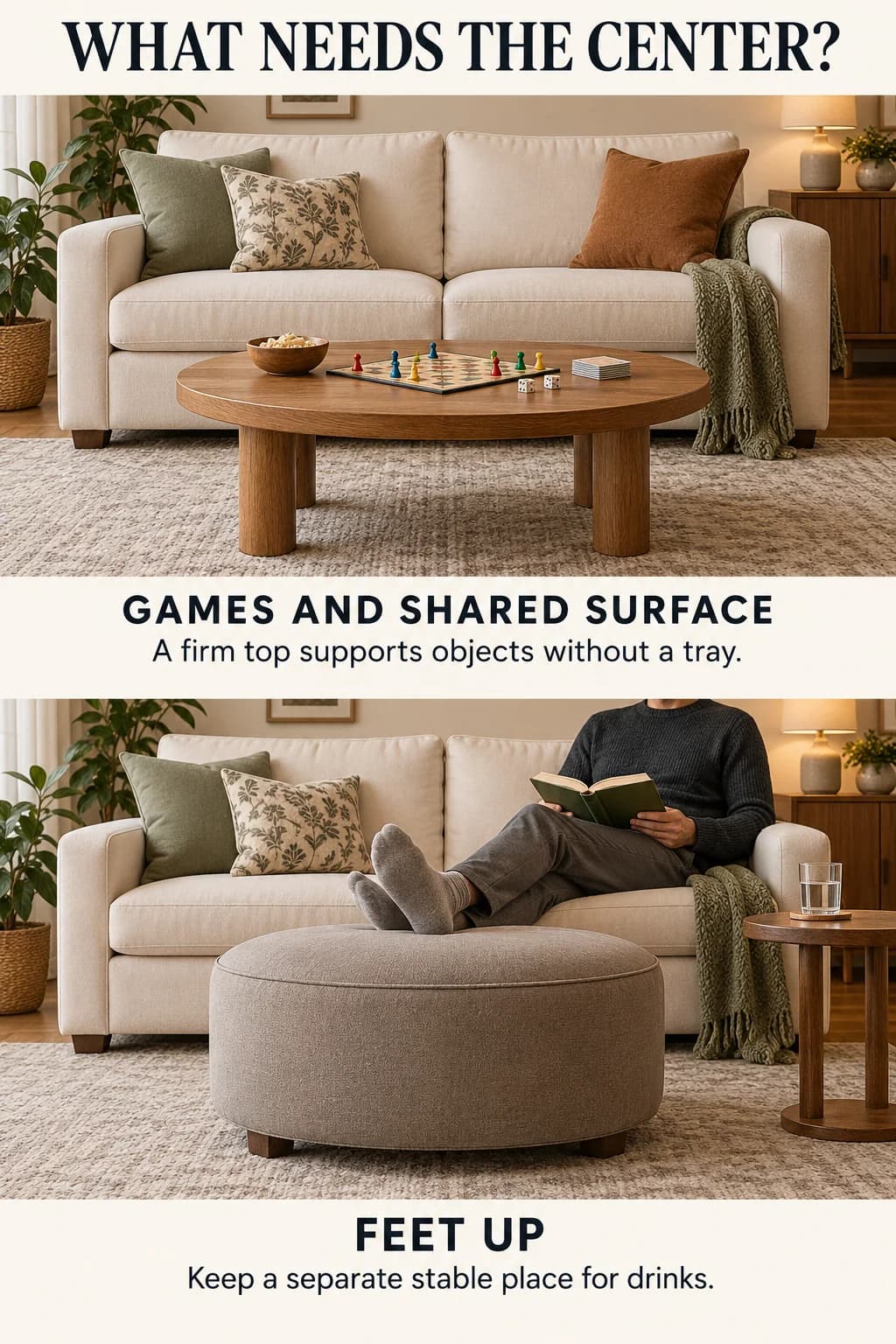
For a room used for games and visitors
Imagine a sofa facing two chairs, with the center used for drinks and a board game when friends visit. A coffee table with enough clear surface for those activities is a practical starting point. Choose its footprint around reach and the routes between the seats. A round table may ease movement around a tight corner, while a longer shape can place more surface within reach of a long sofa.
Those shape choices do not replace measuring. Use our coffee-table sizing guide to compare the actual sofa, walking space and table height. Then set out the game or serving items you use. A table can be perfectly proportioned in a room and still be too small for that particular activity.
Keep most decoration removable. A shallow tray of small objects can move to another surface before a game, whereas several heavy sculptures make every change laborious. The coffee-table styling guide helps preserve usable space instead of filling it simply because it is flat.
If the room is used for games only twice a year and for reclining every evening, reconsider the priority. An ottoman plus an occasional game surface elsewhere may serve the household better. The busiest photograph does not have to dictate the everyday arrangement.
For a room where feet go up every evening
In a television room with a sofa and one armchair, try an upholstered ottoman within comfortable reach of the person most likely to use it. Choose its height and distance while seated, not only by comparing catalog measurements. The feet should rest in a position the user finds comfortable; an ottoman that is much too high or distant will not become useful through better styling.
Provide a stable side table for drinks if space allows. That separates two competing jobs: the ottoman remains available for feet while the drink stays on a dedicated hard surface. It also prevents a large tray from covering the very upholstery you chose for comfort.
For a shared sofa, check whether one person's preferred ottoman position blocks another person's route. A smaller movable footstool may be more adaptable than a broad ottoman spanning the whole sofa. In a long, narrow room, the layout guide can help identify the main route before you fill it.
If you want hidden blanket storage, try opening the lid from the seated arrangement. Make sure you can reach the contents and that the lid's movement follows the manufacturer's instructions without hitting nearby furniture. If retrieving a blanket requires clearing the entire surface every night, a basket or another storage location may be easier.
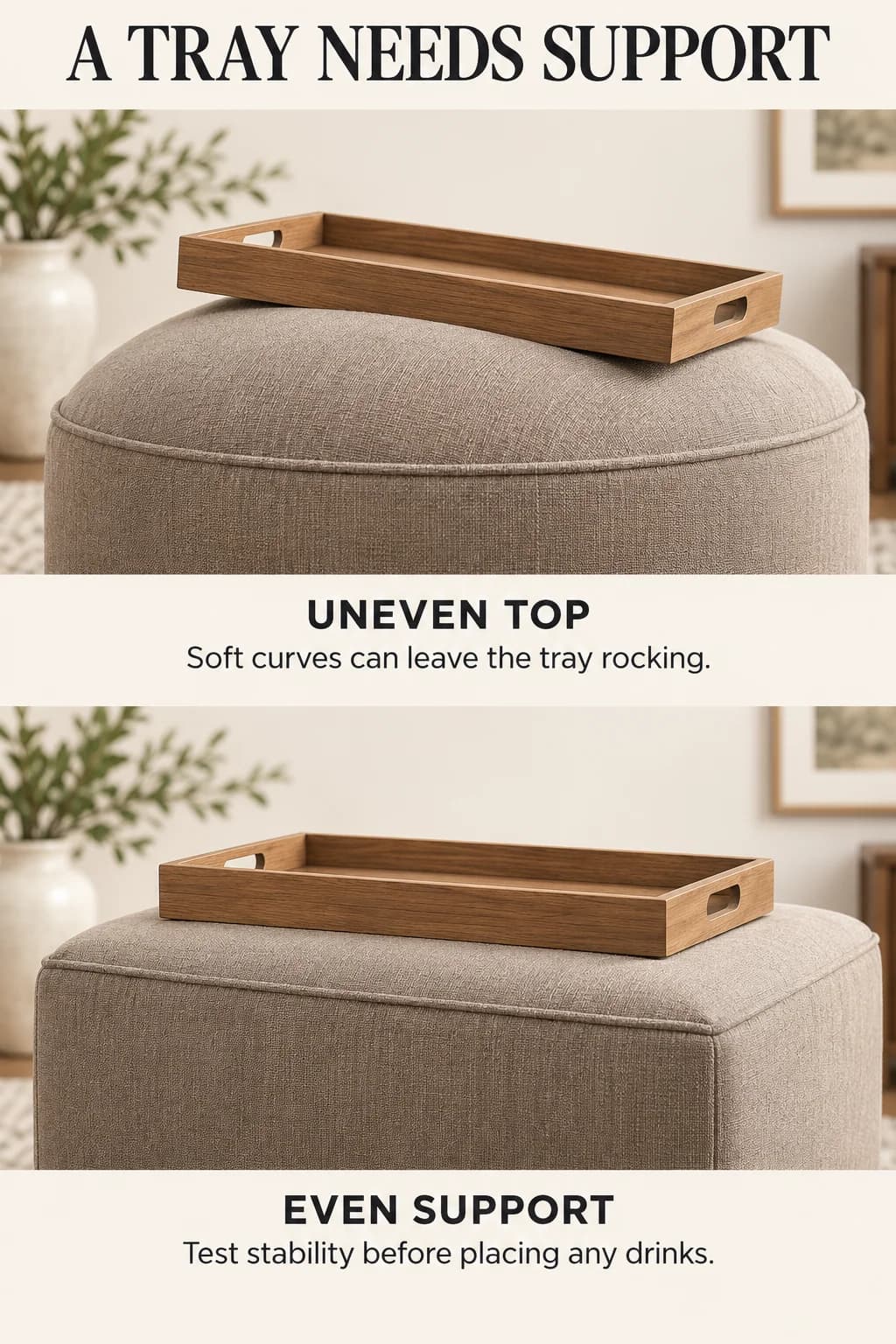
A tray is useful only when it is supported
A tray can provide a defined surface on a firm, sufficiently even ottoman top. Place it so its base is fully supported, then check whether the upholstery compresses or the tray rocks when someone sits nearby or rests their feet. Do this with empty objects first, not a hot drink.
Deep tufting, a domed cushion or soft padding can leave the tray uneven. A larger tray is not automatically the answer if its edges overhang or its center lacks support. If you cannot establish a stable arrangement, move drinks to a table. Avoid treating a decorative tray as a guarantee of safety.
OKA's ottoman guide discusses the appeal of combining these functions. The compromise becomes clearer when you consider them together: feet, drinks and opening storage may all want the same patch of furniture. Decide which use gets priority and where the others will move.
Surface care and visual weight matter after function
Upholstery brings texture, but spills need care appropriate to its fabric or leather. A hard table surface has its own requirements too; wood, stone and glass do not share one cleaning routine. Check the exact maker's instructions before assuming either choice is maintenance-free. Pottery Barn's coffee-table guide usefully separates material, size and storage considerations.
Visually, an upholstered block can feel substantial even in a pale fabric. Legs that reveal more floor can make either type appear less solid, but appearance does not change the real footprint. Walk around the proposed position with the seats occupied and storage open where relevant.
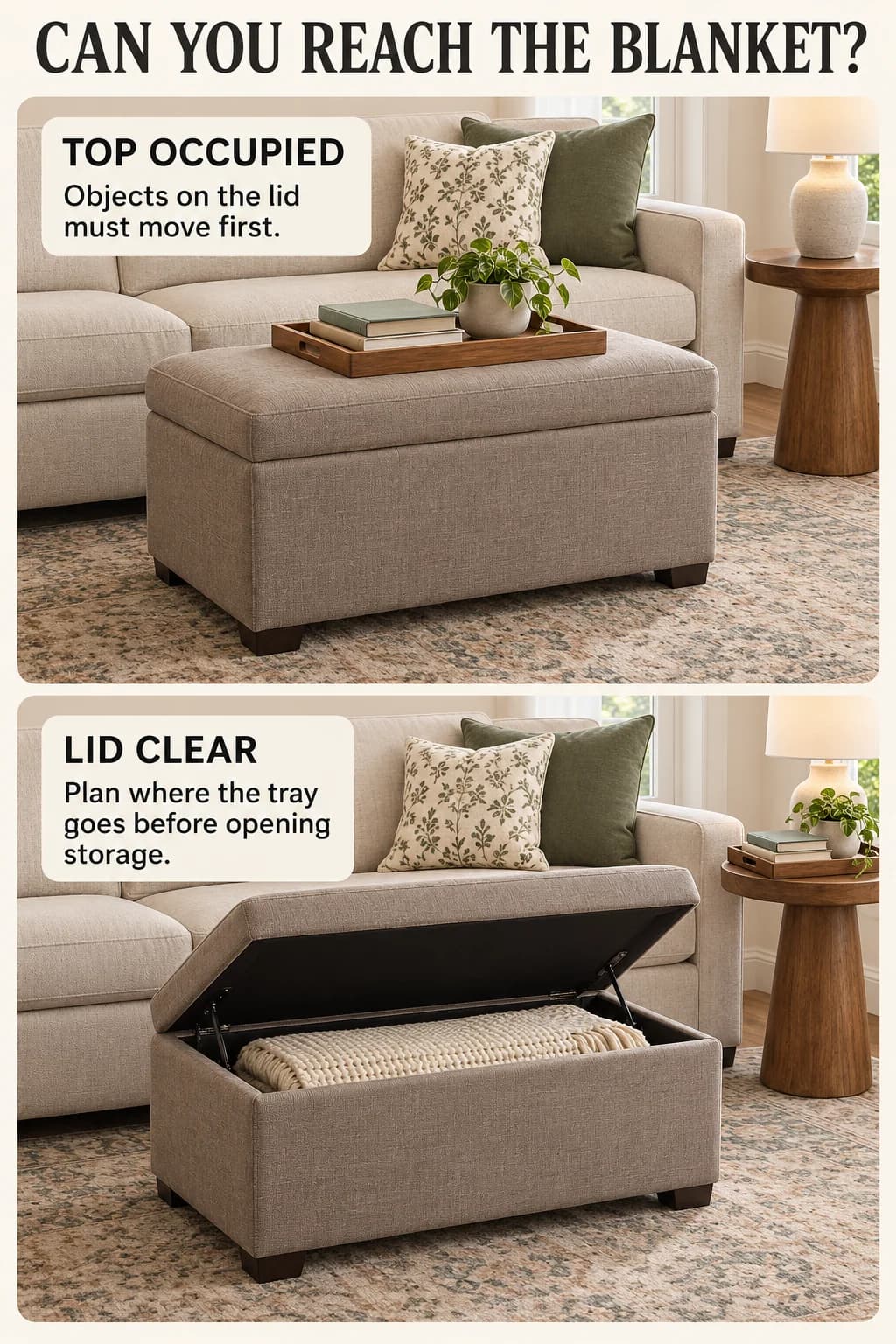
If neither option leaves a comfortable route, use smaller side surfaces and keep the center open. You can add a movable footrest when needed. Choosing no central piece is a valid answer when the room works better without one.