Where do your feet spend time while you cook? A continuous stretch between sink and prep counter asks a different question from two separate standing spots across the room. Use those locations to choose the floor covering before considering how much of the kitchen it could fill.
The difference is coverage, not a comfort guarantee
A runner supplies a long strip of coverage. A smaller mat concentrates it at one station. Neither name tells you how stable, cushioned or easy to clean the particular item will be. A thin woven mat and a thick resilient mat can behave very differently; a runner is not automatically an anti-fatigue product.
Watch the route between tasks. If you repeatedly move along one counter, continuous coverage may make sense. If the sink and prep area turn a corner or sit on opposite sides of an island, a straight runner may cover the connecting traffic route more than either standing area. A local mat, two independently suitable pieces or bare floor can be the better arrangement.
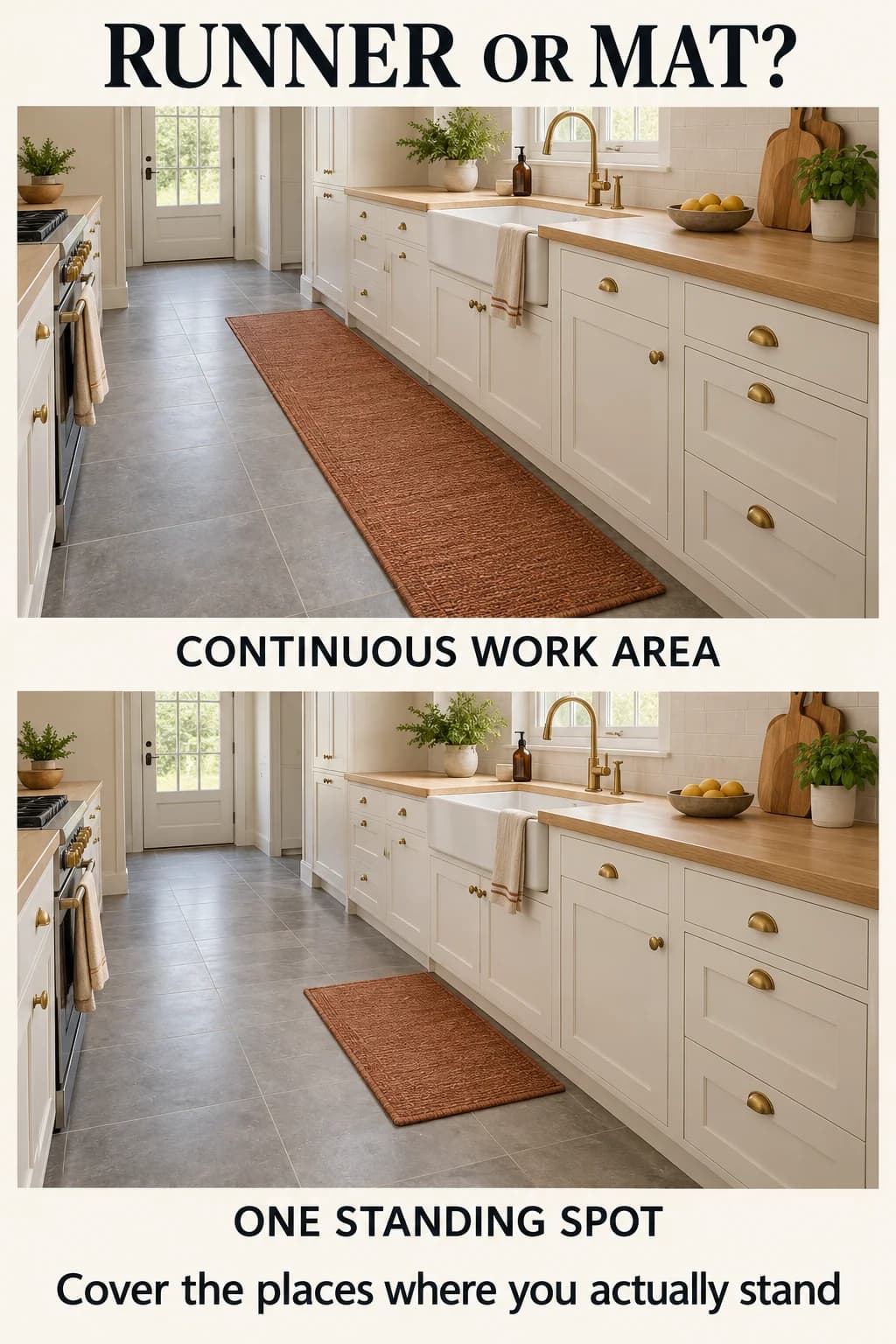
A galley with one continuous working stretch
Imagine a galley whose clear floor area along the sink and prep counter measures 42 inches wide by 108 inches long. The household tapes out a 24-by-84-inch runner centered in that rectangle. It leaves 9 inches of visible floor at each side and 12 inches at each end. These are the results of this example's dimensions, not required margins for every kitchen.
The marked area connects the two places where this cook stands most often. It ends before the dining space, so chairs do not cross it when pulled out. The household then opens the dishwasher, oven, refrigerator and nearby cabinets through their full travel. Tape can reveal a misplaced boundary, but it cannot prove that the real covering and any required pad will clear a low door.
Suppose a low-profile woven polypropylene runner is available in that footprint. Its exact care instructions allow the cleaning method the household can manage, and the flooring and rug guidance allow the proposed backing or pad. With the actual combination in place, the doors open fully without touching it, the edges lie flat and the runner stays put during ordinary use. Those conditions support choosing the runner for this galley.
The material name alone did not settle the decision. If that particular construction requires cleaning the household cannot arrange, or the approved pad makes it catch a door, the candidate fails even though its length looks right. A thinner compatible alternative may work; removing a required pad merely to gain clearance is not a reliable solution.
Separate stations favor a smaller commitment
Now picture an L-shaped kitchen with a sink on one leg and a prep surface on an island. The clear area directly in front of the sink is 30 inches along the cabinet by 22 inches out into the room, after allowing for adjacent door movement. The prep station lies around the corner. A long runner would cross the route between the room entrance and refrigerator without connecting the two work surfaces usefully.
A common 24-by-36-inch mat cannot fit within that sink footprint in either orientation. An 18-by-28-inch mat can, with its 28-inch edge parallel to the cabinet and its 18-inch depth extending into the room. The household still tests the actual item while opening doors and turning away from the sink. A numerical fit is only the first condition.
Suppose they choose a low-profile cotton mat whose exact size is approved for their washer and drying setup, with a backing arrangement compatible with the floor. They can lift and clean this small piece promptly when splashed, and it stays flat and secure in use. One mat at the sink is the useful choice here; the island remains bare because another piece would sit in the turning route.
If the smaller mat shifts when the cook steps away, the household checks the maker-approved backing or pad arrangement. If no compatible combination stays secure and clear of the doors, they leave the sink area bare too. There is no need to put a covering at every station simply to make the room look coordinated.
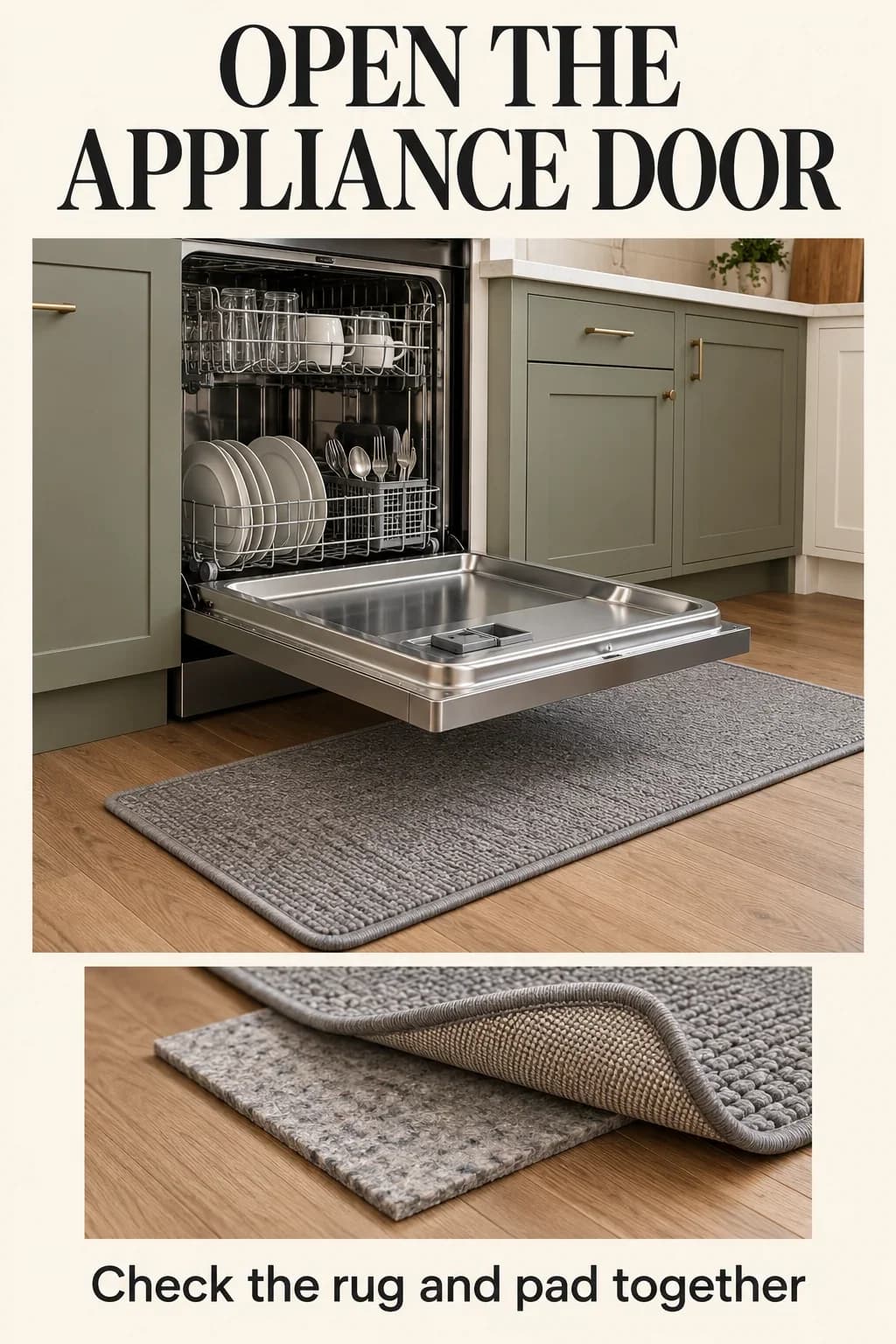
Check thickness while the door is moving
Test the covering and pad together, including raised edges or binding. A dishwasher door that clears the rug when closed can still catch it partway down. Do not keep using a combination that folds, drags or interferes with normal opening. Move it completely clear of the affected path or choose another suitable covering.
Keep vents and other required clearances unobstructed. In an open plan, also pull out the dining chairs and walk past them. The small living-dining layout guide can help identify the route that should remain usable beyond the kitchen work area.
Choose a pattern you can maintain beneath
A patterned runner carries color along the cabinets; a patterned mat creates a smaller accent. If open shelves already hold varied dishes, a quieter floor covering can give the eye a pause. The open kitchen shelving guide explores that balance without requiring every surface to match.
Pattern does not remove crumbs or dry a spill. Follow the exact product's care instructions, lift it to inspect the backing and floor, and address moisture according to both the covering and flooring guidance. Do not assume that a collection described as washable approves every size, machine or drying method.
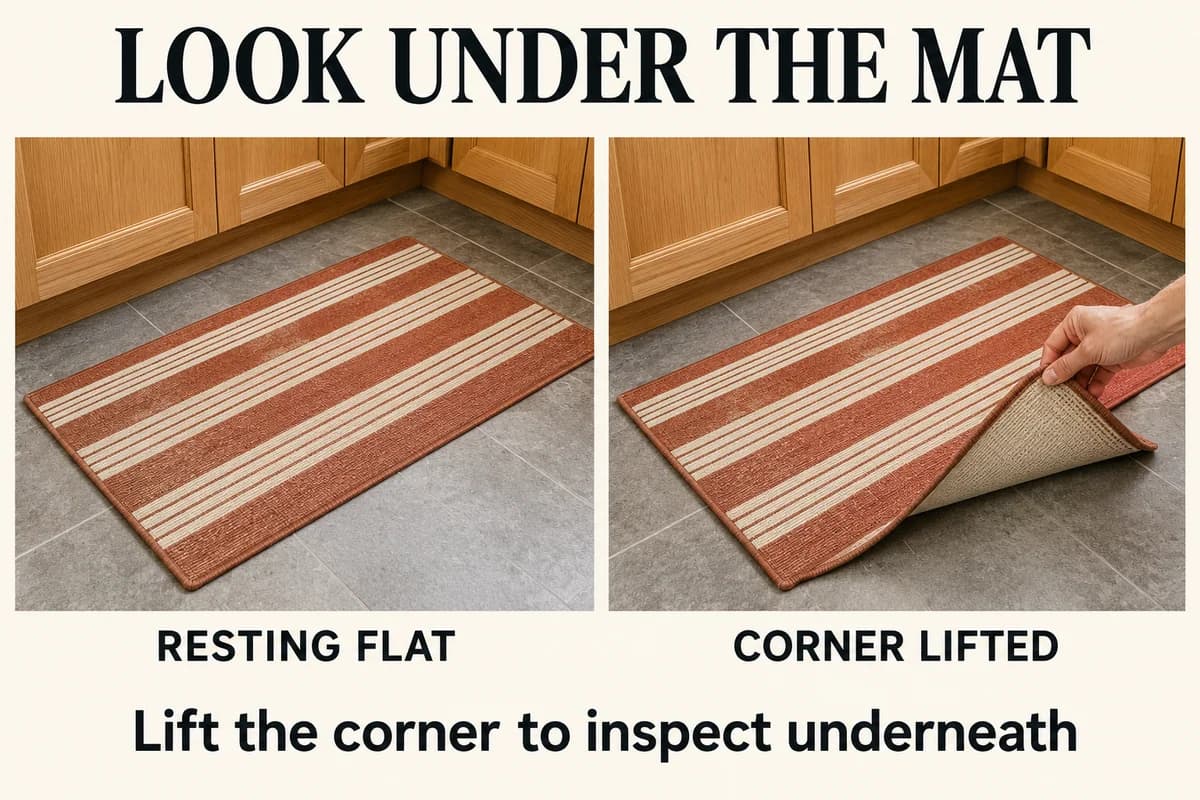
A large runner that is impractical to clean may be a worse everyday choice than a manageable mat. Equally, a small mat that repeatedly curls in a busy route is not improved by its convenient size. Keep the option that fits the work, the moving doors and the maintenance you can actually do.