A modern brooch guide covering placement, scale, outfit formulas and fabric-safe pinning on jackets, knits, shirts and accessories.
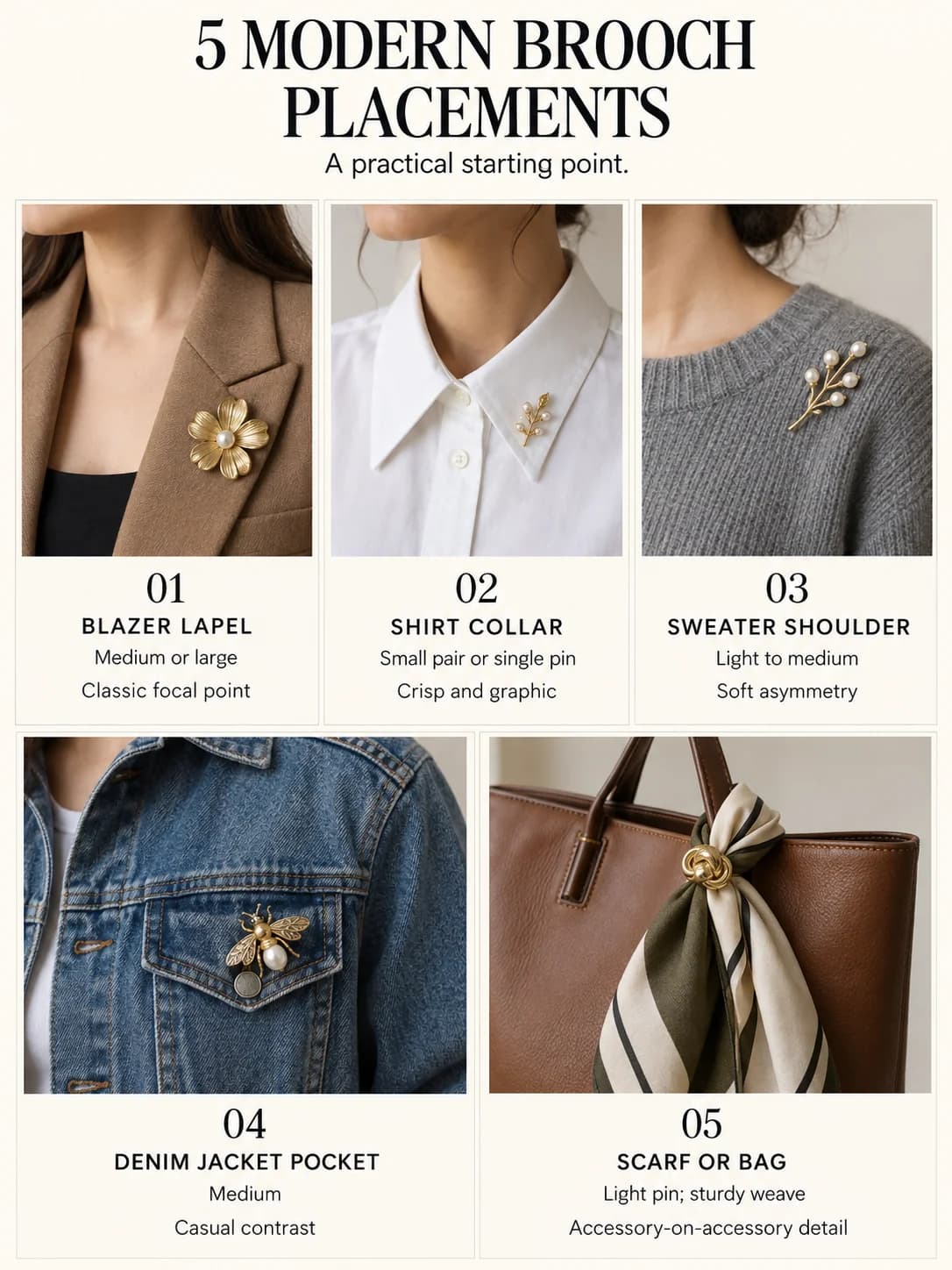
| Starting piece | Best match | Why it works |
|---|---|---|
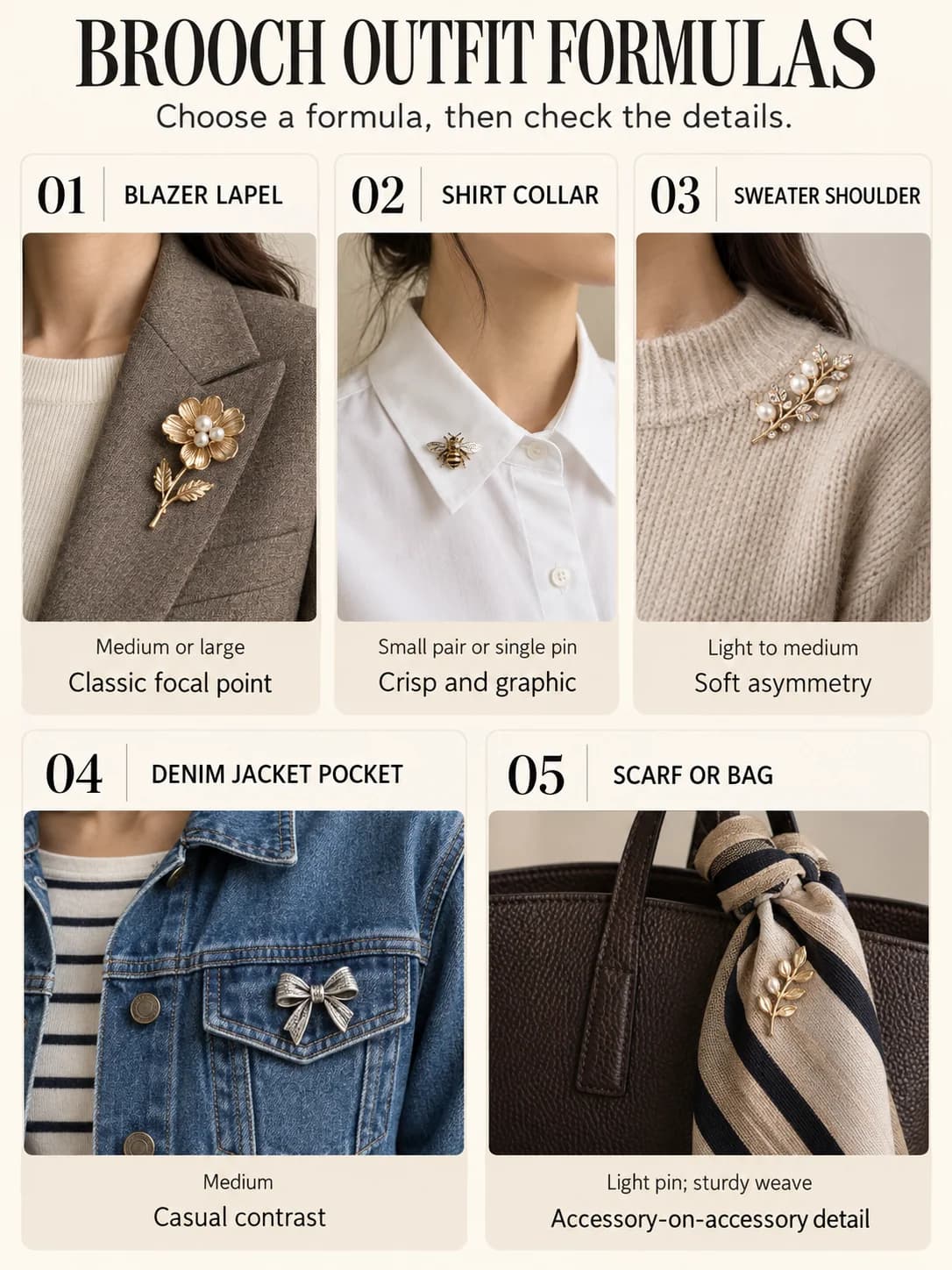
| Blazer lapel | Medium or large | Classic focal point |
| Shirt collar | Small pair or single pin | Crisp and graphic |
| Sweater shoulder | Light to medium | Soft asymmetry |
| Denim jacket pocket | Medium | Casual contrast |
| Scarf or bag | Light pin; sturdy weave | Accessory-on-accessory detail |
1. Start with placement, not the brooch
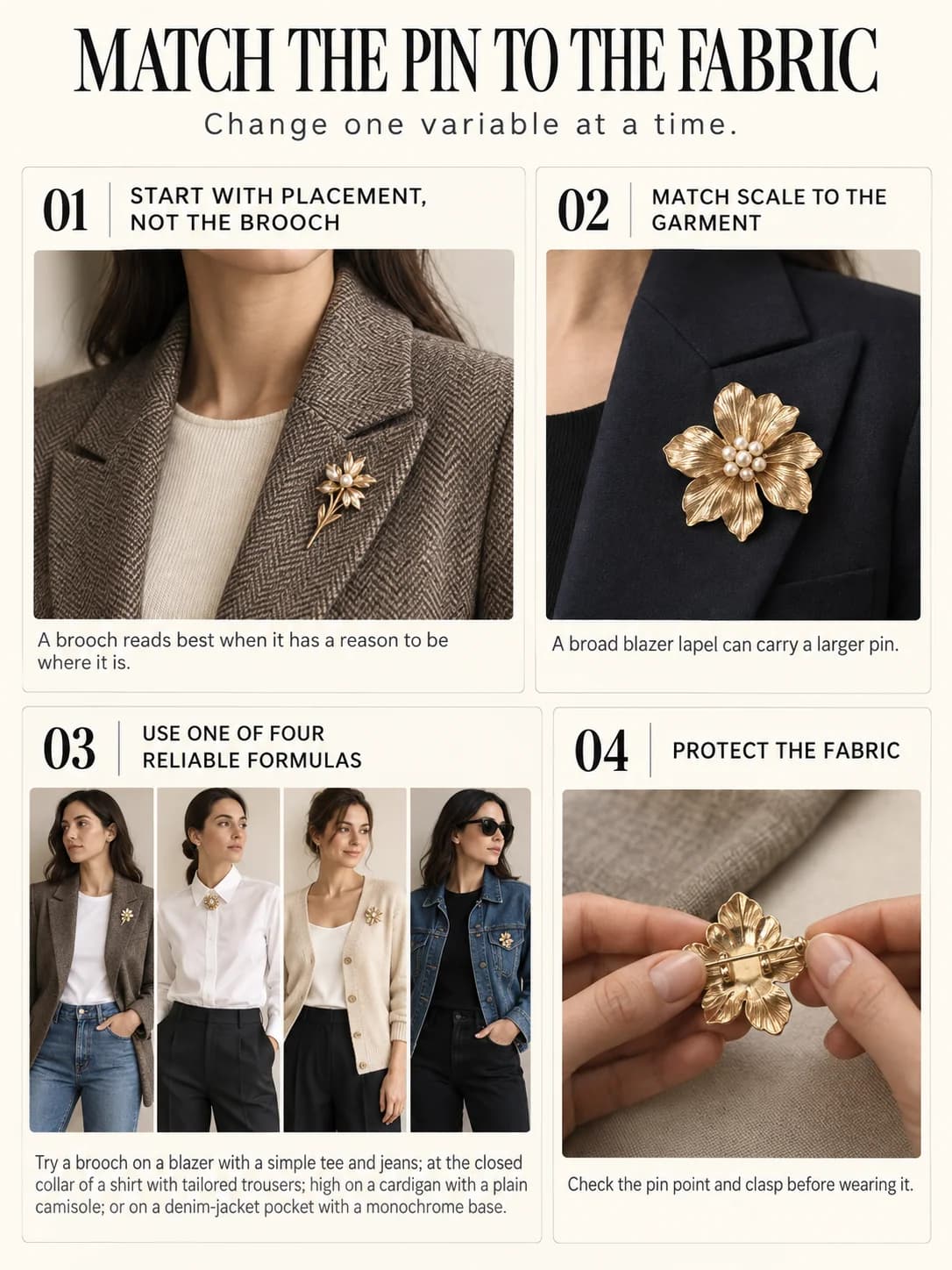
A brooch reads best when it has a reason to be where it is. A lapel supplies an obvious anchor; a collar point creates symmetry; a shoulder placement adds deliberate asymmetry. Hold the pin against the outfit before fastening it, then step back. If your eye lands on the pin and then travels through the outfit, the placement works. If it looks stranded, move it closer to a seam, edge, neckline or pocket.
2. Match scale to the garment
A broad blazer lapel can carry a larger pin. A fine shirt collar usually wants something smaller. On a chunky knit, a tiny brooch can disappear; on silk, a heavy pin can pull. Scale is both visual and practical. The brooch should be visible without dragging the surface beneath it.
3. Use one of four reliable formulas
Try a brooch on a blazer with a simple tee and jeans; at the closed collar of a shirt with tailored trousers; high on a cardigan with a plain camisole; or on a denim-jacket pocket with a monochrome base. Each formula gives the pin a defined job instead of treating it as an afterthought.
4. Protect the fabric
Check the pin point and clasp before wearing it. Avoid forcing a heavy piece through very fine, loosely woven or fragile fabric. When in doubt, test an inconspicuous area, use a backing patch or pin through a sturdier construction point such as a lapel facing. Remove the brooch before storing the garment so the fabric is not held under tension.
5. Edit the rest of the jewelry
A brooch can replace a necklace, especially near the neckline. Small earrings or a plain ring are usually enough beside a statement pin. If you do combine metals, repeat one metal elsewhere so the mix looks connected rather than accidental.
A five-minute mirror test
Photograph the outfit from straight on with your arms relaxed. First check the main transition described above, then look at the outfit as a thumbnail. The leading shape should still be obvious. Next, cover the accessory or layer you are least sure about with your hand. If the outfit becomes clearer, that piece is competing rather than supporting.
Walk, sit and reach before deciding. A formula that only works in one posed position is not useful enough. Check that closures lie flat, layers return to place and the key line remains visible. Finally, change only one element: try the alternative in the first column of the table while keeping every other piece fixed. The better option is the one that makes the relationship easier to read and still feels like you.
Common mistakes to avoid
Do not combine several fixes at once. Moving a hem, changing a shoe and adding a new color may produce a better outfit, but it will not tell you why. Avoid treating “Blazer lapel” as a universal prescription; it is one useful route with the effect “Classic focal point.” The other rows create different, equally valid results.
Also avoid choosing from a cropped mirror view. Shoes, hems and outer layers affect the whole outline. Review the complete look in ordinary light, then make the smallest change that resolves the specific problem.
The final check
Step back and look for one clear relationship: the eye should understand what leads, what supports it and whether the result still works in real use. If something feels off, change one variable at a time instead of replacing everything. That is the fastest way to learn which detail is doing the work.

Frequently asked questions
Which side should a brooch go on?
Either side can work. Use the side that balances the neckline, lapel, hairstyle or bag strap; consistency matters less than a clear visual anchor.
Can I wear a brooch on a sweater?
Yes, if the knit is sturdy enough for the pin. Use a lighter brooch on fine knits and support the fabric from behind.
Can a brooch replace a necklace?
Yes. A pin near the collar or shoulder gives the eye a focal point, so a necklace is often unnecessary.