The easiest casual trench outfit is one you would happily wear after taking the coat off. That matters because an open trench shows almost the entire base, while a closed one concentrates attention on the collar, belt and shoes. Build the base first; then decide how the coat should sit around it.
Read the coat before copying the outfit
A crisp, lined trench holds its own shape. Over a thick sweatshirt, that structure can turn into crowded shoulders and bunched sleeves. A fluid, unlined version may accommodate a relaxed knit more easily, but can also fold inward around loose trousers. Neither is automatically better: put the intended layers on and check the coat buttoned as well as open.
Length changes the amount of base you see. A short trench shows more of the trousers; a mid-calf one forms a long frame around them. If a long hem catches your legs on stairs, or a stiff skirt of fabric feels awkward when seated, choose a shorter length or have a suitable coat altered. You do not have to wear heels to make a long trench work.
Construction also changes weather performance. Burberry's trench guide describes its gabardine as shower-resistant and distinguishes several fits and lengths. That is not a guarantee that every coat called a trench is waterproof. Check your own garment's specification before relying on it in sustained rain; a fashion trench may be the wrong outer layer for that journey.
The dry-day walking outfit
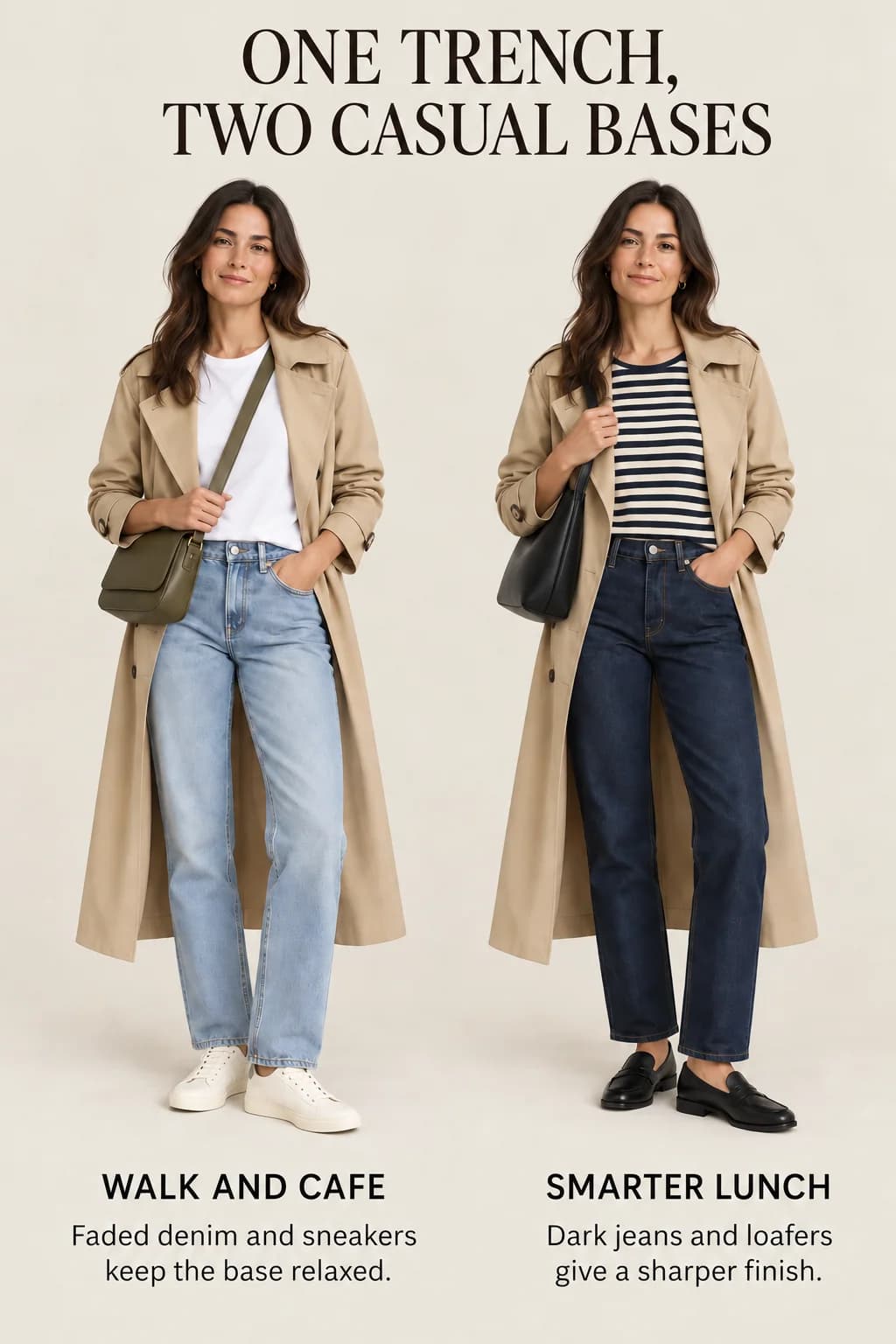
Wear a beige knee-to-mid-calf trench over a white cotton tee, faded-blue straight jeans and cream sneakers, with a compact olive crossbody bag. This is a straightforward base for a walk with a café stop: comfortable shoes, a simple palette of beige, blue and white and no delicate layer that needs constant rearranging. Actual walking comfort still depends on the shoes you own.
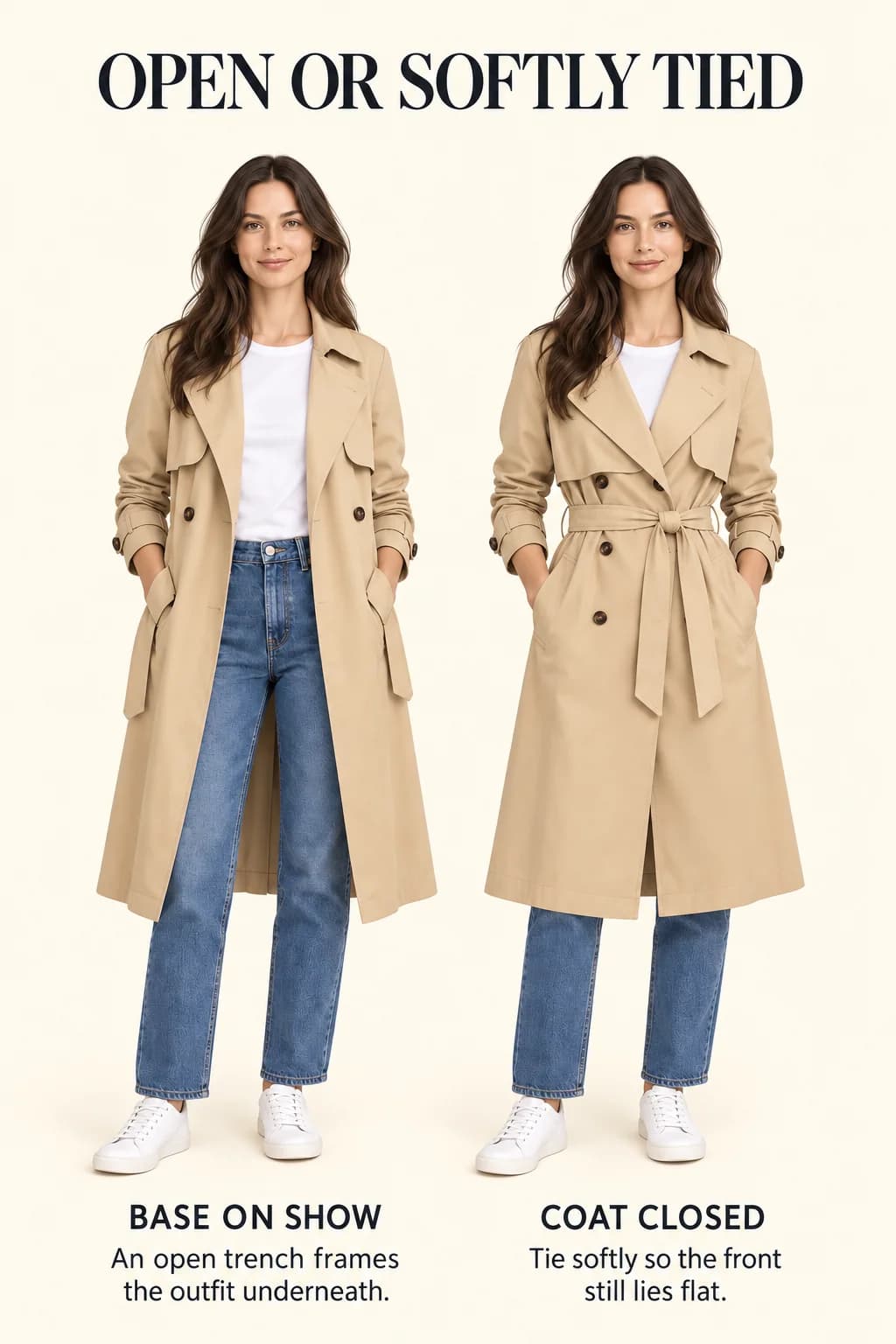
Leave the coat open. The white tee and denim remain visible down the center, while the trench supplies the outer shape. If the tee is long, try a small front tuck to reveal where the jeans start; if you prefer it loose, choose a hem that does not bunch beneath the coat's belt line. A casual outfit does not require the entire waist to be visible.
Secure the unused belt so its ends cannot trail or catch. A loose knot behind the coat can work if it does not pull the fronts backward. Otherwise, pass the ends through their keepers or remove a detachable belt and store it safely. Do not cinch the back so tightly that the lapels stop lying naturally.
For cooler weather, replace the tee with a fine merino crew-neck knit or a thin long-sleeve cotton top, according to what your coat comfortably accommodates. If you want a hood, check the extra fabric at the neck and shoulders rather than simply forcing it beneath the collar. The layering checks in our hoodie-under-a-coat guide are useful here.
Dark denim and loafers for a smarter casual lunch
Try a stone trench with a navy-and-cream striped knit, dark straight jeans and black loafers. Carry a small black shoulder bag and keep other accessories simple. The darker jeans and leather shoes make the base feel more finished than the faded denim and sneakers, while the striped knit keeps it relaxed enough for lunch or an informal meeting.
Choose a knit that does not fill the coat sleeves tightly. On a breezy day, button the trench with enough overlap that the front lies flat, then tie the belt softly if you like that shape. The knot should hold the fabric in place, not pull the button line sideways. You should still be able to sit without the back vent spreading under tension.
If you want no pressure at the waist, leave the belt loose or omit it. A closed, uncinched trench can be just as deliberate. You can also wear this exact base with the coat open: it will show more stripes and give the outfit a less enclosed appearance. Treat closure as a comfort and weather decision as well as a styling choice.
For cold ankles, add dark socks and let the jeans meet the shoe without a large gap. For rain, use suitable weather-ready footwear and recheck the jean hem. A loafer is not automatically a practical wet-weather shoe merely because it looks good with a trench. The darker-denim approach also works in blazer and jeans outfits, where the outer layer has a different level of structure.
A fluid trench with wide trousers and flat boots
For a cool, unhurried day, combine a soft olive trench, a cream fine-gauge crew-neck knit, charcoal wide trousers and black flat ankle boots. Add a charcoal tote. Keep the knit at hip length or tuck it loosely if the trousers allow, and let the coat hang open over the darker lower half.
Here the coat and trousers both move, while the quieter knit gives them a simple background. The black boot provides a definite finish below the charcoal hem. Choose a trouser length that clears the ground in those boots; a long coat does not hide dragging trousers when you walk. If the coat collapses into the trouser volume, try a straighter trouser rather than immediately buying a smaller trench.
A shorter trench is a useful alternative when you want more of the wide-leg shape on view or dislike fabric around your calves. Keep the same colors and footwear, then judge where the coat hem meets the trousers. For more warmth, replace the thin knit only if the sleeves still have room. If a heavy sweater makes the armholes restrictive, a roomier or warmer coat is a better answer than wearing an unsuitable trench half on.
Sleeves do not all behave like a shirt cuff
Pushing up the sleeves can expose a striped cuff or lighten the appearance of an outfit, but it is optional. Soft sleeves may stay above the wrist; stiff, lined sleeves with cuff straps often form a bulky ring. Try one gentle push, then lower them if they squeeze, slip down or pull the lining out.
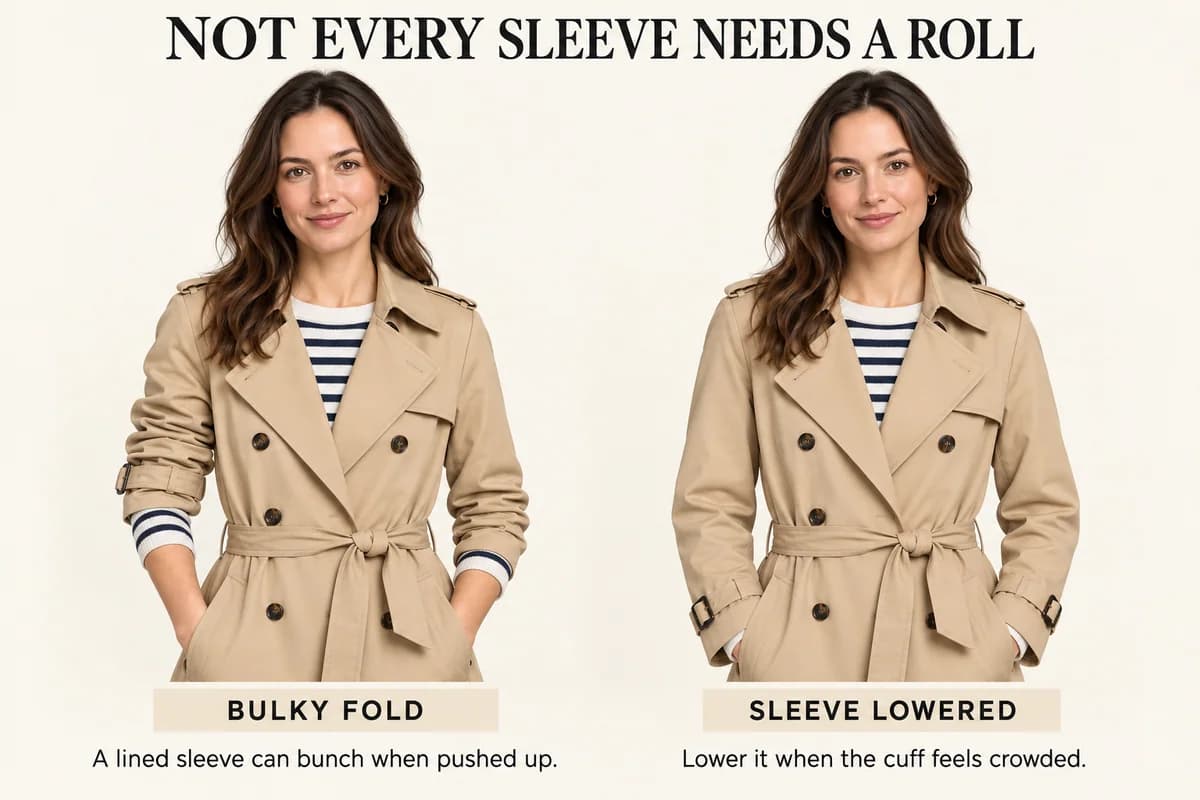
If the sleeve is too long even when worn normally, repeated rolling is not always a satisfying repair. Alterations may need to account for tabs, lining and button details. Keep those details intact rather than forcing a fold across them. Before heading out, sit with the coat closed, reach forward and lift a foot onto a step. Those movements reveal belt tension, arm restriction and hem interference that a standing mirror view can miss.