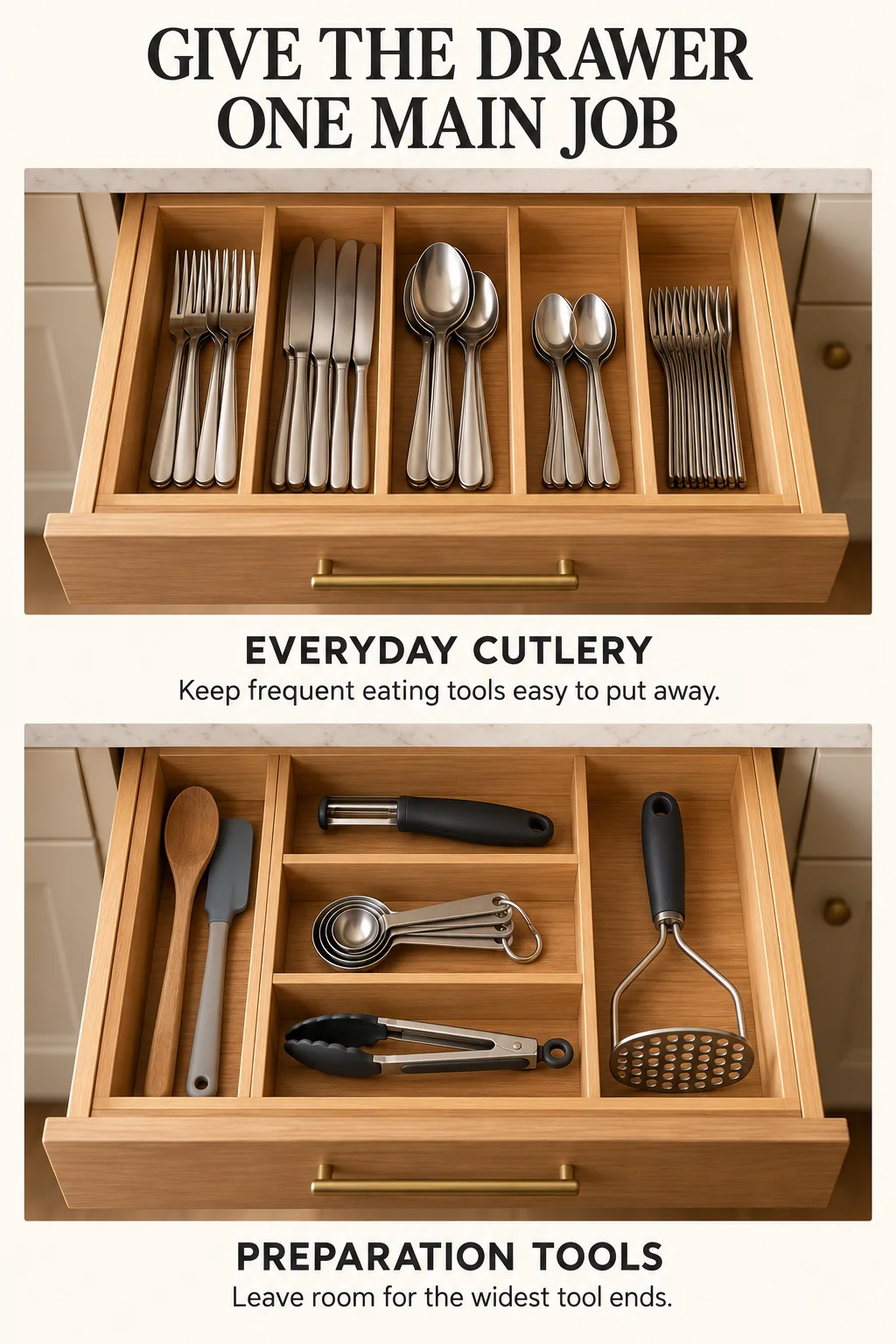
The drawer that looks beautifully divided while empty can become impossible once the potato masher returns. Organize around the objects you need to retrieve and put away, including their awkward ends. An insert provides boundaries; it does not add capacity.
Give each drawer a job before giving it an organizer
Empty one drawer at a time and group its contents by use: eating, food preparation, cooking, storage and occasional tasks. Separate items that belong elsewhere and remove duplicates you do not use. Keep frequently used tools in reach, but do not decide that every small kitchen object belongs in the top drawer.
Location creates trade-offs. Cutlery near the dishwasher is easy to put away; prep tools near the work surface are easy to use. If one drawer serves both locations, give the front or easiest-to-reach section to the items used most often and place the other group beside it. A long walk for a tool used every meal may be a larger inconvenience than a slightly longer unloading route.
Watch an ordinary meal before rearranging the whole kitchen. Where do you reach for the peeler, where do you open containers, and who sets the table? In a shared kitchen, those tasks may belong to different people. Agree on the drawer's main purpose so it does not become four competing systems in one box.
Measure the usable interior, including the space above it
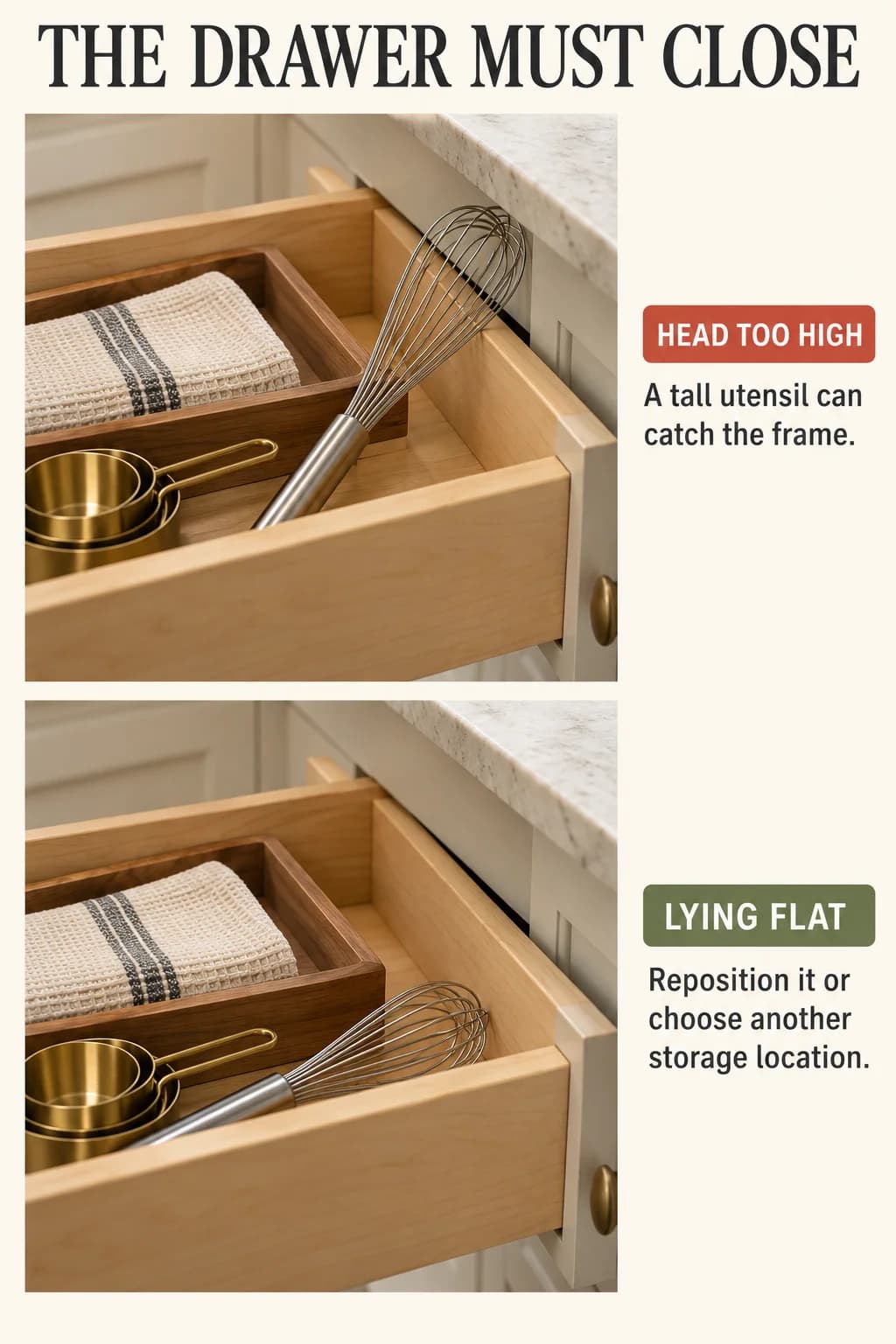
Measure inside width and depth, accounting for any curved corners or hardware. Check the usable height with the drawer closed, not merely the height of the front panel. A tall whisk may fit inside an open drawer but strike the frame as it closes.
Lay out the intended groups on a clear surface within those measurements. Include room for fingers to lift objects without removing the whole tray. For long tools, measure the widest end as well as the handle. A potato masher's head and a pair of open tongs can defeat a narrow compartment that looked adequate from handle length alone.
Use existing shallow containers to test the arrangement before choosing fitted inserts. They need to sit securely and allow the drawer to close without force. A purpose-made knife insert or appropriate blade guards can keep knives organized without leaving loose exposed blades among other utensils. Do not use an attractive open bin as a substitute for suitable blade protection.
Rework a shallow drawer with cutlery and long tools
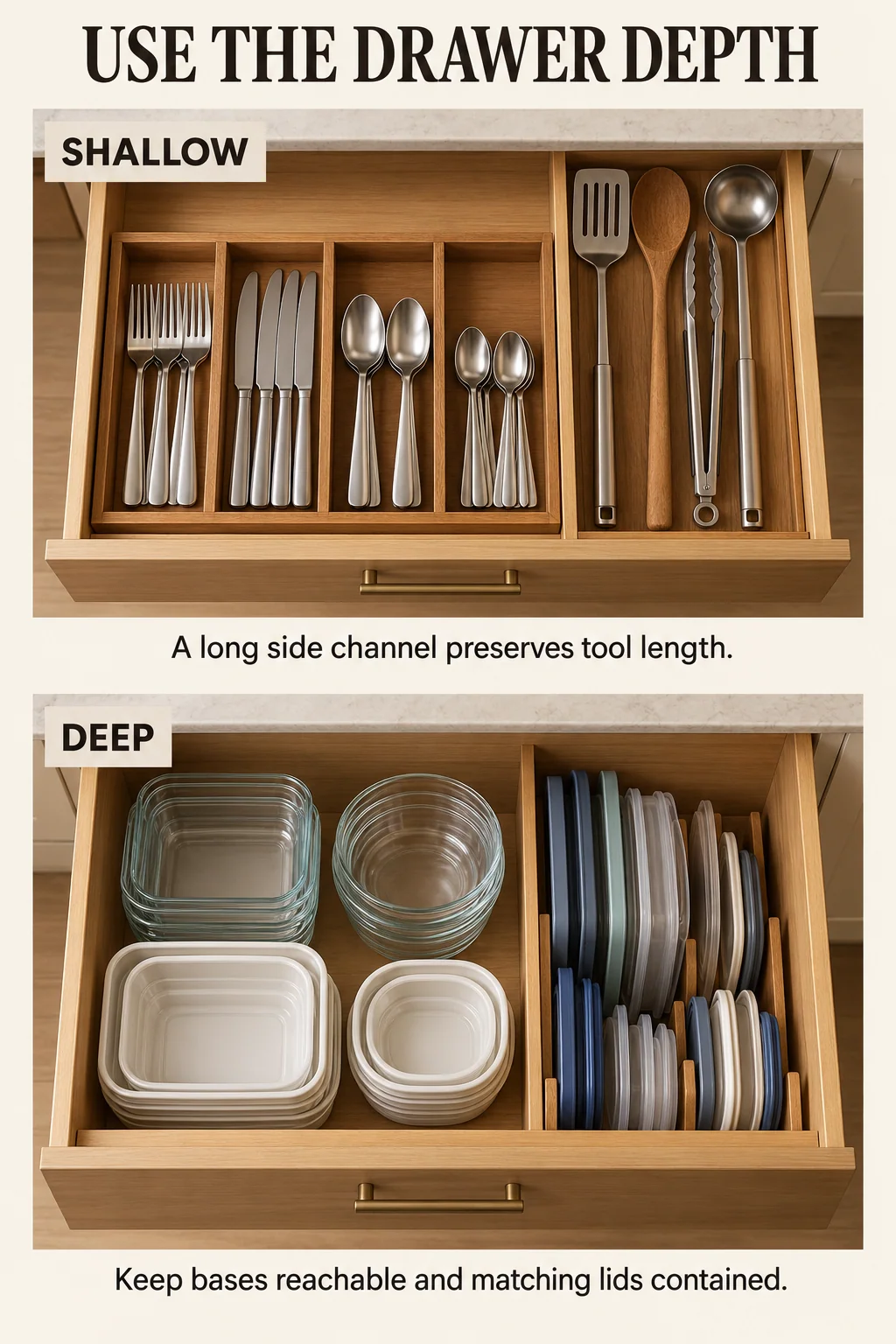
Suppose the drawer holds everyday forks, spoons, knives, a peeler, kitchen scissors and several long serving tools. Put eating cutlery in a few parallel compartments at the front. Give the peeler and scissors a separate space where their outlines remain visible. Place the long serving tools in a full-depth side channel rather than diagonally across smaller compartments.
The side channel is useful because it preserves the tools' length without wasting the whole drawer on oversized divisions. Try lifting the longest item with the drawer only as far open as you normally use it. If you must remove neighboring pieces first, the channel needs more access or the item needs another home.
Move rarely used serving utensils to a secondary drawer if their volume prevents the everyday contents from lying comfortably. A divider does not make an overfilled pile easier to retrieve. For a small household, fewer cutlery compartments may be enough; for a shared kitchen, a simple label can help people return similar-looking tools to the right group.
Give a deep container drawer a matching system
For a deep drawer of food-storage containers, pair every base with a usable lid first. Remove the orphaned pieces from the working group until their partners are found. Nest compatible bases in short stacks, with the most frequently used sizes nearest the front. Store matching lids vertically in a contained section if the lids and divider fit below the closing clearance.
This arrangement lets you choose a base and find its lid without lifting a heap of unrelated plastic. Keep glass containers in manageable stacks according to their design and handling requirements; nesting is not permission to force incompatible shapes together. Leave enough room to lift a stack without scraping it against the drawer sides.
If the drawer is too shallow for vertical lids, lay each size in its own low stack instead. If it is very deep, a removable upper tray can be useful only when lifting or sliding it does not make the lower contents a nuisance. Put occasional items underneath, rather than burying the container you use every morning.
The same visibility principle helps in a small pantry, but drawers have a closing limit that shelves do not. An extra tier is worthwhile only when the complete arrangement still moves freely.
Find the cause of the jam
A drawer that stops halfway often has an object projecting above the available height. Open it gently, identify the interference and reposition or relocate that item. Do not push harder to compress the contents. If the mechanism itself is damaged or sticking when empty, organization will not repair it.
If inserts slide, check that their dimensions suit the drawer and that any liner is compatible with the surface. Avoid building a thick stack of liners that raises the contents into the frame. A better-fitting tray may solve the movement more cleanly.
Repeatedly unmatched lids mean the put-away method is too ambiguous or the collection has more formats than you can manage. Group by actual fit, not merely by color. If a lid looks right but does not close its container, keep those two families separate rather than expecting everyone to remember the difference.
Let the arrangement survive washing-up
Return the contents after a normal dishwasher load and notice where the system slows you down. A category that requires precise stacking every time may need a wider compartment or fewer pieces. A tool that repeatedly lands elsewhere may be stored too far from its task.
Keep the most-used items at a height and depth the household can reach comfortably. In a rental, removable trays can provide useful boundaries without altering cabinetry. Reserve separate storage for cleaning supplies, following the practical constraints in the under-sink organization guide; the utensil drawer should not absorb every homeless kitchen item.
Change the one division that fails first. You do not need to empty a working drawer again because the scissors have taught you something new.