If finding the rice requires moving three jars, the pantry has an access problem, even if every jar matches. A small pantry works better when the things you use together are easy to see, remove and put back. More containers help only when they improve one of those actions.
Measure the opening, then rehearse the movement
Empty one shelf at a time if clearing the whole pantry would overwhelm the kitchen. Group the food you remove by how you use it: breakfast, quick dinners, baking or another category that fits your household. Notice the awkward shapes before deciding that everything needs the same container.
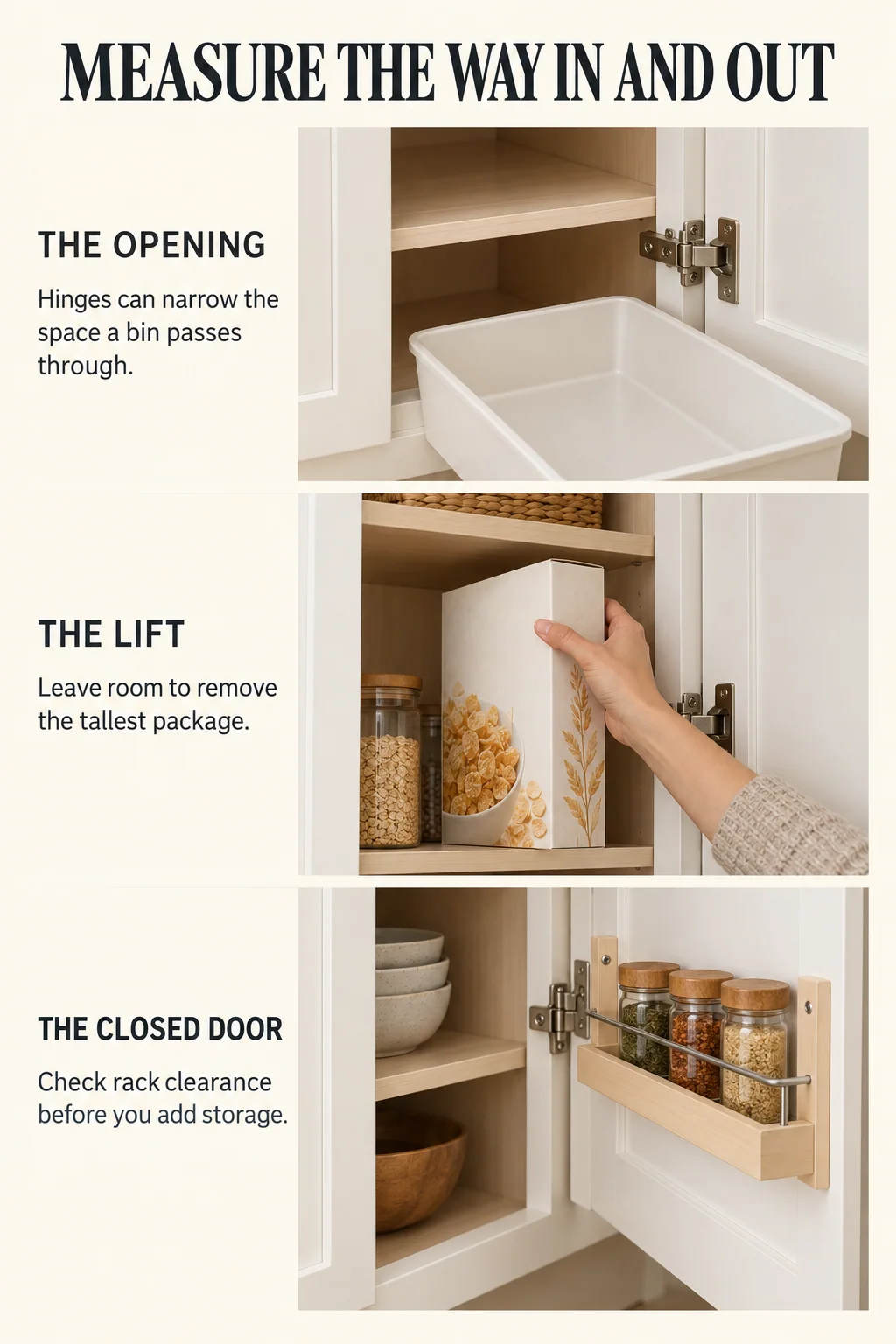
Measure the usable shelf width and depth, but also the narrowest opening through which a bin must pass. A face frame, hinge or partly open door can make that opening smaller than the shelf behind it. Check the vertical space needed to lift an item out, not only the height needed to park it on the shelf.
Use a box you already own to rehearse the movement. Can you pull it forward without hitting the hinge? Can you reach what is behind it without taking everything out? If you are considering a door rack, check the closed-door clearance against the shelf contents and follow the rack's mounting and load instructions. A photograph of an open pantry cannot answer those questions.
A shallow cupboard needs visibility more than layers
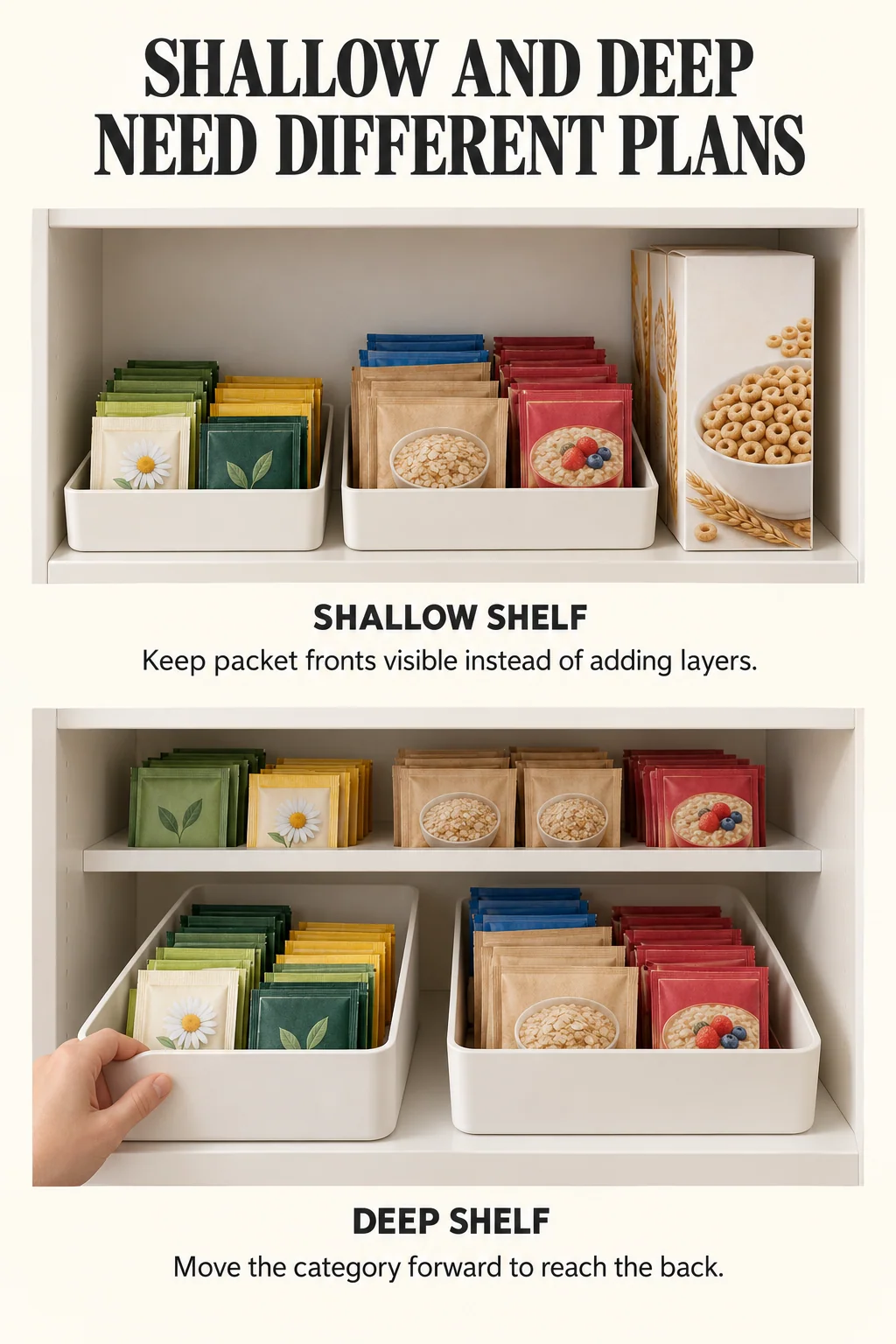
Consider an illustrative cupboard with a usable shelf 24 inches wide and 10 inches deep. This is an example for planning, not a recommended standard size. Suppose breakfast packets and tea fit in two existing shallow trays, each 9 inches wide and 8 inches deep. Together they occupy 18 inches of shelf width, leaving 6 inches for a narrow box or breathing room, before allowing for any protruding handles.
Keep the packet fronts visible and put the tray you use most often closest to the easiest reach. Stand tall cereal boxes beside the trays on a shelf with enough vertical space, rather than stacking several trays in front of them. If the opening is too low to remove a box upright, move it to another shelf. Forcing it diagonally past a heavy jar every morning is not a useful storage system.
Retrieve the tea, then return it with one hand. If the tray must be lifted out to get a single packet, a lower-sided tray may be more useful. If the packets fall over, retain them in their original box with the top opened neatly. Decanting is optional; the package may already be the right shape for the job.
For a household that eats breakfast at different times, keep the shared items together and place occasional baking supplies elsewhere. If you use a small pantry mainly for dinner ingredients, give the same convenient shelf to those foods instead. Frequency matters more than an attractive label.
Deep shelves need a route to the back
Now consider a different illustrative shelf, 30 inches wide and 18 inches deep. A shallow front row with unrelated items hidden behind it makes the rear difficult to inspect. Try two movable category bins placed side by side, sized to pass through the actual opening. Do not assume that two nominal 15-inch bins will fit: rims and handles count, and a little movement space is useful.
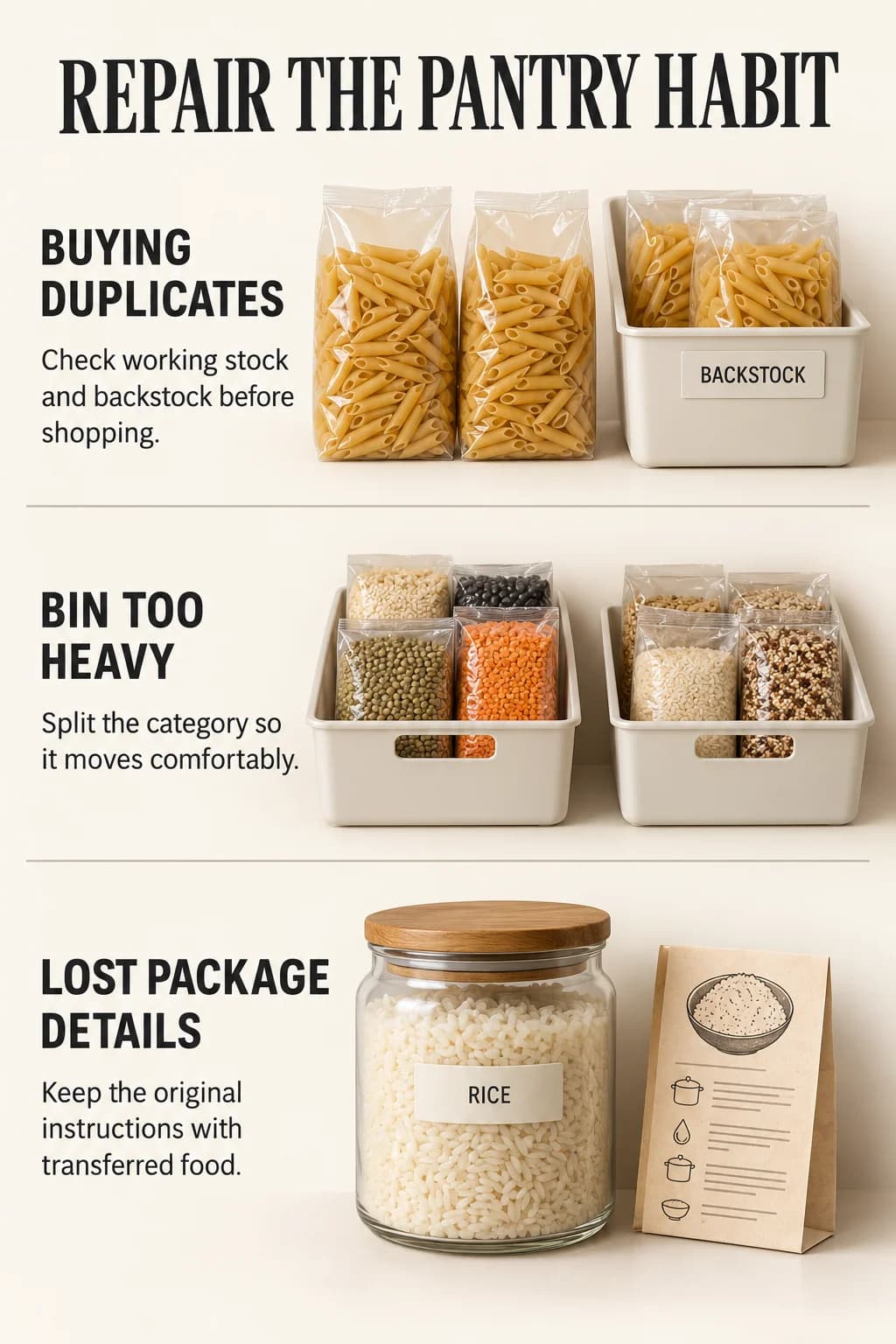
Use one bin for pasta and its usual accompaniments, another for baking packets. Keep the bins light enough to move comfortably when full. Place sealed duplicate packages behind or beside their active category only if you can reach them easily; otherwise give duplicates one clearly marked backstock area on another accessible shelf. Record what is there on a short list rather than trusting a hidden row to remind you.
A riser can help distinguish small cans when it leaves enough room to read and retrieve the rear row. It is less useful when tall packages block that row anyway. A turntable may suit a group of bottles, but its circular shape will not fill every rectangular corner. Choose the arrangement for the actual items, not the organizer's reputation.
Test this layout with a normal task: take out the pasta, locate an unopened replacement and put the working package back. If that requires unloading both bins, make the categories smaller or change the rear arrangement. Useful capacity is the food you can retrieve, not the largest quantity you can fit behind a door.
Put the working stock where you can reach it
A pantry often needs less separation than a shop display. One small baking tray can hold related packets of different sizes. A breakfast area can include boxes and loose packets together. If you already use the same principle when organizing a linen closet by frequency, apply it to groceries: daily items should not be trapped behind occasional supplies.
Keep original ingredient, preparation and date information accessible. If you transfer food to a suitable food-storage container, retain the package information with it or record it clearly. Do not top up an unidentified mix of old and new contents simply to keep the container looking full. Follow the food's storage instructions; an attractive jar does not establish a new shelf life.
Reserve a modest space for incoming groceries. A shelf packed to its edge may photograph well but leave nowhere for the next packet. Before shopping, check the active category and the duplicate area together. This is more reliable than seeing an empty working jar and assuming there is no replacement.
The Home Depot pantry guide discusses zones and different storage formats. IKEA's pantry ideas also cover groceries stored across shelves, drawers and cabinets. The layouts here apply those access questions to two different shelf shapes, without requiring a particular product.
| What keeps happening | Likely issue | Useful adjustment |
|---|---|---|
| Duplicate packets disappear | Working and spare stock are scattered | Give backstock one visible home and check it before shopping |
| A bin stays on the floor | The filled category is too heavy to return | Split the group into smaller movable containers |
| Half-packets pile up | Every new package needs a decanting task | Keep suitable original packages in one low-sided tray |
| Tall boxes sit sideways | There is not enough removal space above them | Move them to a shelf with usable lifting clearance |
A system that another person can put away
Use labels that describe what belongs in a space, such as breakfast or baking, rather than labels tied to one brand or package size. Show other household users where duplicate stock lives. If the same item repeatedly lands elsewhere, ask whether its assigned place is too high, too full or unrelated to how it is used.
For fixed rental shelves, start with removable trays and package arrangement. Check shelf and organizer load limits before adding weight or hardware. Keep heavy items where they can be handled comfortably, and avoid using a tall stack as a substitute for suitable storage. The pantry should fit the people using it.
Keep cleaning supplies separate from food. If that frees pantry space but creates a crowded sink cupboard, our guide to organizing under the kitchen sink handles the separate problem of pipes, leaks and cleaning-supply access.
Leave the layout in use for a normal grocery cycle before buying more organizers. The packet that keeps falling out and the bin nobody wants to lift will tell you more than an empty shelf can.