A patterned base can make a plain doormat look deliberate. It also adds a second moving edge and another layer under the door. Before choosing stripes or checks, find out whether the landing can accommodate the stack during actual use.
Start with the lowest part of the door
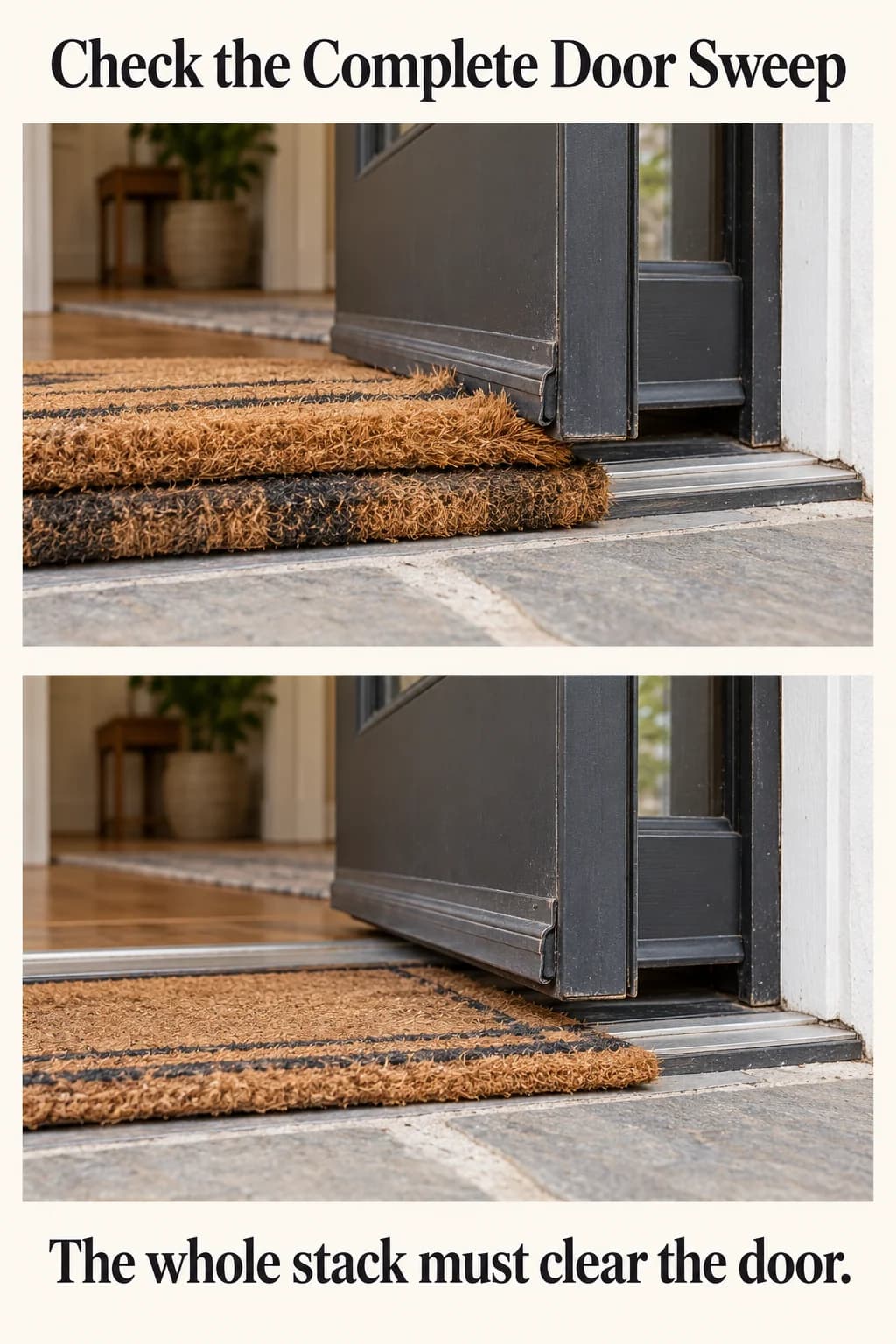
Open every door that sweeps over the proposed mat position, including the storm or screen door. Measure the smallest floor-to-door clearance through the full swing, using the lowest sweep or weather seal rather than the bottom of the wooden panel. A gap at the closed position can disappear farther along an uneven landing.
Add the base rug, top mat and any pad that their manufacturers permit. Compare their combined uncompressed thickness with that smallest gap. Do not count on the door compressing the pile as it opens: that can push the mat into a ridge. Lay the real pieces down and move the door slowly through the entire arc before leaving the arrangement in service.
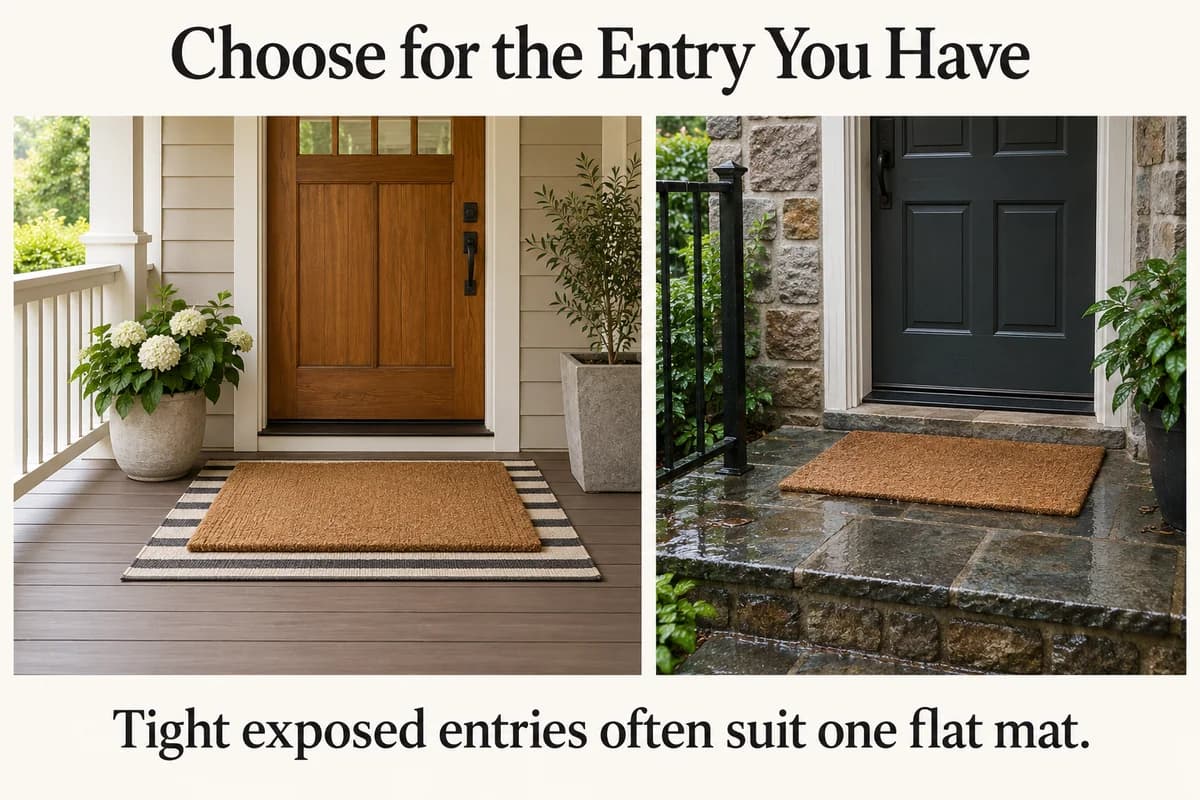
A sheltered porch with room for a border
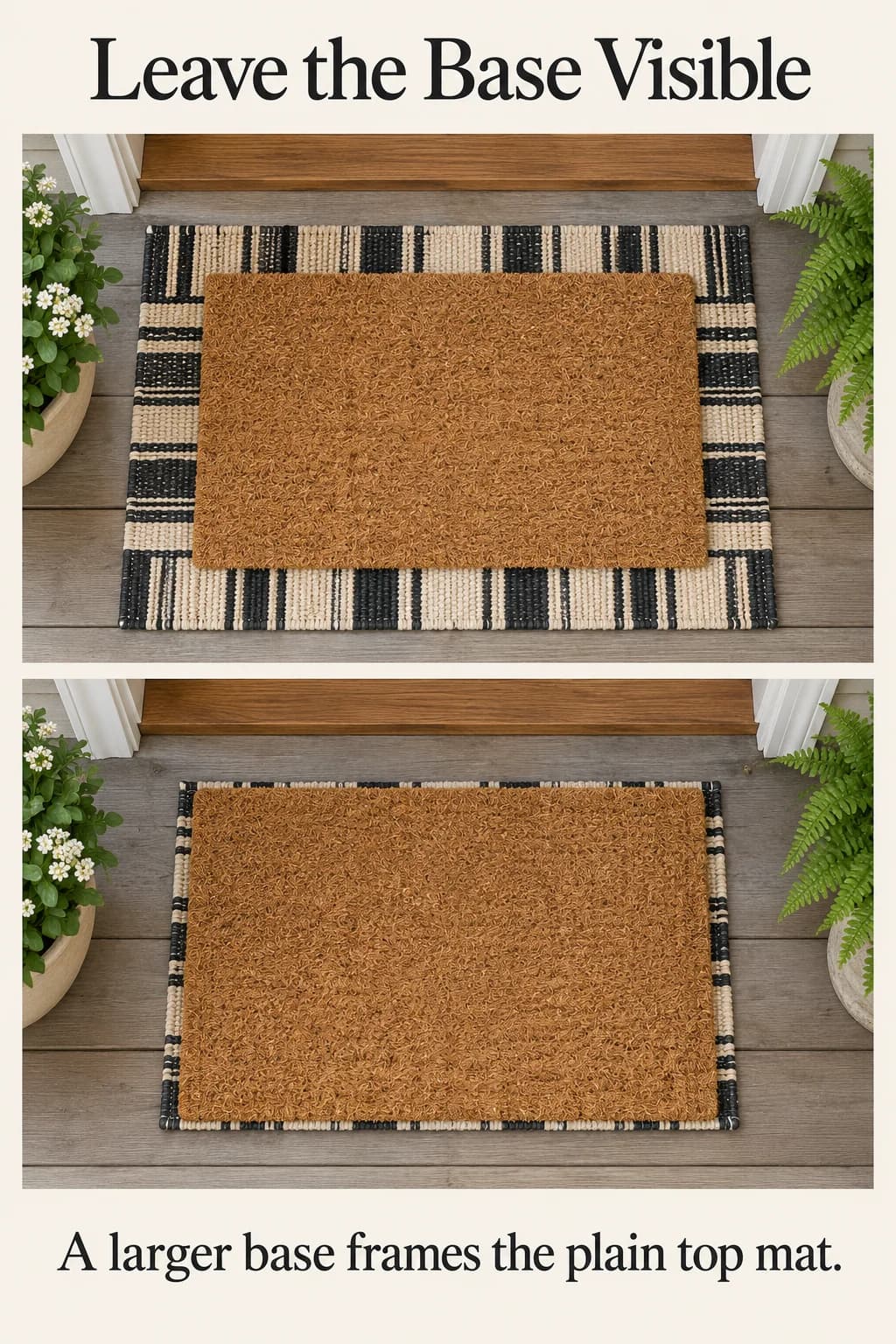
For a worked example, take a level covered landing 72 inches wide and 60 inches deep. Center a base rug 60 inches wide and 36 inches deep beneath a top mat 36 inches wide and 24 inches deep. The exposed base is 12 inches at each side and 6 inches at the front and back. Subtract the matching dimensions and divide each difference by two; the border need not be equally deep on all four sides to look intentional.
This leaves 6 inches of landing beyond either side of the base rug. Its depth leaves 24 inches of landing to allocate in front of and behind it. Check where the threshold, landing edge and walking route actually fall rather than automatically centering the whole stack on the porch depth. Neither mat should hang over a step.
Suppose the base measures one eighth of an inch thick and the top mat one half inch. Their stack is five eighths of an inch. The lowest measured door gap is one inch, leaving three eighths of an inch in this static calculation. That is promising for a trial, not a guarantee: edge binding, a permitted pad, door sag and curled corners all change the result. Test the assembled pieces without assuming the nominal thickness includes every raised edge.
Choose a low-contrast black-and-oatmeal stripe for the base and a plain natural-color top mat. The top mat gives shoes a clear place to land; the stripe reads around it as a border. Studio M's layering guide likewise favors a larger, flatter base and notes that sheltered placement makes the arrangement easier to maintain. Only use products whose instructions suit the surface and exposure.
A tight exposed entry where one mat wins
Now consider a landing only 42 inches wide and 36 inches deep, with an outward-opening door and rain reaching the threshold. Its smallest measured sweep clearance is three eighths of an inch. The five-eighths-inch stack from the first example exceeds that gap by one quarter inch before anyone steps on it. Changing the base pattern cannot fix the mechanical conflict.
Select a single 36-by-24-inch low-profile exterior mat as a candidate instead. Centering it across the landing leaves 3 inches on either side. A nominal quarter-inch thickness would leave only one eighth inch beneath the measured sweep, so inspect the actual binding and test the full door motion carefully. If it catches, creeps or curls, choose a thinner permitted product or leave the sweep area clear. That small arithmetic margin is not a claim that the mat is automatically suitable.
Here the single mat is also easier to lift and dry than a layered pair. Give it an integrated border or restrained stripe if you want a finished appearance. The door color, house number and planter already provide plenty of visual interest; a second textile is optional. Our entryway rug sizing guide helps distinguish the landing footprint from a longer indoor runner.
Watch what happens after rain
Lift both layers, if used, to check underneath. An outdoor label does not mean every backing is compatible with every floor or with another mat. Chilewich's care instructions, for example, call for dry surfaces and ventilation and identify specific rubber-contact restrictions. Read the instructions for your actual products rather than treating that as a rule for every brand.
If water remains trapped, remove the stack and let the mats and surface dry fully. Repeated wetness is a reason to change the arrangement, not merely a reason to buy a darker color that hides it. A sliding base, lifted corner or bunched top mat also ends the trial until the cause is resolved with a compatible product or simpler layout.
Keep shoes and parcels off the usable landing so they do not force feet onto a raised mat edge. The entryway shoe-storage guide is useful when clutter, rather than the mat size, is narrowing the route. Finish by carrying a normal bag through the doorway, opening the door fully and turning back to close it. That everyday movement is the final test of whether the border belongs there.