A tablecloth can fit the length of a table and still hang much farther down its sides. The seating count on the package will not reveal that. Start with the tabletop dimensions and calculate each drop separately.
Choose a drop you can sit with
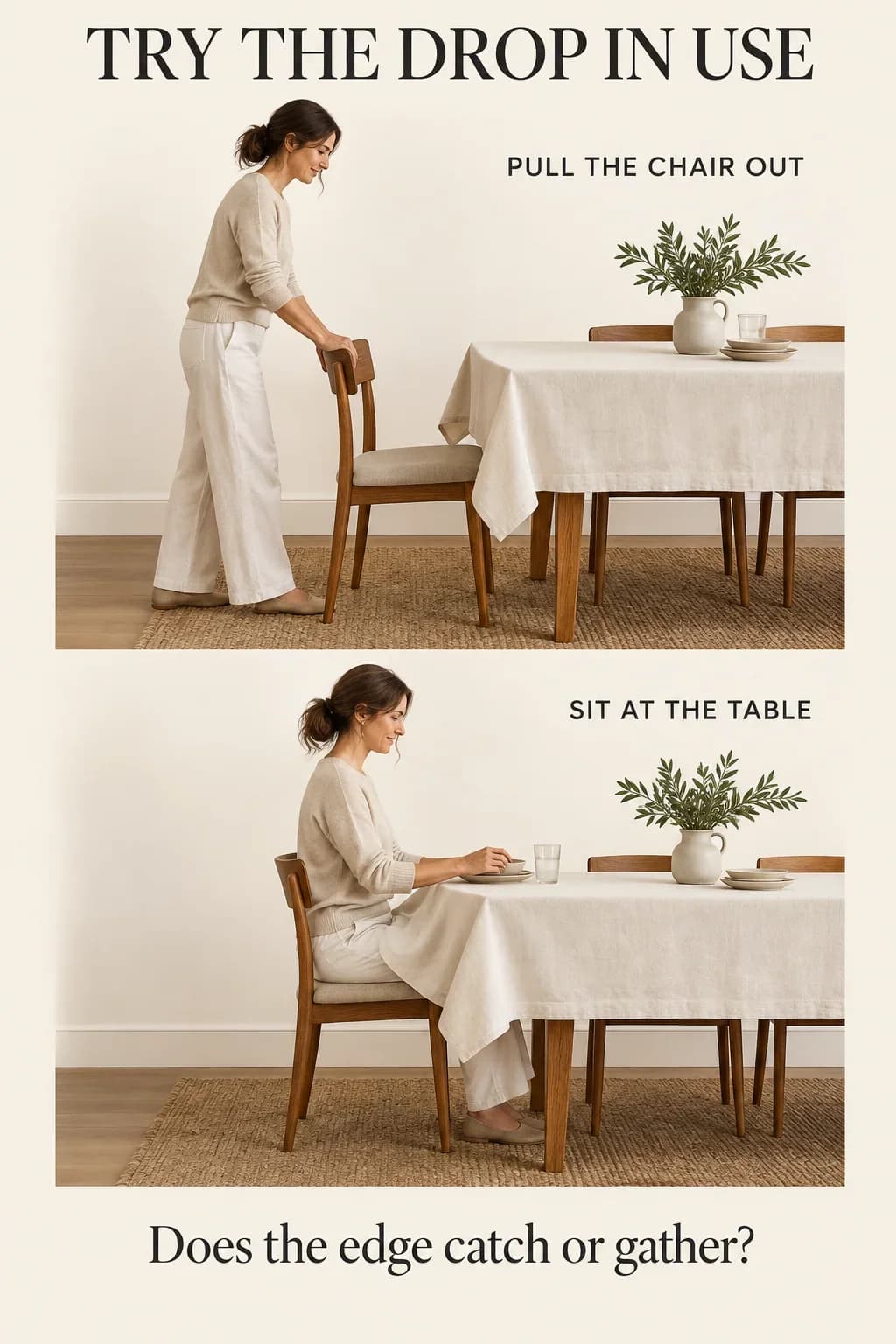
The drop is the fabric hanging beyond the tabletop edge. Before choosing a number, drape a sheet over one side and fold it to the length you are considering. Pull out a chair, sit down, bring the chair back toward the table and stand again. A drop that looks attractive across an empty room may catch between the chair and your legs.
Repeat the test at the ends, where an armchair or a different seat can change the result. With a bench, try sliding sideways into place rather than lifting the fabric out of the way for the test. The dining bench versus chairs guide explains that difference in access. Choose a shorter drop if ordinary movement repeatedly gathers the cloth onto your lap.
There is no single drop that every casual or formal table requires. A longer edge gives more fabric to the setting, but the meal still has to be comfortable. A buffet without seated guests can tolerate a different arrangement from the same table used for dinner. Keep any cloth clear of the floor where people need to walk.
Calculate the cloth, then calculate the available alternative
For a rectangular tabletop, add twice the chosen drop to both its width and length. A 36-by-72-inch table with an 8-inch target drop needs a cloth 52 inches wide and 88 inches long: 36 + 16 = 52, and 72 + 16 = 88. Measure the tabletop itself, without rounding it to a familiar advertised table size.
Suppose the available cloths are 60 by 90 inches and 60 by 102 inches. To find the actual drop, subtract the table dimension from the corresponding cloth dimension and divide by two. This assumes the cloth is centered. The 60-by-90 cloth gives a 12-inch side drop, because (60 − 36) ÷ 2 = 12, and a 9-inch end drop, because (90 − 72) ÷ 2 = 9.
| Cloth size | Side drop | End drop |
|---|---|---|
| 52 × 88 in | 8 in | 8 in |
| 60 × 90 in | 12 in | 9 in |
| 60 × 102 in | 12 in | 15 in |
The 60-by-102 cloth keeps that same 12-inch side drop but increases the ends to 15 inches. Moving either cloth off center can lengthen one edge only by shortening its opposite edge. It cannot make all four drops equal. If the sheet test confirms that 12 inches at the sides and 9 inches at the ends are comfortable, the 60-by-90 cloth is a practical compromise. If the side chairs catch the 12-inch drop, look for a narrower cloth or an alteration suitable for the fabric.
This is an illustrative sizing decision, not a claim that those sizes are available in every range. Check the dimensions of the specific cloth before ordering. Its description may use rounded measurements, and decorative edging can affect where the lowest point falls.
A round table needs a diameter, not two sides
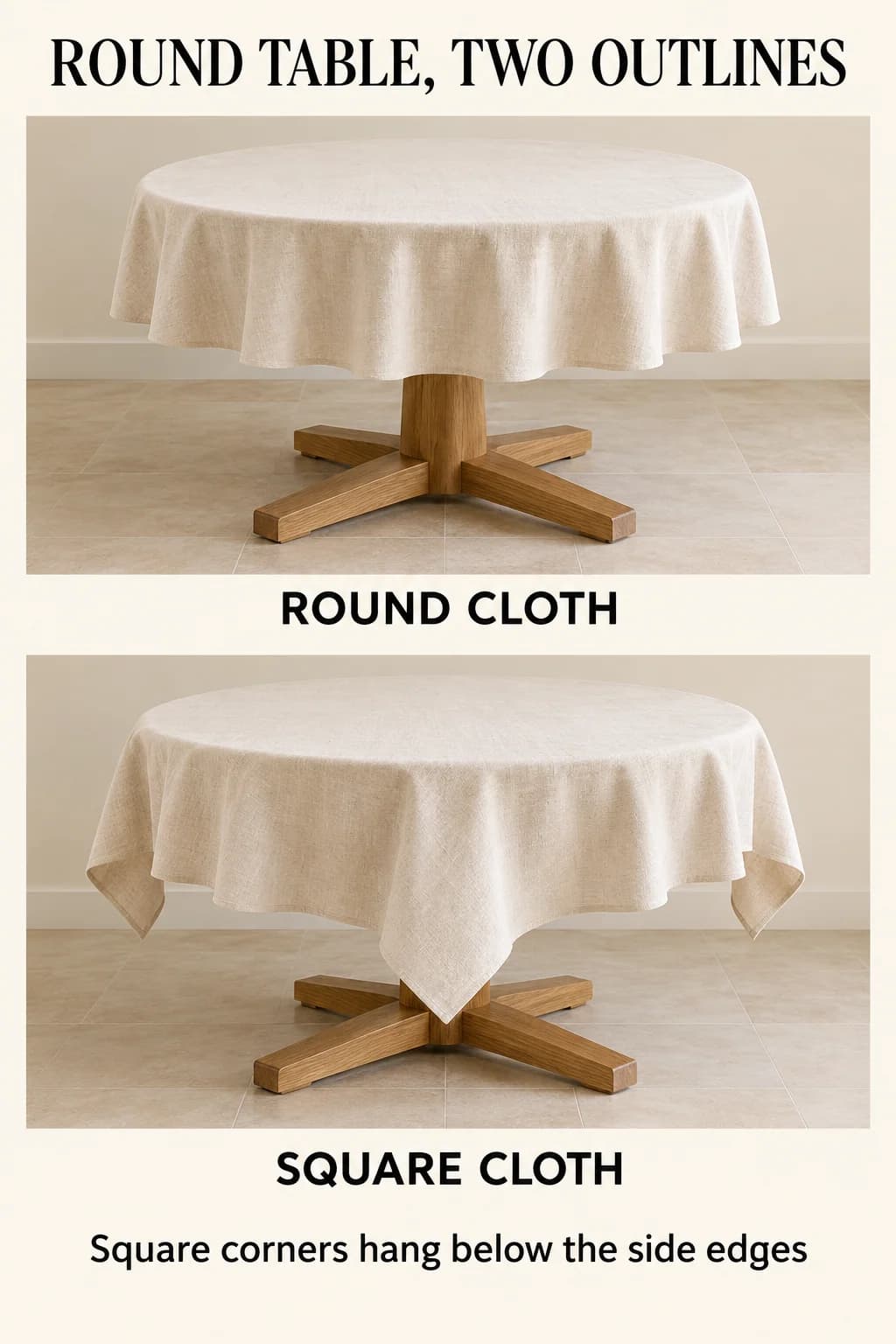
For a 48-inch round tabletop, a 72-inch round cloth gives a 12-inch drop all around: (72 − 48) ÷ 2 = 12. A 60-inch round cloth gives 6 inches. Suppose the household likes the fuller 12-inch edge but finds it gathers against the dining chairs during the seated test. The 60-inch option gives a shorter, usable finish; choosing it is a resolved tradeoff rather than a sizing error.
Check whether the package says round or square. A 72-inch square cloth is not equivalent to a 72-inch round cloth on that table. Its corners extend farther from the center and hang lower. The drop measured at the middle of a side does not describe the corner's lowest point. Test those corners beside the chairs before deciding that a square cloth solves the problem.
An oval table has a similar shape question. Record its maximum length and width, then check the outline of the cloth. A rectangular cloth can cover an oval tabletop but will make longer corner points; an oval cloth follows the curved ends more closely. Neither shape can be judged from a seating label alone.
Put the leaf in before measuring for guests
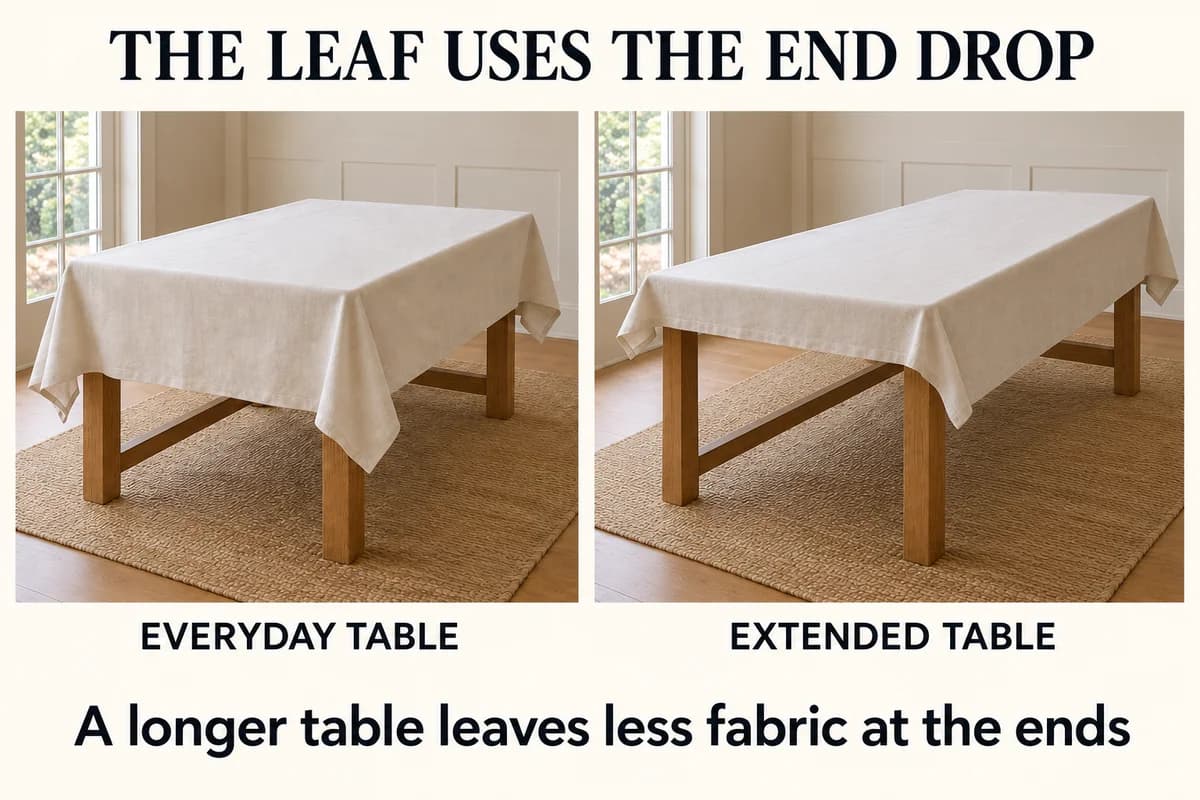
Return to the 36-by-72-inch table and add an 18-inch leaf. The tabletop is now 36 by 90 inches. The original 60-by-90 cloth still has a 12-inch side drop, but its ends have no drop at all: (90 − 90) ÷ 2 = 0. Extra table length has used up the fabric that previously hung at the ends.
A 60-by-108 cloth would restore a 9-inch end drop while retaining the 12-inch side drop. That calculation makes it a candidate for the extended table, subject to the same chair test. Keep separate notes for everyday and extended dimensions rather than buying a very long cloth and accepting excessive end fabric every ordinary evening.
Check the finished setup and the care label
Use the intended chairs, any table pad and the actual cloth when possible. Pull each chair out fully and sit at the table; do not judge clearance while holding the cloth away from it. Then arrange the centerpiece without dragging the fabric to reposition it. The dining table centerpiece guide covers the remaining space for dishes and conversation.
For laundering, follow the particular cloth's care instructions and the maker's dimensional guidance. Do not add a universal shrinkage percentage to every cotton or linen cloth. If a cloth you own has already changed size, measure it after the prescribed care and recalculate its drops. Those actual dimensions are more useful than the number still printed on its old packaging.