The softest rug pad is not necessarily the right one for an entryway. Extra thickness can lift a rug into the path of a door, while a cushion-only pad may do little to stop a small runner moving. Choose the pad in this order: floor compatibility, grip, clearance, then the amount of cushion you want.
The floor gets the first vote
Identify the floor underneath the rug, including its finish where possible. Wood, laminate, vinyl, tile and carpet are not interchangeable surfaces. Check the flooring manufacturer's care instructions and the pad manufacturer's compatibility guidance for the particular pairing. If they disagree, do not treat a broad “safe for floors” claim as permission to ignore the flooring instructions.
For example, Shaw's resilient-vinyl guidance advises against latex or rubber-backed mats on those floors because of possible discoloration. That is why a natural-rubber recommendation for another surface cannot simply be transferred to vinyl. An unknown floor in a rented home is a reason to ask the landlord or installer before choosing a backing.
Newly finished or installed flooring may also have waiting periods or other restrictions. Follow the product-specific guidance; a pad that is suitable eventually may not be appropriate immediately. Underfloor heating needs its own compatibility check for both rug and pad. Neither a thin profile nor a natural-material label establishes that suitability.
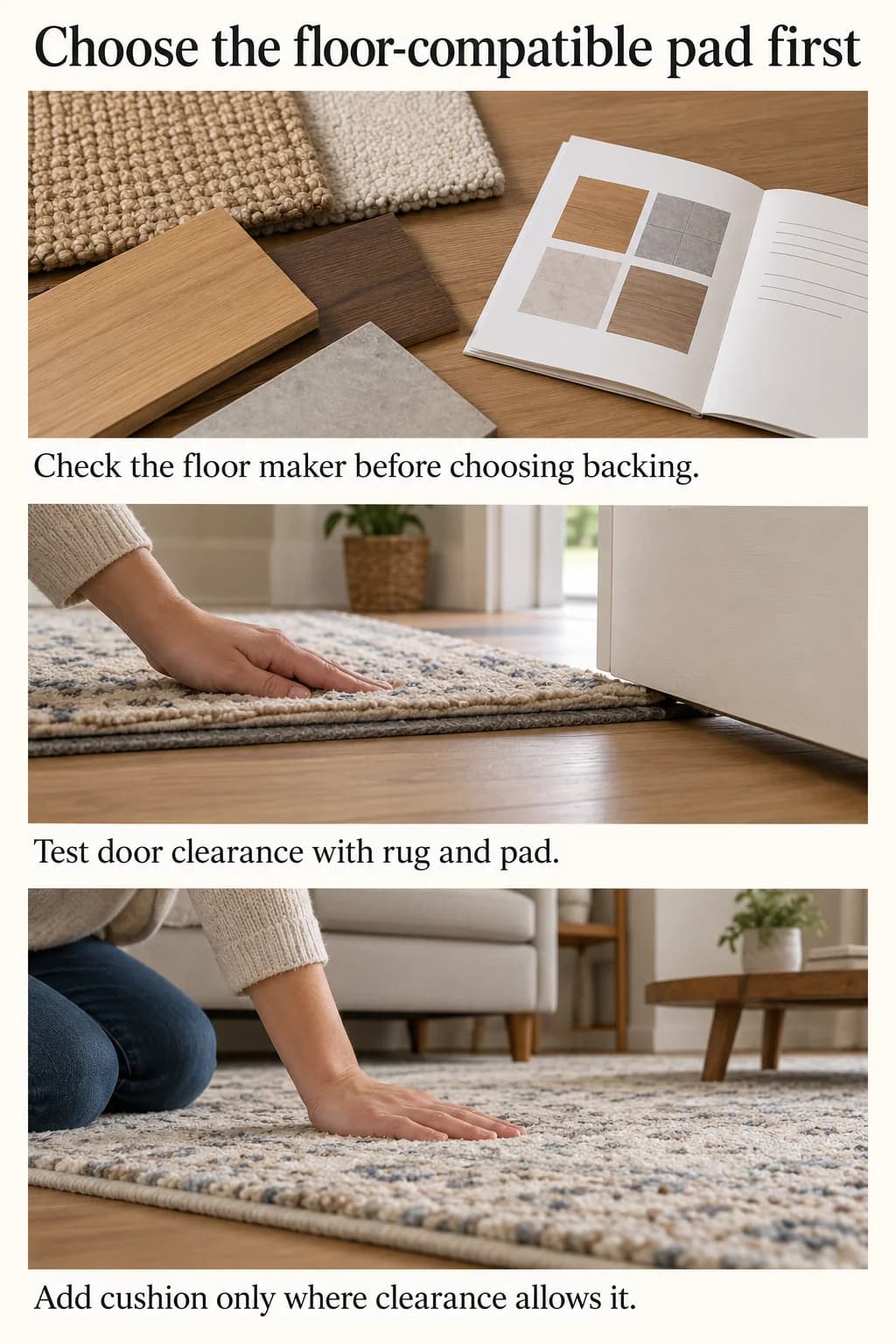
Decide whether you need grip, cushion or both
A felt pad can add cushioning and separate a rough rug backing from the surface below. Felt alone should not be assumed to grip a smooth floor. A grippy backing serves a different purpose: helping resist movement. Combination pads aim to supply both functions, but they still need to be compatible with the floor and rug.
Thickness affects how the rug feels and how high its edges sit. RugPadUSA's selection guide distinguishes cushioning from nonslip performance and notes the importance of door clearance. Use that distinction to define the job, rather than choosing the thickest pad available.
A large rug partly held by furniture may move less than a light runner in an open passage, but furniture does not make a slippery edge harmless. Check the exposed areas people actually step on. The useful test is how the complete rug-and-pad combination behaves in that location, not how substantial the pad feels in your hand.
Work through two different rooms
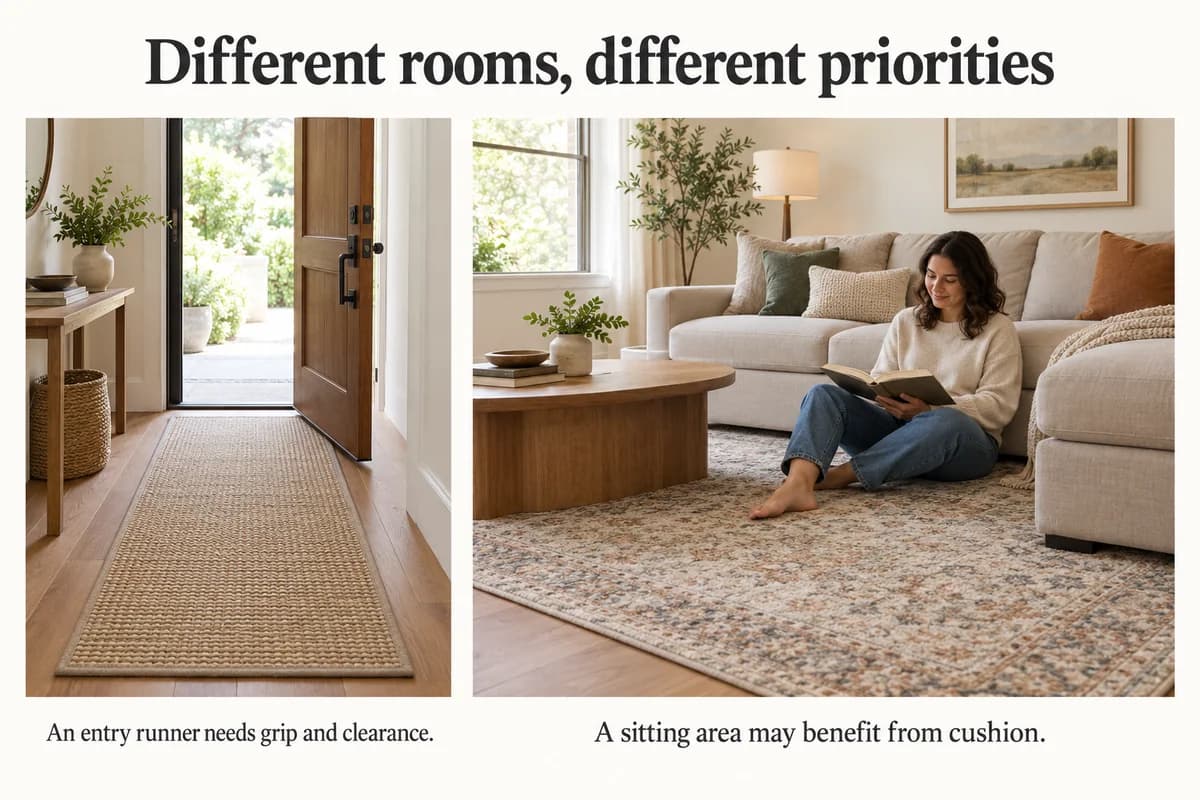
A runner just inside the front door
Imagine a lightweight runner on a hard floor, with an inward-opening door passing over one end. Start by confirming compatible backing materials, then look for the needed grip in a low-profile construction. Add the rug's own thickness to the pad's lift when judging clearance.
Lay the combination in position and open the door through its full swing. Check where the door comes closest, including uneven parts of the floor. If it brushes the rug, the solution may be a thinner compatible pad, a thinner rug or moving the runner beyond the swing. Do not cut a pad away only beneath the door and leave an uneven hump under the rest of the runner.
Then walk the usual route and inspect the corners. If the runner still slides, more cushion is not the answer. Reconsider grip and compatibility, and stop using a combination that remains unstable. The guide to entryway rug size helps with the separate question of where the rug should sit in the room.
A living-room rug where people sit on the floor
Now imagine a larger rug in front of a sectional, with no door crossing it. A denser cushioned pad may be useful because sitting comfort matters and there is more freedom to add height. Choose a compatible construction, then test the edge nearest the main walking route before treating the whole room as a cushion-first space.
Put the furniture back in its intended position and check for ridges where the rug transitions away from furniture weight. A thicker pad should not leave a conspicuous unsupported border or make a chair feel unstable. If the rug is already plush, a modest pad may supply enough comfort; more thickness can add awkwardness rather than a noticeable benefit.
If the furniture itself is pulling the rug into an odd position, revisit the rug layout beneath a sectional. A pad cannot compensate for a rug that is too small for the layout you are trying to create.
Measure the rug you own, not just its label
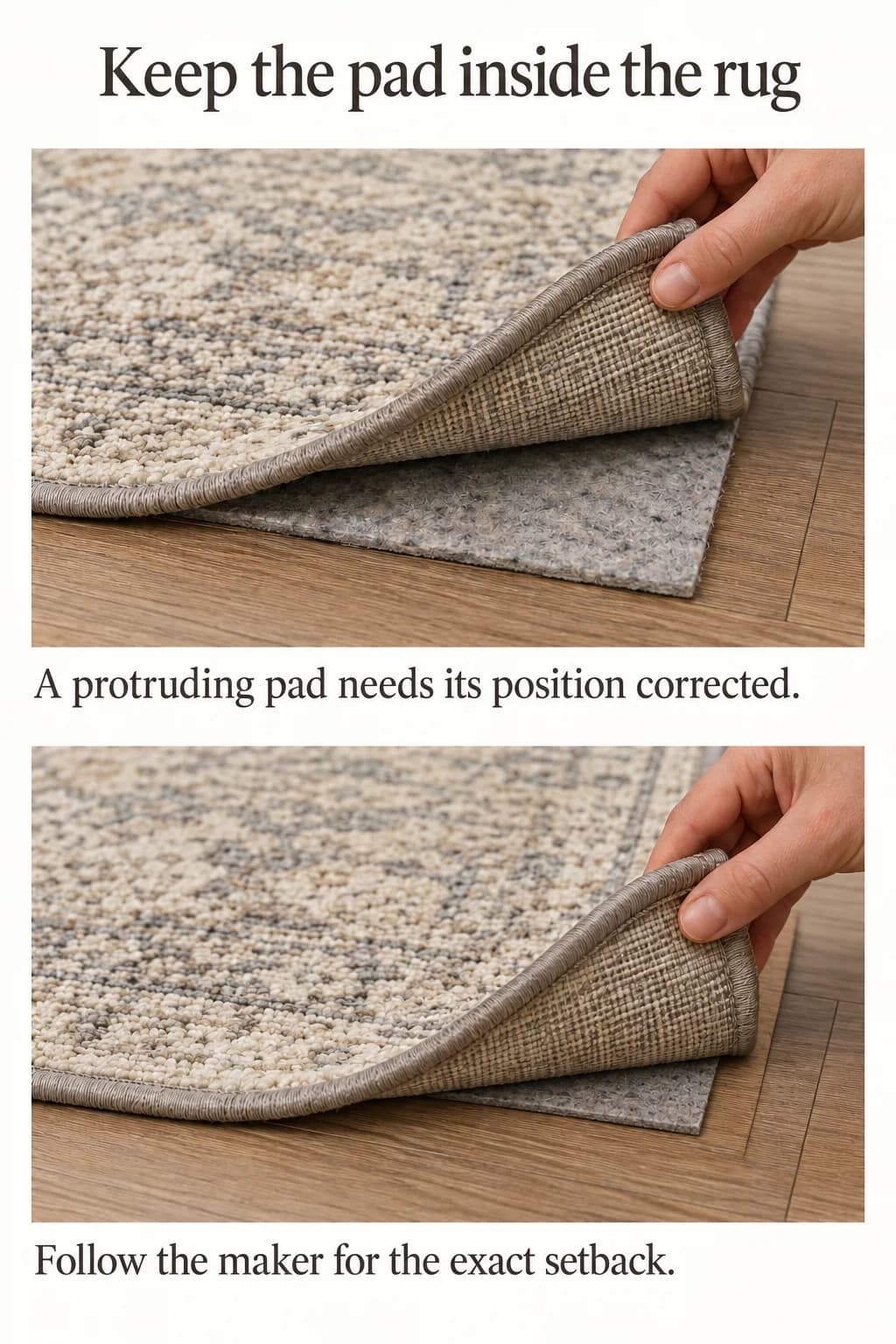
Measure the actual rug after it is lying flat. Nominal sizes can differ from the finished dimensions. The pad should normally sit inside the rug's perimeter so it is hidden and the outer edge can settle, but follow the recommended setback for the pad and rug you choose.
For an arithmetic example only, a rug measuring 60 by 96 inches with an instructed one-inch setback on every side would need a pad measuring 58 by 94 inches. You subtract twice the setback from each dimension. This is not a universal instruction to cut every pad one inch short; it shows how to apply a product's own requirement correctly.
Center the pad and check all sides before trimming. Use the maker's cutting instructions and a protected work surface. An irregular rug may need its actual outline checked rather than a rectangle copied from a size label. Follow any orientation instructions too: different constructions are not necessarily reversible.
A pad cannot solve every curl or wrinkle
If a corner curls, check whether the pad protrudes, sits off-center or creates a thick step near the edge. Correct those placement problems first. A rug with persistent curling may need the rug maker's care advice; stacking another pad beneath it can make the height problem worse.
For a rug placed over carpet, use a solution specifically intended for that application. A hard-floor grip pad is not automatically suitable for holding one textile surface over another. If the rug continues to creep or buckle, reconsider the combination rather than adding layers until it appears fixed.
Lift the rug periodically according to its care guidance and inspect for trapped grit, moisture or backing deterioration. Clean and dry the floor as directed before replacing it.