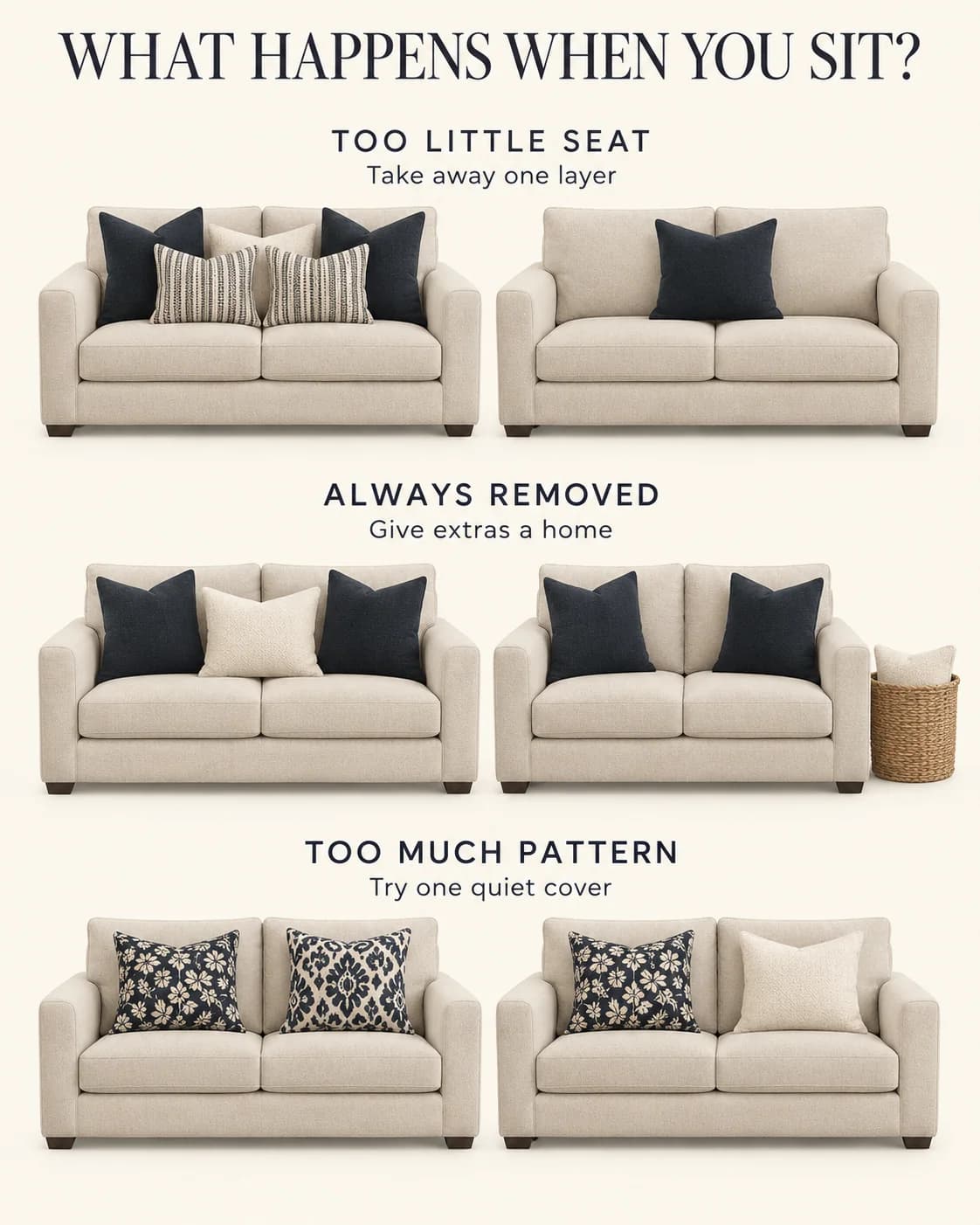
A good pillow arrangement should survive someone sitting down. If the first move is always to clear the sofa, start again with fewer pillows rather than finding a more elaborate way to stack them.
Use what you already own for the first pass. Moving a cushion tells you more about the space than buying another one.
Reserve the seats before styling the ends
Remove the decorative pillows and sit where you normally sit. Notice the corners, the middle seat and the spot used for reclining. Those are not empty spaces waiting to be decorated; they are the sofa's working areas.
Put back one pillow at each end. Sit again. A pillow tucked into a deep corner may make the seat more comfortable, while the same pillow on a shallow seat may push you forward. Keep or remove it based on that difference.
If a pillow is only decorative, it can still stay. Just be clear about where it goes when someone wants the seat.
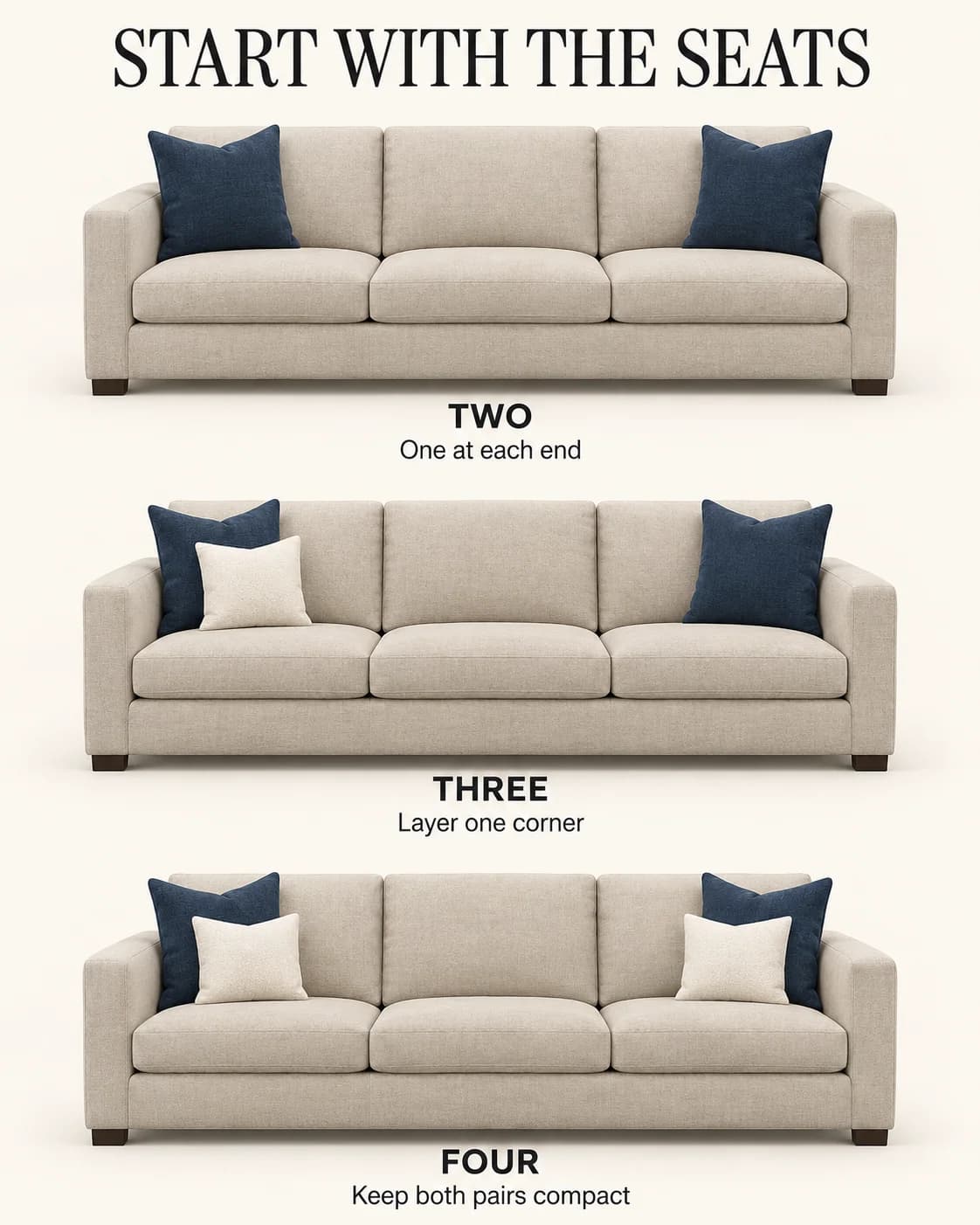
Try two, three or four, in that order
Two: one at each end
This is a useful starting arrangement for a small sofa or a clean, symmetrical look. Use matching covers if you like order, or two different covers with a color in common.
Do not make the pair larger just to fill the sofa visually. Check the usable depth behind your knees and the comfort of the seat with the pillows present.
Three: a pair at one end, one at the other
Add a smaller pillow in front of one end pillow. This makes one corner more layered while leaving the center clear.
Choose the less-used corner for the pair if that reflects how the sofa is occupied. An arrangement does not have to be symmetrical to be intentional, but asymmetry is not a requirement either.
Four: two pairs, only if the seats remain useful
Try a larger pillow behind a smaller one at each end. The difference in size lets both covers show. If the layers spill into the seats, remove the front pair or use one smaller accent.
These counts are examples, not a progression you have to complete. Two well-placed pillows may be the finished arrangement.
Give each fabric a job
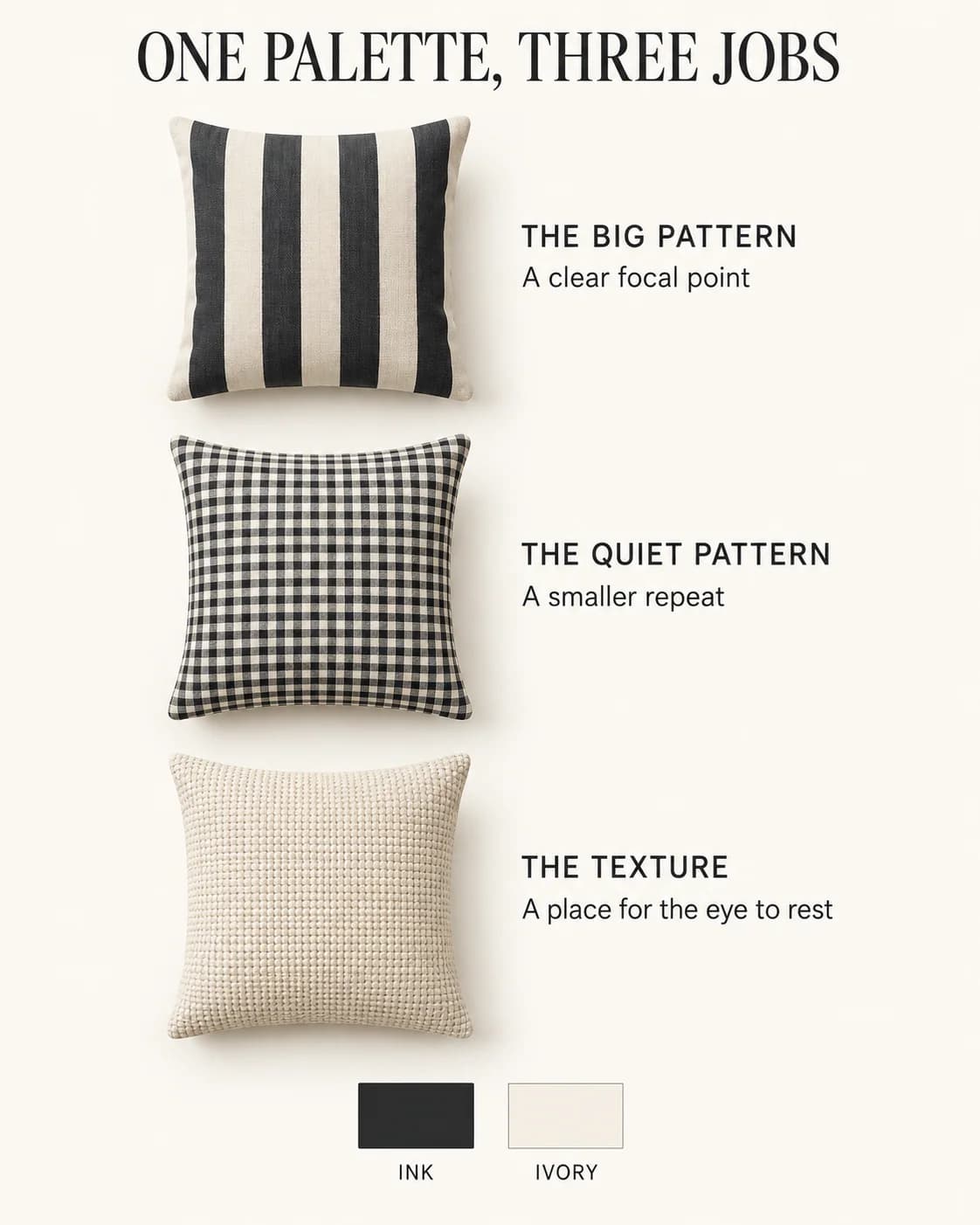
Choose one cover you want to notice first. It might be a broad stripe, a botanical print or a strong solid color. Let another pillow repeat a color from it without repeating every detail.
A useful three-fabric experiment is a large pattern, a quieter small pattern and a textured solid. Janet Clark demonstrates different pattern scales in her own room, while also emphasizing the ability to sit comfortably. Janet Clark at Home.
For example, pair an ivory-and-ink broad stripe with a small ink check and plain ivory woven fabric. Keep the colors connected while the pattern sizes differ. You can use the same idea with all solids by varying texture instead.
Adapt the arrangement to the sofa, not its label
A low back may disappear behind tall cushions. Try fewer pillows or a lower rectangular shape if you want the sofa's outline to remain visible.
On a sectional, inspect the corner and chaise separately. A corner pillow may be useful support; a decorative pile where someone stretches out may be in the way. You do not have to decorate every junction.
A decorating guide from Southern Home and Hospitality similarly distinguishes between sofa shapes rather than treating them as identical. Its specific sizes are options, not a universal fit prescription. Southern Home and Hospitality.
If the whole seating area still looks unsettled after the pillows are simple, check the larger relationships separately: the rug under a sectional or the art above a sofa. More cushions cannot solve every room-scale problem.
Run the everyday reset
Use the sofa normally for an evening. Notice which pillows stay, which become support and which land elsewhere.
Move the useful ones to their natural places. Remove a decorative extra if it continually occupies a needed seat. If covers seem busy, swap one patterned cover for a solid before changing all of them.
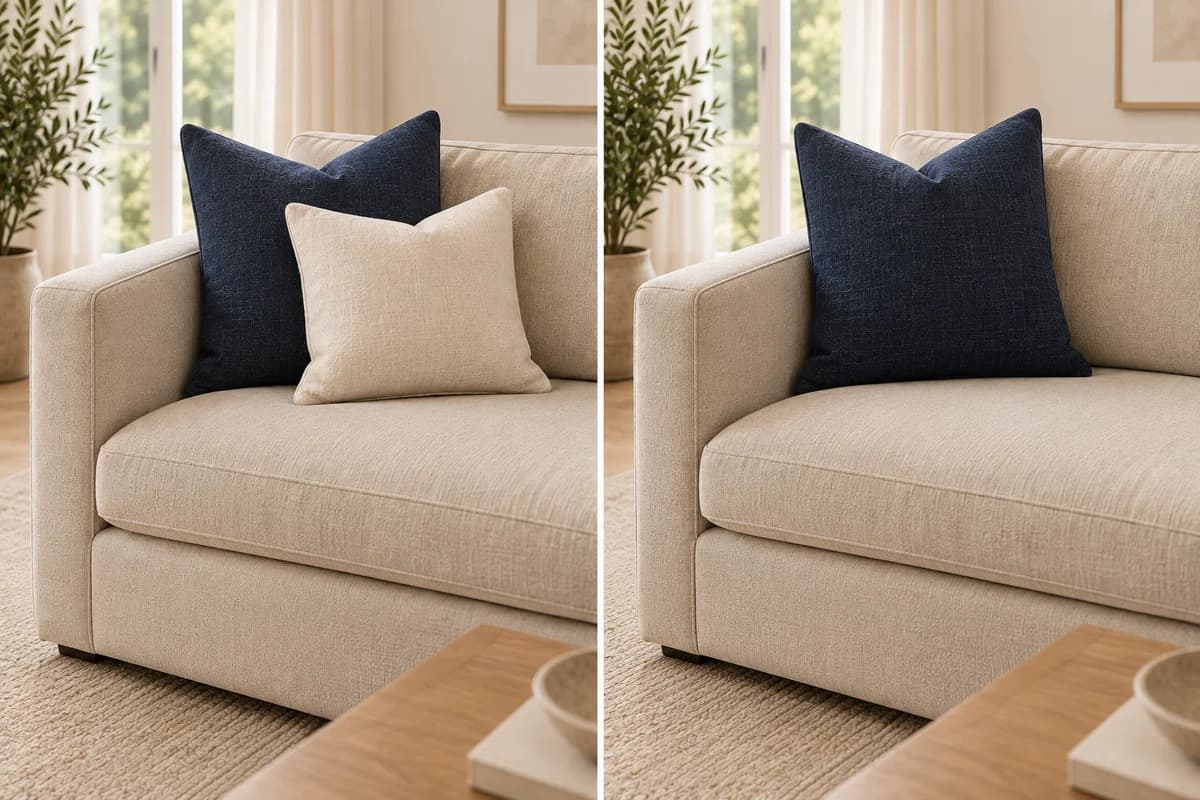
Compare the same seat with one less layer
Photograph the same end of the sofa with a layered pair, then with only the rear pillow. Keep the sofa, camera and remaining pillow unchanged.
The point is to see how much seating depth the extra layer occupies, not to declare a sparse sofa superior. Your comfortable sitting arrangement is the deciding evidence.
Frequently asked questions
Do throw pillows have to be an odd number?
No. Two can look deliberate, and four can be balanced or asymmetrical. Choose the arrangement that suits the sofa and leaves the seats usable.
Should both ends of the sofa match?
Only if you want that effect. Matching one color or texture can connect different pillow shapes without making the two ends identical.
What if I remove every pillow before sitting?
Try fewer or smaller pillows, or none. If you want occasional decorative extras, give them a nearby storage place instead of assuming the seat has to hold them all day.