Put your phone in the bag first. Add the wallet, keys and other things you normally carry, then put on the layer you will actually wear. An empty bag over a thin tee is a poor stand-in for a loaded bag over a coat.
Find the adjustment your strap actually has
A sliding adjuster changes length continuously; a buckle usually gives you a series of existing holes. Take the bag off while moving the hardware, keep the strap flat through the slider, and secure any loose tail in its keeper. On a buckle, seat the pin fully in a hole. Check that removable clips have closed and that the strap has not twisted around an attachment ring.
Make one small change at a time. With a buckle, that might be one hole; with a slider, move it a little and put the bag back on. Do not force hardware past a sewn stop or improvise a new hole while wearing the bag. A fixed-length strap may need replacement rather than a knot that changes how it lies on your shoulder.
Start with reach, not a prescribed position on the hip. Can you open the bag and retrieve your phone without lifting the entire bag or bending sideways? Next walk, turn and sit. The setting has to work for the bag's depth and your clothes as well as your height.
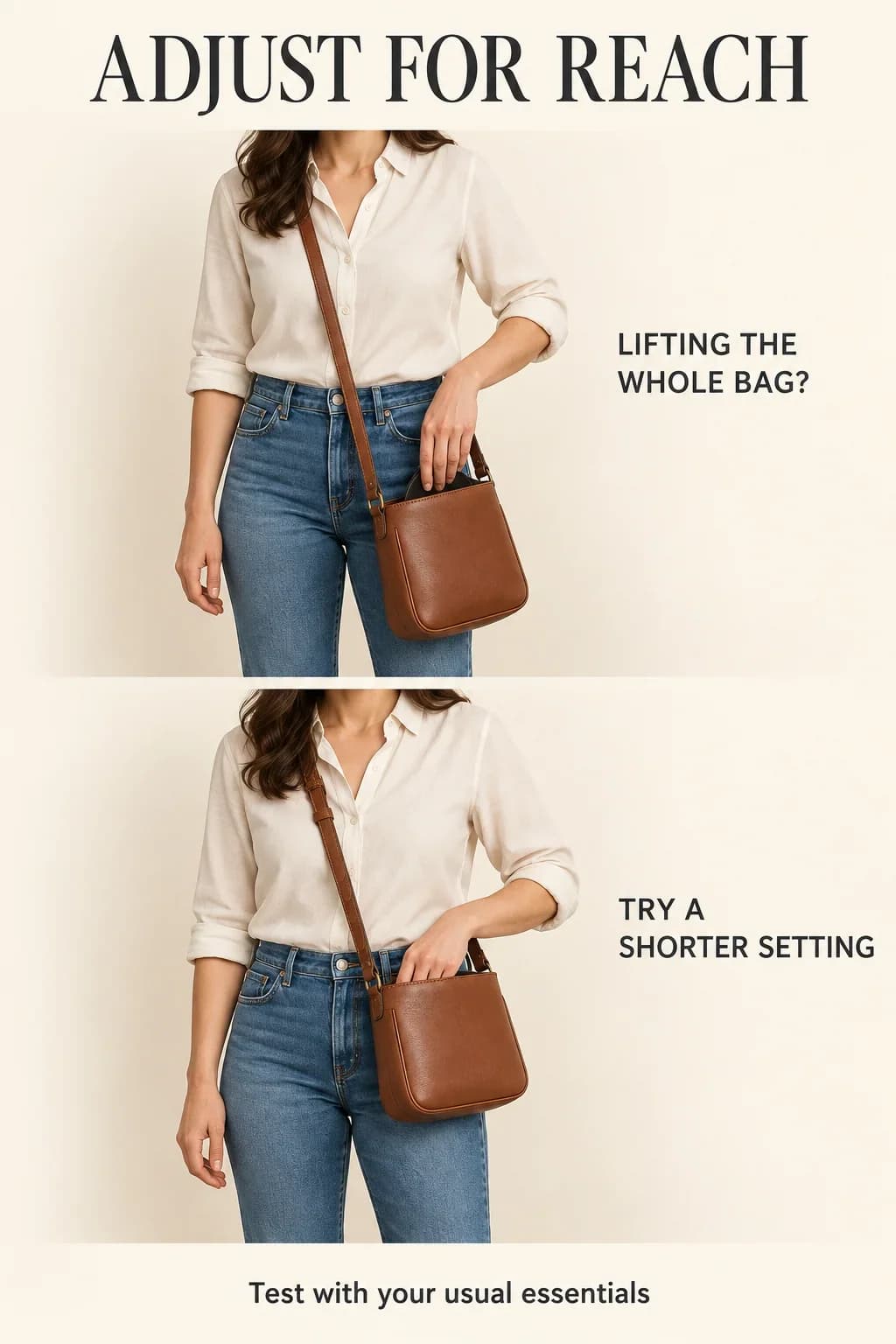
One loaded bag, two different clothing setups
Over a shirt: fix the low opening, then check the chair
Imagine a medium brown crossbody carrying a phone, small wallet, keys and glasses over an ivory shirt and straight jeans. At the first setting, its opening sits below the hand's comfortable reach and the base taps the thigh with each step. Shorten the strap a little, put it on again and try the phone without lifting the bag.
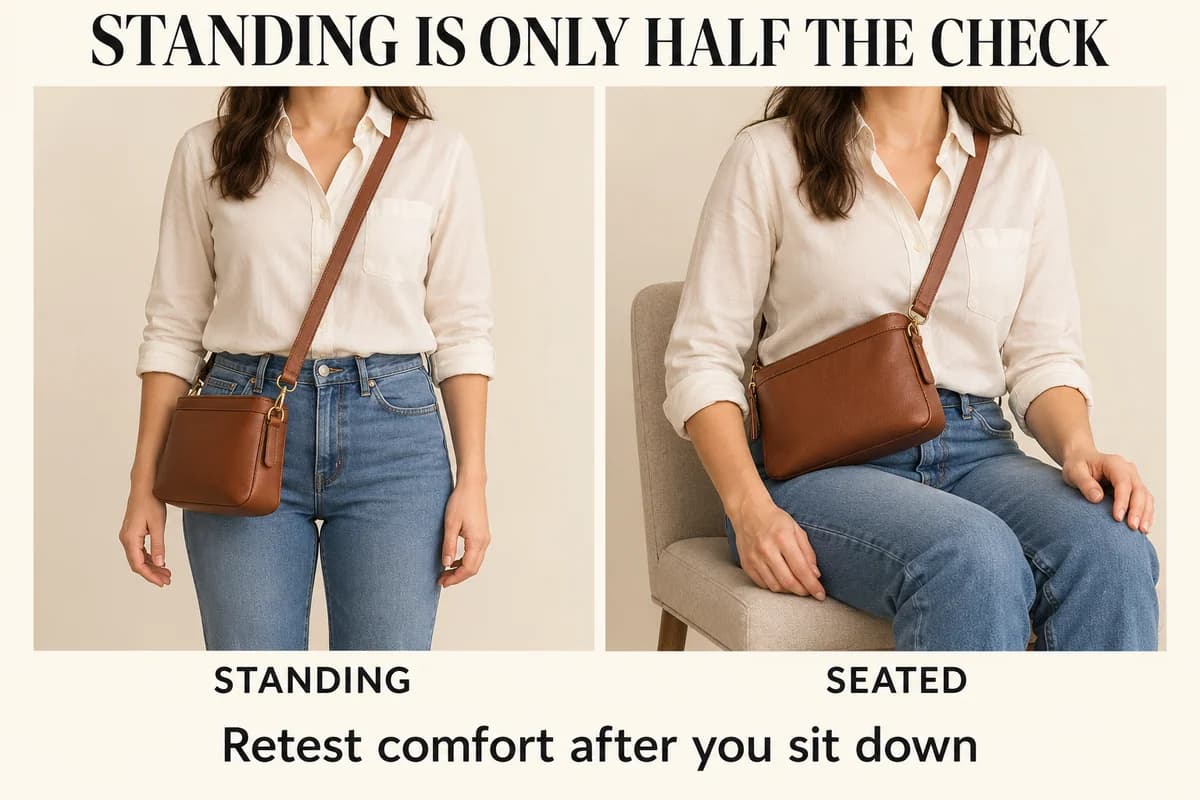
Suppose the opening is now accessible and the bag moves less as you walk. Sit on a dining chair before calling that setting finished. If the top corner presses into your lower ribs, lengthen the strap slightly and move the bag a little toward the front, provided the strap stays flat. Repeat the reach and walking checks. The useful compromise may sit lower than the neatest-looking standing position.
For a long seated journey, you can take the bag off and keep it where appropriate for the setting. There is no obligation to find one crossbody position that remains perfect through every activity. If shortening makes the shoulder dig in, remove unnecessary contents before assuming another adjustment will solve the weight.
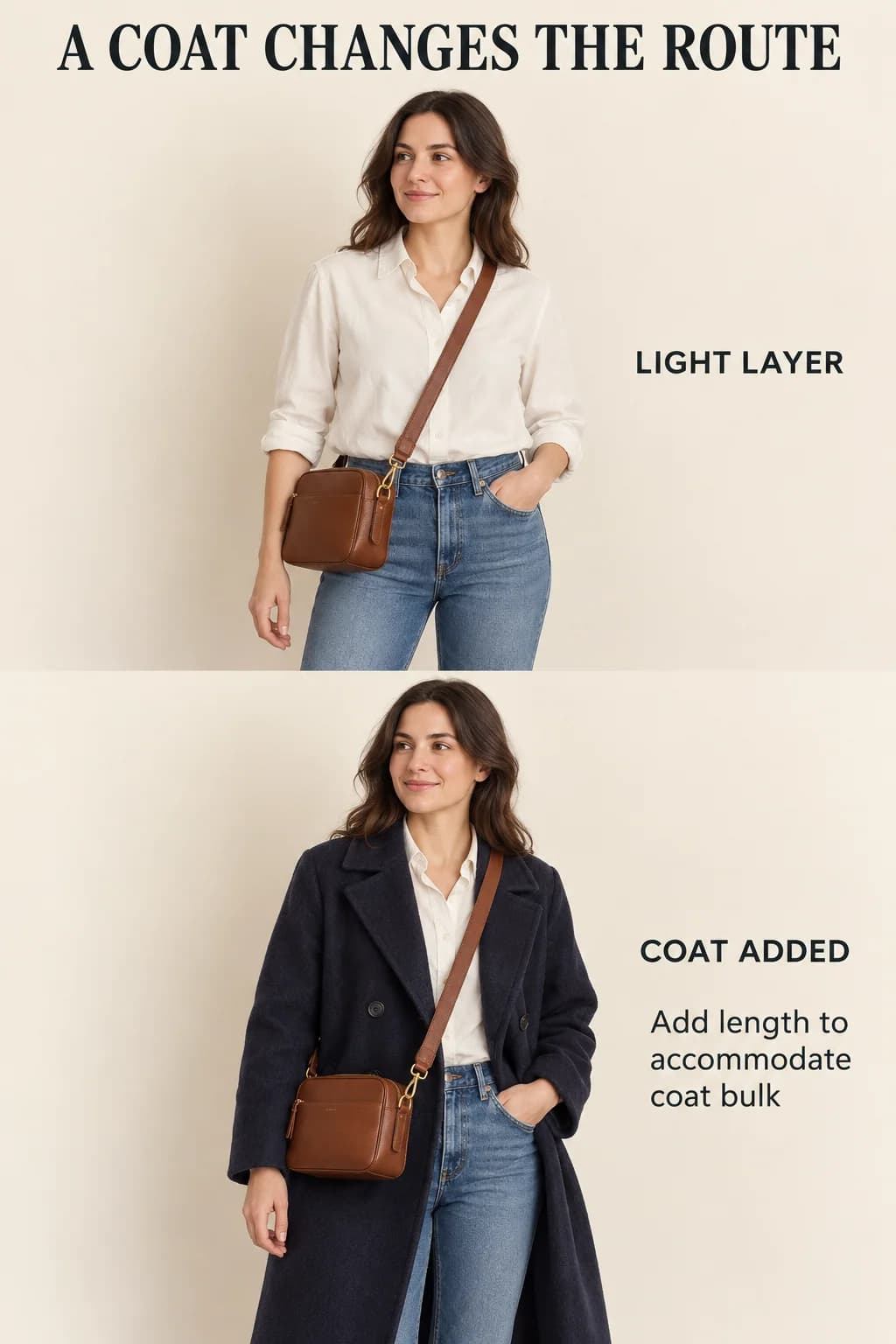
Over a winter coat: reset the route around the layers
Now keep the same contents and add a thick wool coat. The old setting may pull the bag higher and make the strap tight across the coat because it travels around more bulk. Put on your scarf first if you wear one, let the coat settle, and lengthen the strap until the bag's opening is reachable without compressing the layers.
Walk with your arms swinging normally. If the bag knocks against a coat pocket, shift its position slightly rather than repeatedly lengthening it. Then sit with the coat fastened as you intend to wear it. The bag should not be trapped on your lap by a taut strap. If it is, try a little more length and retest standing reach; if that makes it swing too low, carry it off the body while seated.
After removing the coat indoors, return to the lighter-layer setting. A small removable marker on your own adjustment record, or a note of the buckle hole, can make that change quick. The scarf guide helps keep neck layers clear, while the leather-jacket guide covers a less bulky outer layer that may need a smaller adjustment than wool.
Measure a replacement at the same endpoints
Use the strap that already works as your reference. Set it for the shirt, remove it from the bag if detachable, and lay it flat without stretching it. Measure along the strap from the outer end of one attachment clip to the outer end of the other, including the hardware. Record that as the full end-to-end length. Repeat at the coat setting.
For example, suppose those measurements are 115 cm and 120 cm. A replacement adjustable from 110 to 130 cm, measured including its clips, covers both settings. A strap whose maximum finished length is 114 cm does not, even if its description calls it a crossbody strap. These numbers illustrate the comparison; they are not recommended lengths for every wearer.
Ask the seller whether its stated range includes the clips. If it excludes them, obtain the finished end-to-end range before comparing. Check clip opening, attachment-ring compatibility and the maker's intended load as well. A comfortable length is little help if the clips do not attach properly.
Strap drop is a different measurement: the vertical distance from the strap's high point to the top of the bag in the maker's stated setup. It is not the full curved route around the body. Do not double a drop measurement to order a replacement or compare a full-length listing directly with a drop listing.
When another length will not fix it
A strap that slowly slips through its adjuster needs a hardware check, not endless shortening. A twisted strap needs rerouting; a heavy bag may need fewer contents or a different carrying option. If the bag's rigid corner presses in at every usable height, its shape may be the mismatch. Stop trying to solve those separate problems by choosing a position that makes opening, walking or sitting awkward.