The loafers fit yesterday. Today you added thicker socks, and getting them on has become an event.
Socks change two things at once: the space inside the shoe and the visible section above it. Sort out the first, then choose the second.
Start with the loafers on your feet
Put on both socks and both shoes. Smooth the sock over the toes and heel before you judge the fit. A fold under your foot can make a perfectly ordinary sock feel like a very small obstacle course.
Stand and walk around indoors. Check for new pressure over the top of your foot, crowded toes, a heel that will not settle, or a seam you keep noticing. If a thicker sock changes a comfortable loafer into a tight one, try a finer pair.
Do not judge fit from the shoe’s outside alone. A deep-looking upper or chunky sole does not tell you how much room your foot has inside it. Nor does a fine sock automatically solve every fit problem.
Sleek and substantial loafers give different starting points
A slim loafer with a low sole often looks especially simple with a fine sock. The small amount of fabric preserves the shoe’s outline and avoids a thick roll at the opening.
A loafer with a substantial sole can visually hold its own beside a more textured sock. But texture and thickness are not the same thing: fine ribbing can give you visible detail without the bulk of a cushioned athletic sock.
Try the same fine sock with either shape first. Add thickness only if you want its appearance and the shoe still fits. You do not owe a chunky loafer a chunky sock.
| What you want | Sock to try | What to check |
|---|---|---|
| Bare-looking ankle | Low-cut no-show sock | It stays below this shoe’s opening and does not slide under the heel |
| A small visible edge | Fine ankle sock | The cuff shows as much as you intend above the loafer |
| A distinct sock section | Fine crew sock | The cuff works with the hem when standing and sitting |
| More texture | Ribbed or thicker sock | Foot section leaves enough space inside the actual shoe |
| A quiet transition | Sock close to the shoe or trouser color | The color connects the part of the outfit you want to connect |
| A clear contrast | White, ivory or another contrasting color | Keep a comfortable thickness and compare in the whole outfit |
Choose how much sock you want to see
Minimal visibility: a no-show pair
Choose a cut that sits below your particular loafer’s opening. Some loafers show more of the top of the foot than others, so a sock labeled “no-show” may still show in yours.
Walk before deciding. If the heel repeatedly slips down, the hidden look may not be worth the adjusting. A different sock cut, size or grip design may work better, or you can choose a visible fine ankle sock.
A small visible section: ankle socks
An ankle sock can leave a little fabric above the shoe without creating a long section up the leg. Start here if you want to see the sock but prefer a smaller accent.
Look at the cuff’s actual position. A thick cuff sitting directly on the shoe opening can look quite different from a fine edge just above it, even when both pairs are sold as ankle socks.
A distinct section: crew socks
A crew sock extends farther up the lower leg, giving color and texture more space. With cropped trousers or a skirt, that visible section becomes part of the outfit’s proportions.
In the comparison below, the same loafer is shown with a hidden sock, a fine ankle sock and a fine crew sock. The visible socks stay the same color and thickness, so you can judge height on its own.
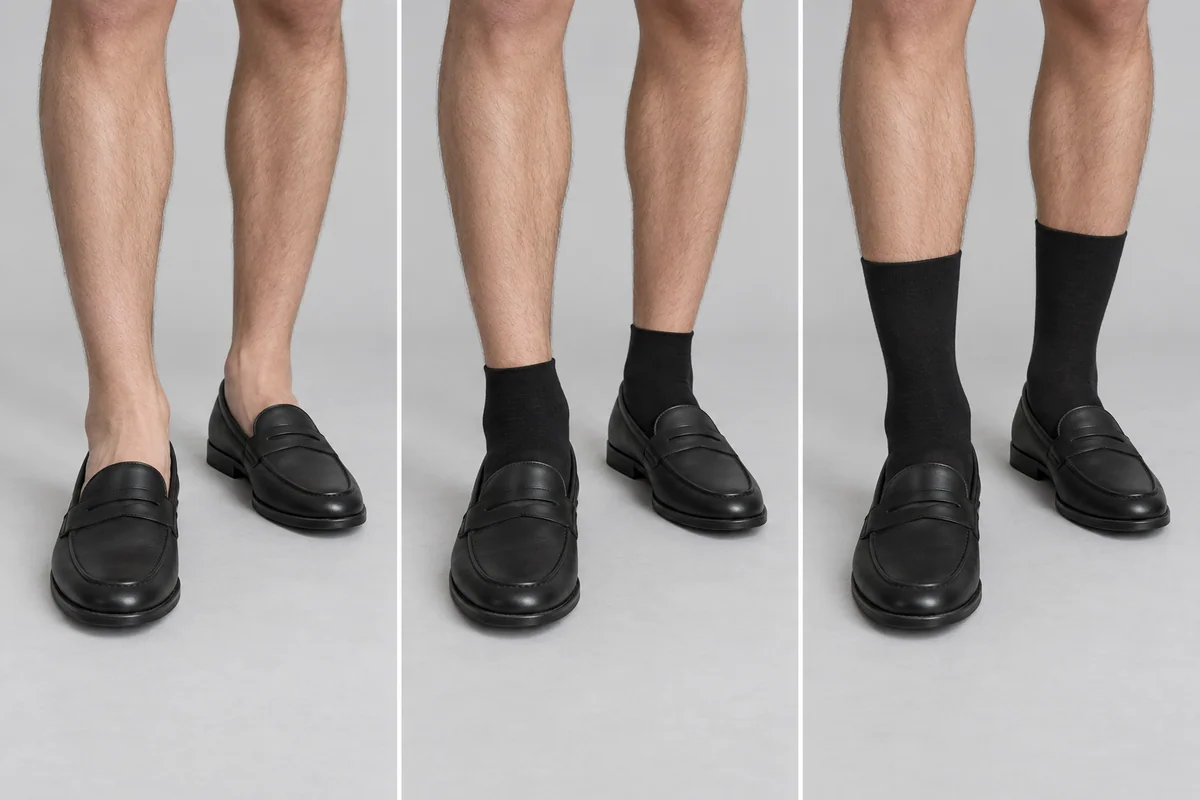
Treat the names as starting points, not fixed measurements. What matters is where the cuff lands on you relative to the shoe and hem.
Compare thickness without changing everything else
Try a fine sock and a thicker pair in a similar color and at a similar height. Keep the loafer unchanged. That lets you see whether you prefer the extra fabric, rather than reacting to a new color at the same time.
The thicker sock below brings more texture around the opening. That visible bulk is a styling choice; a photograph cannot tell you whether the foot inside is comfortable.
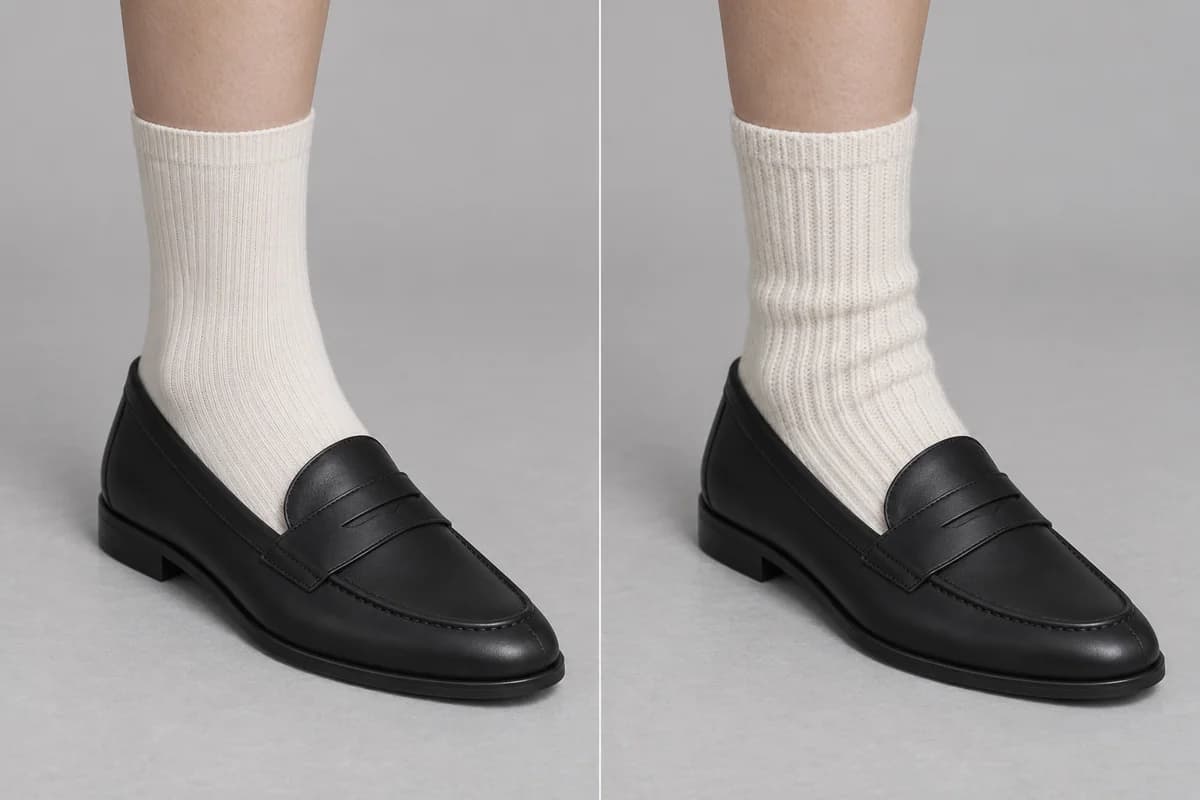
Check the foot section, not only the cuff. Some socks have a substantial top but a finer foot; others add cushioning under the sole or through the toe. What looks delicate above the shoe is not always what you feel inside it.
If you like a slouched sock, begin with a pair that fits smoothly inside the loafer. Let any intentional folds sit above the shoe. Repeatedly tucking extra fabric into the opening changes the fit you just checked.
Use color to choose which boundary stands out
Near the shoe color: a black sock with a black loafer carries the dark shape upward. You still see the cuff against the leg, but the sock-to-shoe join is quieter.
Near the trouser color: a sock close to the trousers carries their color down toward the shoe. This is useful when you prefer a softer break beneath a cropped hem.
In contrast: white or ivory against a black loafer makes the sock a clear feature. A fine pair can deliver that contrast without adding much bulk. For a different accent, pick a color already present in the top or another small detail.
The next image keeps the black loafers fixed. The top row compares dark and ivory socks under cropped trousers; the bottom row makes the same color comparison with a skirt. Compare across each row to isolate color, then look down to see the different hem context.
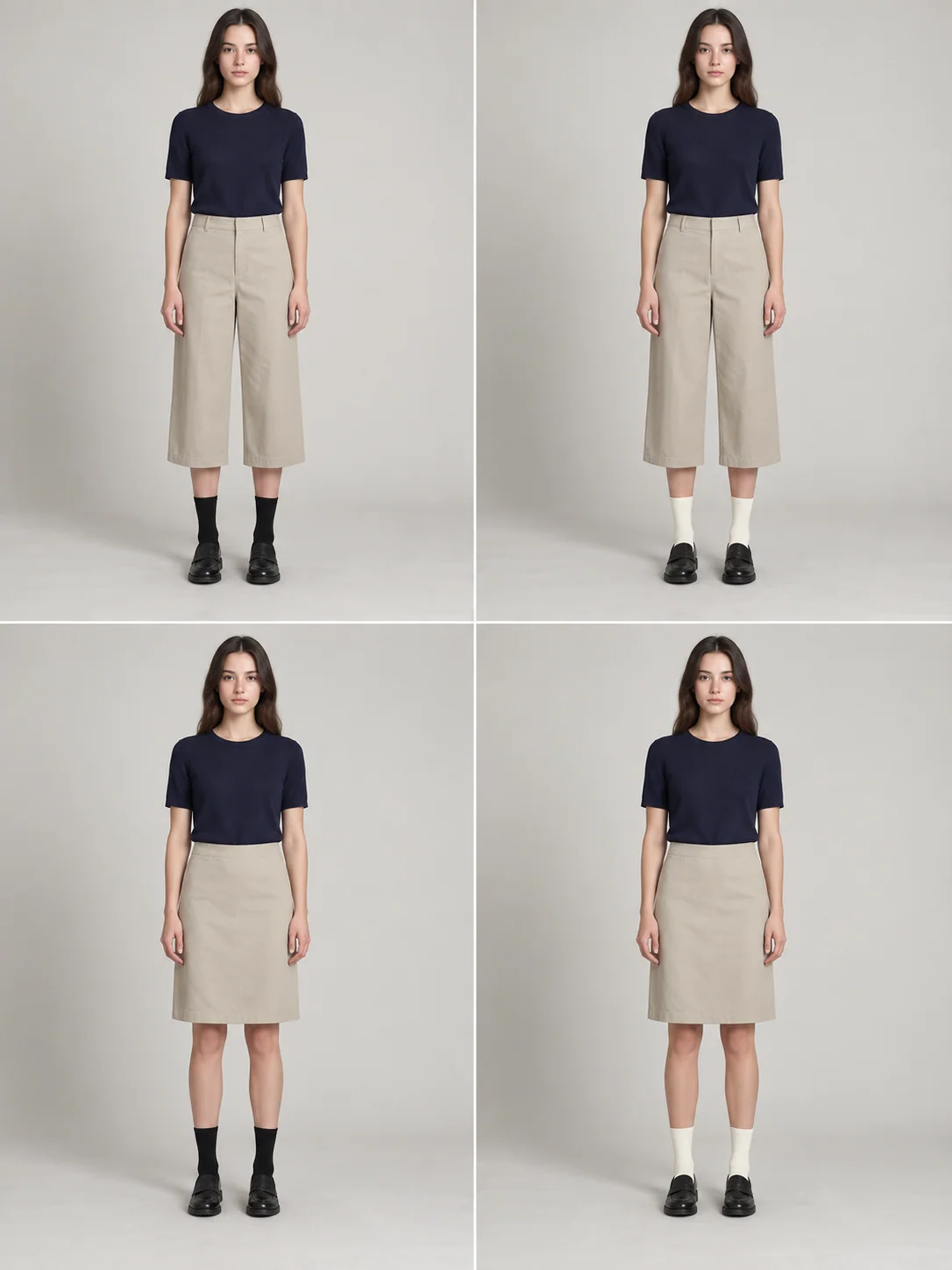
If you want a calm outfit, you do not need an exact color match. A close shade can soften the transition while leaving the separate pieces visible.
Check the hem standing and sitting
With cropped trousers, look at the gap between trouser hem and sock cuff. Do you want a visible strip of leg, or would you prefer the sock to reach under the trousers? Either can be deliberate. Sit down and check again, because the hem may rise.
With a skirt, judge the sock in the full outfit. A higher sock shows less bare leg; a contrasting one makes a stronger horizontal section. If the combination feels busier than you wanted, try a lower-contrast color before changing your skirt.
If you are choosing loafers for wide-leg denim, the wide-leg jeans shoe guide covers the shoe-and-jean pairing.
Make the smallest useful change
If the shoe feels tighter, change thickness. If the lower leg looks more divided than you wanted, change visible height or color contrast. If the socks keep slipping, address their fit before deciding the whole combination does not work.
Frequently asked questions
Can I wear white socks with black loafers?
Yes. The contrast makes the sock a visible part of the outfit. Try a fine white or ivory pair first if your loafers fit closely, then choose the height with your actual skirt or trouser hem. The look does not require thick athletic socks.
Do sheer socks work with loafers?
They can. Check their toe seam, fit inside the shoe and any decoration near the opening. A sheer appearance does not guarantee that every part of the sock is thin, and an uncomfortable seam is a reason to try another pair.
Should socks match my loafers or my trousers?
Either can work. Matching the loafers visually extends the shoe color upward; matching the trousers carries the trouser color toward the shoe. Choose which transition you want to soften. Neither option requires an exact dye match.
What if no-show socks keep slipping down?
Check the sock size and how its heel sits on your foot, then walk in the actual loafers. A different cut or heel grip may help, but is not guaranteed to stay put. A fine ankle sock is another option if repeated slipping makes the hidden pair impractical.