The jeans fit. The boots fit. Put them together and the hem starts climbing the boot like it has somewhere else to be.
Before blaming either purchase, look at the few inches where they meet. Straight-leg jeans and ankle boots need enough room to move past each other, plus a hem that lands where you want it.
Check the opening before the length
Put on the boots and socks you actually plan to wear. Let the jeans fall without tugging them into position.
Can the lower leg slide over the boot shaft, the part that wraps around your ankle? Or does it stop at the top and form a shelf of denim?
If the shaft is holding the jeans up, start with width. Shortening the jeans may move the hem away from the obstruction, but it will not create a smooth overlap over a shaft that is too bulky.
Try another boot with a slimmer shaft, keeping the jeans unchanged. A low heel, high heel, pointed toe or round toe tells you little about shaft clearance. Check that part separately.
If you are comparing measurements, measure around the outside of the boot where the jean needs to pass, including any tab or zipper. A jean opening measured flat across one side is approximately half its circumference; do not compare the flat number directly with a measurement around a boot.
Treat those numbers as a screening tool. Fabric stiffness, seams and the shape of the shaft still matter. Retailer measurements may also describe a reference size: Levi's fit details, for example, identify the waist size used for its listed measurements.
Choose a hem that overlaps or stays above
There are two useful starting positions. Neither requires a particular inseam number.
Let the jeans fall over the shaft
Choose this when you want a continuous line and covered ankles. The hem sits below the top of the boot, while the shaft stays inside the denim without visibly pushing it outward.
A taller, slim shaft can help when a shorter boot catches exactly where the hem lands. But taller is not automatically better: if it is too wide, the same problem simply moves up your leg.
Look from the side and back. The front can appear smooth while a pull tab has quietly recruited the back hem.
Let the hem finish above the boot
Choose this when the jeans are cropped or you want to show the boot shape. Leave enough separation that the hem does not perch on the shaft when you stand naturally.
That space can show skin or a sock. You do not need a prescribed strip of ankle. A dark sock close to the boot color makes the gap less noticeable; a contrasting sock turns it into a detail.
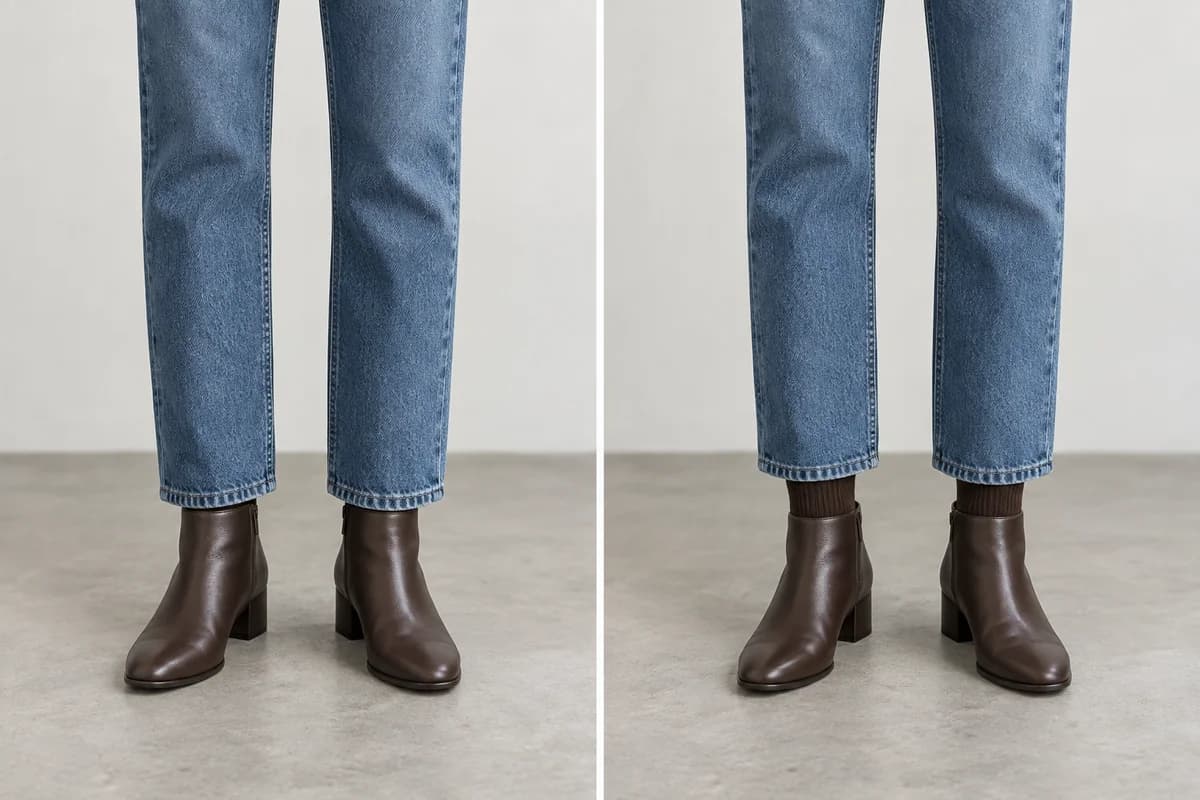
Two usable positions: a free overlap on the left and a clear gap above a lower shaft on the right. The best choice is the one that stays put when you move.
A hem that just touches the top can also work, provided it settles reliably. The problem is catching, not contact itself.
Diagnose the bunching
One soft fold over the front of a boot may be exactly the relaxed finish you want. Several folds that gather around the ankle deserve a closer look.
| What you see | Check first | Try next |
|---|---|---|
| A ridge where the boot shaft ends | Does the denim catch around the shaft or pull tab? | Try a slimmer shaft, or a hem that stays above it. |
| Loose folds collecting over the foot | Does the leg slide freely over the shaft? | If yes, temporarily shorten the hem and retest. |
| One side of the hem stays higher after sitting | Is a seam, zipper or tab holding it up? | Compare with a smoother shaft before altering the length. |
| A cuff that becomes a thick, tight ring | Has folding reduced the usable opening? | Unroll it; test an inward fold or a different boot. |
| More sock shows than you wanted | Is the jean too cropped for this boot? | Try a taller, slim shaft or a longer inseam. |
To separate a length problem from a width problem, gently lift the lower jean leg, then release it. If it drops freely but piles up over the foot, test a shorter hem. If it catches before reaching that point, test a less bulky boot shaft.
The useful question is where the fabric stops, not whether the outfit follows a rule about ankle boots.
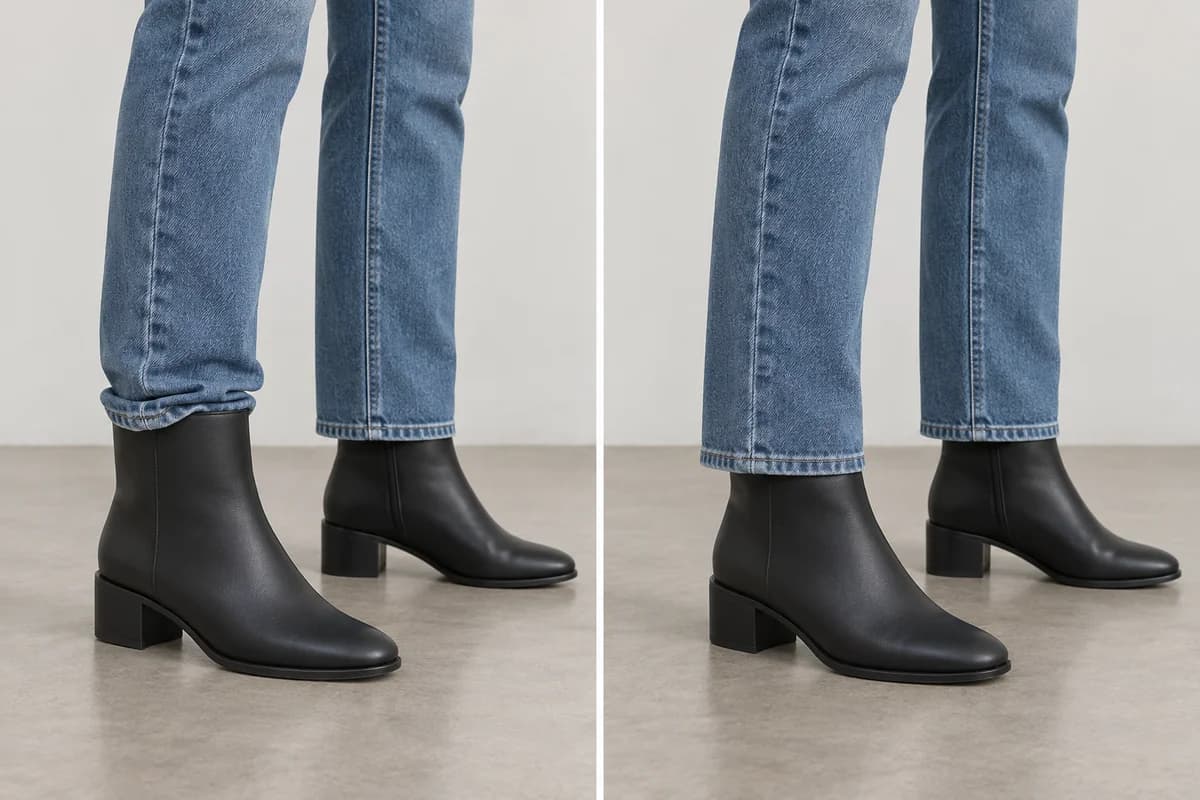
The jeans and hem length stay the same. Changing the shaft gives the denim room to fall.
Cuff only as much as the problem requires
A cuff is a reversible way to test a shorter length. Start with one turn, then look at the new hem position beside the boot.
For example, if a small fold lifts the hem clear of a short shaft and the cuff lies flat, you have found a workable option. If you need several rolls and the ankle becomes a stiff denim ring, stop adding folds.
A cuff adds layers. On a narrow opening, those layers can create the tightness you were trying to remove.
For a visible cuff, keep the fold even unless you deliberately want a slouchy finish. The lighter denim underside creates a horizontal band, so check whether you like that contrast with the boot.
For an uninterrupted wash, try folding the hem inward as a fitting test. This also adds a layer, so it may be unsuitable if the opening is already tight. Check that it stays secure before wearing it out. If that length works consistently, a tailor can help you choose a permanent finish.
Avoid cutting first and diagnosing later. Jeans are remarkably reluctant to grow back.
Do the sit, stand and walk check
Once the pairing looks right, sit down, stand up without adjusting the hem, then walk a few steps.
Check three things:
- Does the denim settle back over the shaft or stay caught above it?
- Does a cuff unfold, twist or tighten around the boot?
- Does the back hem clear the floor and stay out from under the heel?
If it fails, change one variable at a time. Try the same jeans with a smoother shaft, or the same boots with a temporary hem adjustment. That tells you what solved the problem.
The standing mirror view is only half the audition.
Finish the outfit after the hem works
For a covered ankle, check the overlap while seated as well as standing. Longer socks can cover a gap that appears with movement; they do not solve denim catching on the boot.
For a visible gap, choose whether the sock should blend with the jeans, blend with the boots or add contrast. Keep the rest of the outfit simple enough that the cuff and sock do not feel like accidental extra stripes.
Before a permanent alteration, wear the exact boots to the fitting and ask to check the front, side and back. A hem chosen for one boot may land differently with another.
If you are comparing this with a roomier denim shape, the wide-leg jeans shoe guide covers that separate proportion problem.
Frequently asked questions
Should straight-leg jeans be tucked into ankle boots?
For the clean fall described here, leave them outside the boot or above it. Tucking a straight leg into a close shaft gathers the extra denim inside. You can choose that bloused effect deliberately, but it is a different silhouette from a smooth overlap.
Can I wear chunky Chelsea boots with straight-leg jeans?
Yes. Test the shaft as well as the sole: a roomy straight leg may clear it, while a narrow leg can catch on the shaft or back tab. A cropped hem above the boot is another option if you like the visible separation.
Is there a correct gap between jeans and ankle boots?
There is no universal gap. Aim for a hem that stays clearly above the boot if you want separation, or overlaps it freely if you want coverage. The right position depends on your jeans, the shaft and what happens when you move.