A bookshelf is allowed to look like it contains books. You do not need to remove half the collection, reverse the spines or buy matching objects to make it feel considered.
The useful styling question is how to make the collection easier to read visually without making it harder to use.
Keep a system you can remember
Before moving objects, decide how you normally look for a book. By author? Subject? The shelf where you last put it? Start with the system that already helps you find things.
If you want to change that system, try one shelf before reorganizing the whole unit. A color arrangement can be attractive, but it is not automatically the best retrieval method for someone who remembers titles rather than covers.
Keep series together if that helps you. Keep frequently used books where you can comfortably reach them. The display should support your habits instead of asking you to learn a new ritual every time you read.
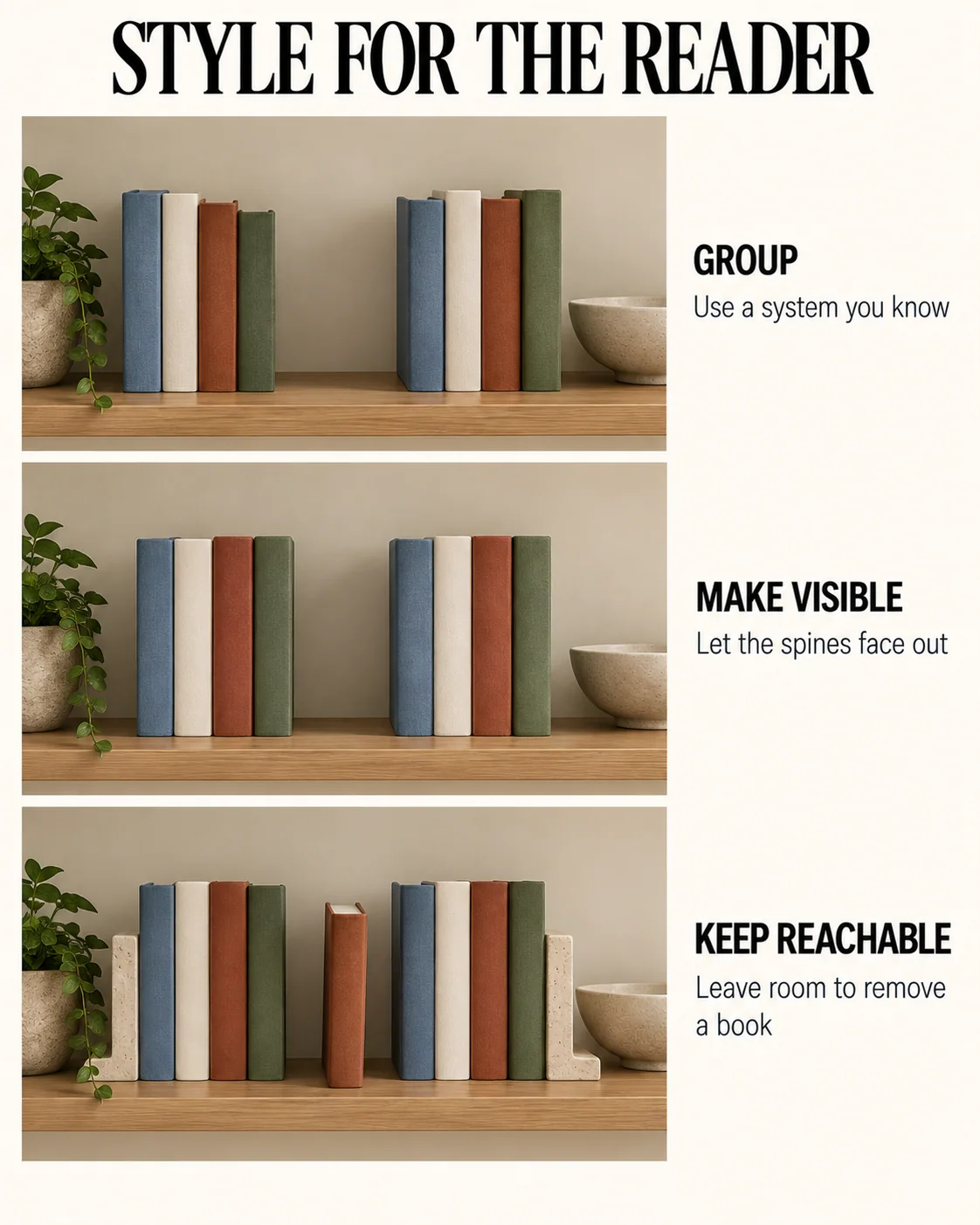
Make the book runs look deliberate
Group related books into clear runs. Within a run, align the front edges in a way you like and allow enough room to remove a volume without forcing it.
A shelf of mostly upright books can be the finished composition. Horizontal stacks are optional, useful when a particular format fits better that way, but they create a different retrieval task. Keep a frequently used book out from under a decorative stack if moving everything above it becomes annoying.
Use suitable bookends where needed. Do not assume a decorative object can support a leaning row simply because it looks substantial.
Follow the shelving manufacturer's load and installation instructions. This is a styling exercise, not a way to determine how much weight a shelf can safely carry.
Let decor occupy a defined area
Gather the small objects you want to display. Rather than placing one in front of every group of books, try a single cluster at a shelf end where there is genuine room.
For example, a small framed photo and a low ceramic bowl can share one area beside an upright book run. The book spines remain visible, and the objects read as a group instead of a scattered obstacle course.
Classic Casual Home shows how owned objects can be reused in a shelf arrangement. You can borrow that no-new-purchases principle without following a decor-first order. Classic Casual Home.
If the bookcase and nearby furniture have different finishes, use the wood-tone guide for that room-level decision. Do not solve it by hiding the shelves behind extra objects.
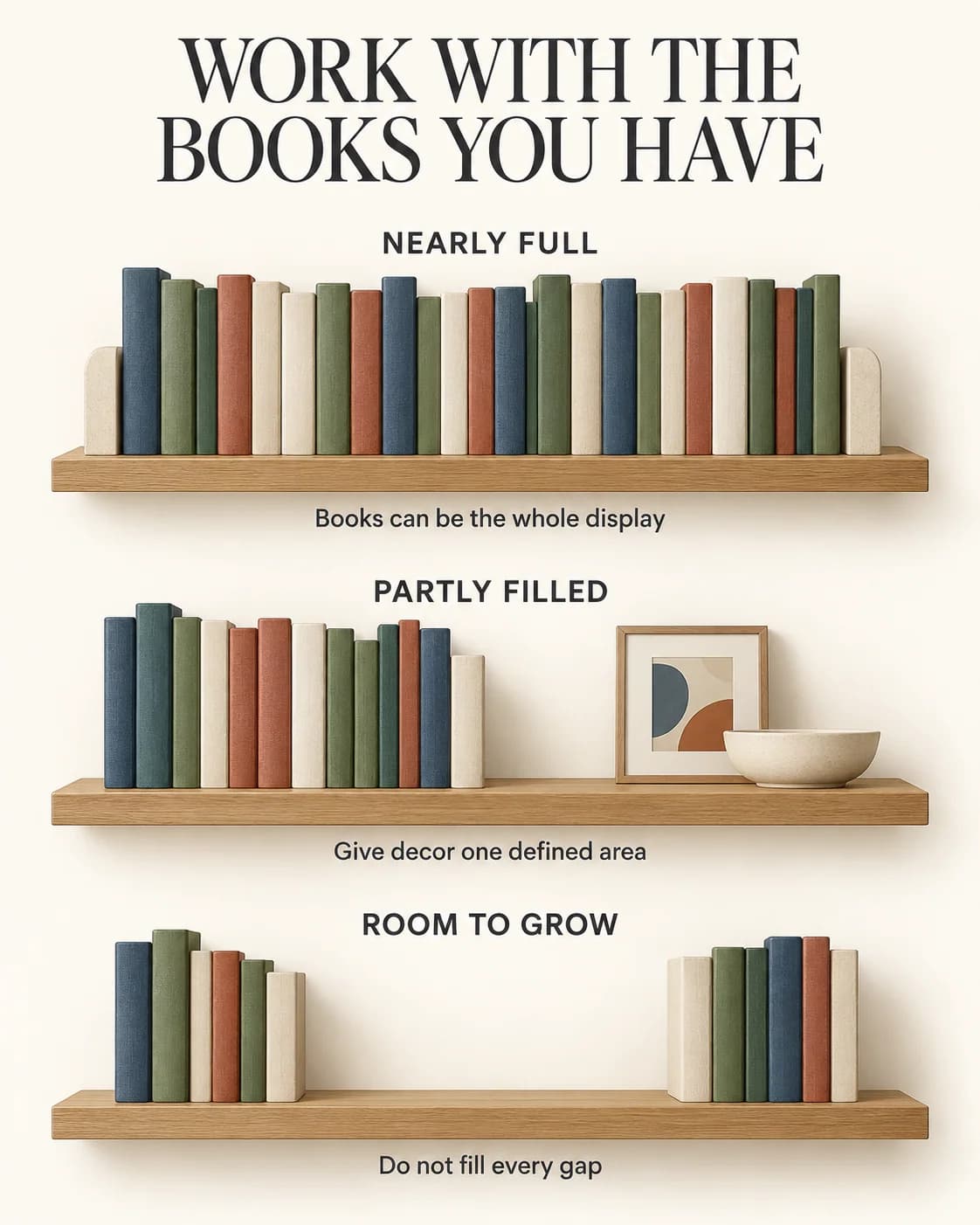
Adapt the display to how full the shelves are
Nearly full shelves
Keep most books upright and readable. If there is no practical space for ornaments, leave them off. Repeating the direction of the book runs can make a full collection feel orderly without reducing it.
Avoid wedging a vase into a gap that you need for taking books in and out. Storage capacity is doing useful work here.
Partly filled shelves
Try a book run at one side and a compact object group at the other. Leave the remaining area open rather than distributing several tiny objects across it.
On the next shelf, you can reverse the placement if you like a less symmetrical effect. Check the full unit before making every shelf identical.
A few books on a large unit
Concentrate the books into useful groups instead of spacing them one by one. Let some shelves remain quieter. You do not need to invent a collection of ornaments just because the unit has more room than your books require.
Vogue's stylist interviews explicitly allow both full and airy shelves. The important distinction is what you want to emphasize, not whether you meet an empty-space formula. Vogue.
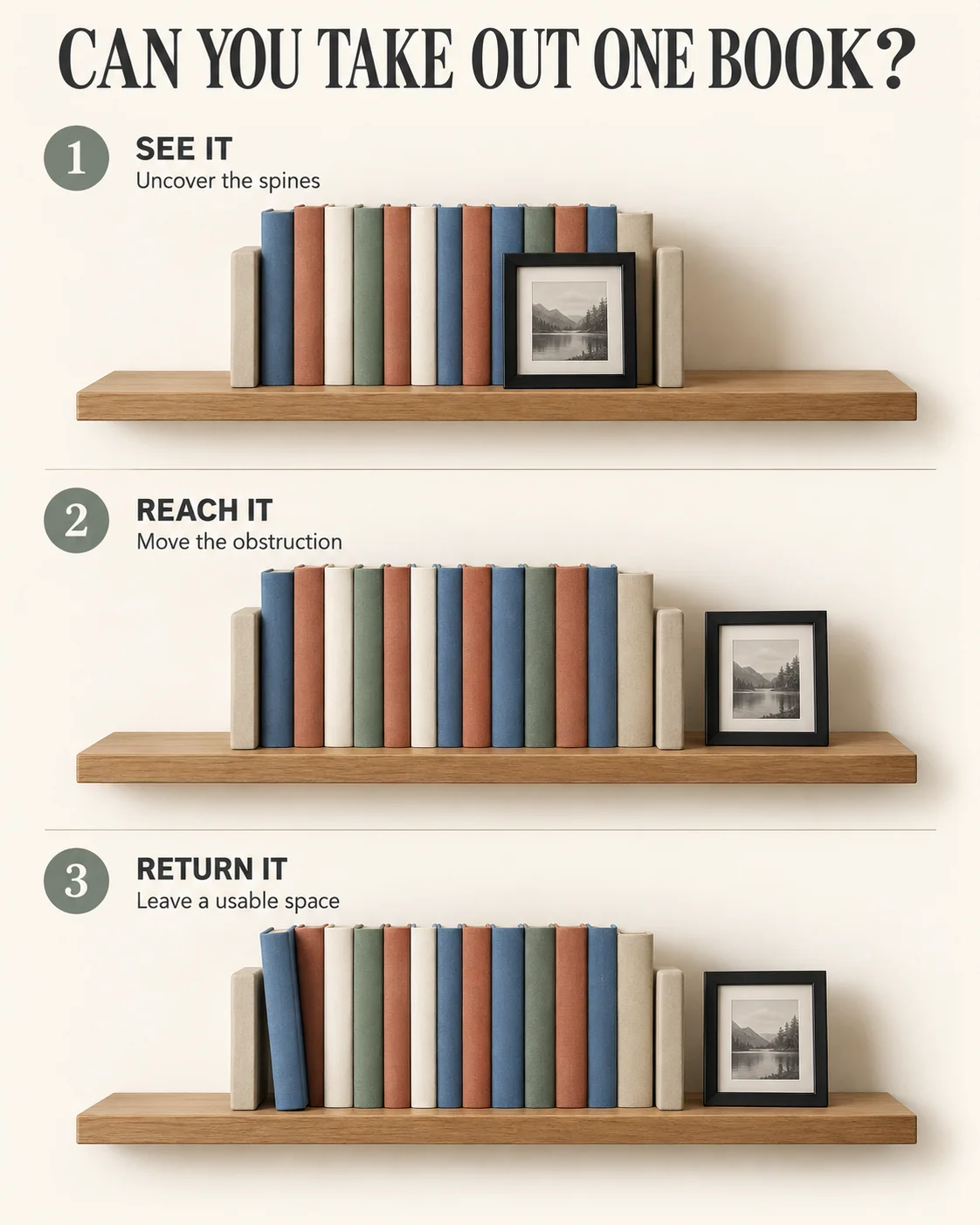
Use the one-book removal test
Pick a book you are likely to read next. Can you see its title, take it out and put it back without relocating a framed photo, balancing an ornament or rebuilding a stack?
If not, move the obstruction rather than accepting the inconvenience as part of the display. Then repeat with a book from a different shelf.
A working arrangement will change. The gap left by a book in use is not a decorating failure.
Frequently asked questions
Do I need to turn book spines inward?
No. If visible titles help you find books, keep them facing outward. A quieter palette is not worth making a working collection difficult to use.
How much empty space should a bookshelf have?
There is no compulsory percentage. A full collection can look deliberate. Leave the practical room needed to remove and return books, then decide whether additional open space suits the collection.
Should I arrange books by color?
Only if that is a useful system for you. Author, subject or another familiar order may be easier to maintain, especially when you regularly borrow from and add to the shelves.