You do not have to replace working blinds to give a window a softer outline. But adding curtains creates two moving layers, and a combination that looks good when everything is open may behave differently when you close it.
Start by deciding what the existing blind does well and what the curtain needs to add.
Give each layer a job
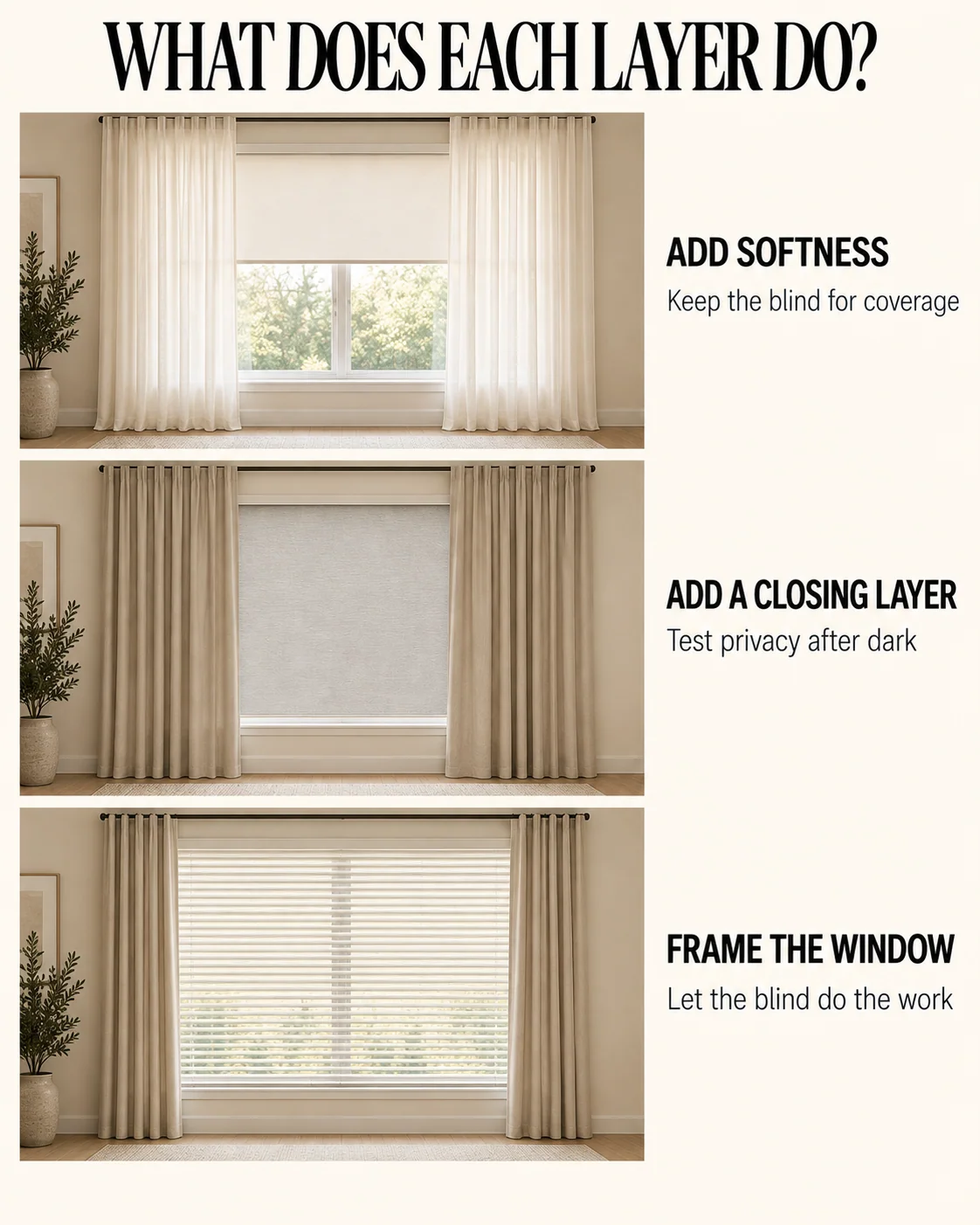
Write a short brief for the window: soften the view, reduce glare, add nighttime privacy, darken the room or simply frame the opening. More fabric is useful only if it serves one of those needs or gives you an appearance you genuinely want.
A common arrangement places the blind closer to the glass and the curtain in front on separate hardware. Curtain Studio describes this sequence and emphasizes clearance between the layers. The Blind Factory similarly separates daytime light filtering from more private closed configurations. Curtain Studio, The Blind Factory.
That does not make every fabric combination equally useful. If the existing blind already does all the functional work, the curtains can be primarily a visual layer.
| Existing layer | What may be missing | Curtain role to consider |
|---|---|---|
| Opaque roller blind | Softness when blind is raised | Sheer or light-filtering curtain, with privacy tested |
| Light-filtering roller blind | More privacy after dark | More opaque closing curtain |
| Slatted blind | Softer frame around the window | Side panels if blind already meets functional needs |
| Roman blind | Texture or visual framing | Curtains with clearance for the raised stack |
Start with the blind you already have
An opaque roller blind
Try a softer curtain layer for the periods when the blind is raised. Sheer fabric can diffuse the appearance of the window without adding a heavy-looking second surface.
Do not assume that “sheer” means private. The view through a fabric changes with lighting conditions and the actual material.
A light-filtering blind
If nighttime privacy is the missing job, purely decorative side panels will not solve it. You need a closing layer that provides the coverage you require, and you need to test the finished arrangement.
A curtain described as blackout still does not guarantee that the entire window assembly blocks all light. Gaps around edges remain part of the result.
A projecting blind or Roman shade
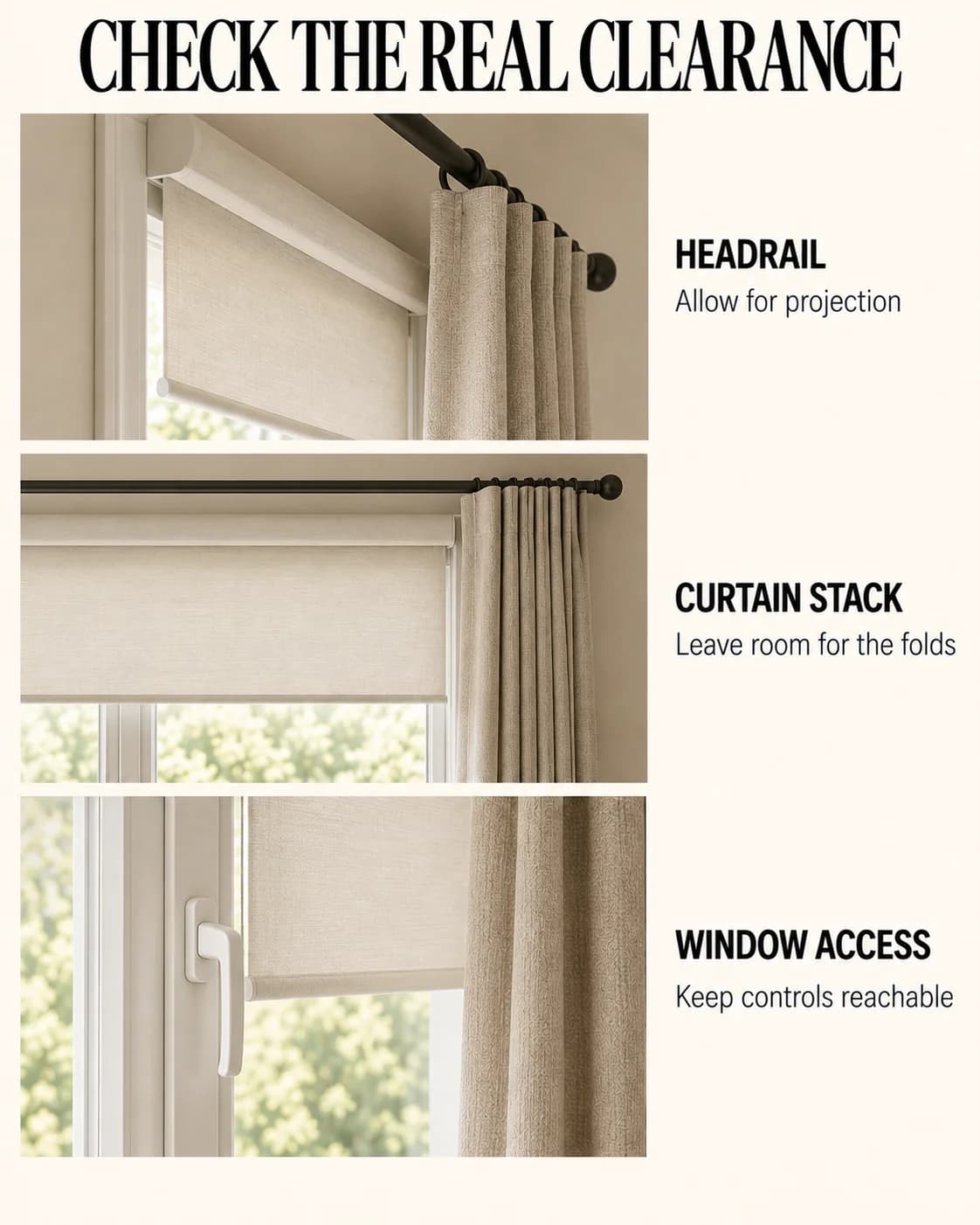
An outside-mounted blind, a headrail or the folded stack of a Roman shade may project farther into the room than you expect. Check that projection in the blind's open and closed positions.
The curtain must clear the actual moving assembly, not just the window frame. Do not select a rod position from a styled photograph.
Check clearance before choosing the finished look
Inspect the window handle, blind controls, headrail and any opening sash. Then consider where the curtains will sit when closed and where their fabric will gather when open.
A slim-looking blind can still have a projecting control or bracket. A curtain that clears it while hanging still may catch when drawn sideways.
For panel length, width and fullness, use the existing curtain-measuring guide. Here, the extra question is whether two systems can move without obstructing each other.
Follow the relevant hardware and window-covering instructions, including mounting and safety requirements. This styling guide does not establish whether a wall, bracket or installation is suitable.
Test four operating states
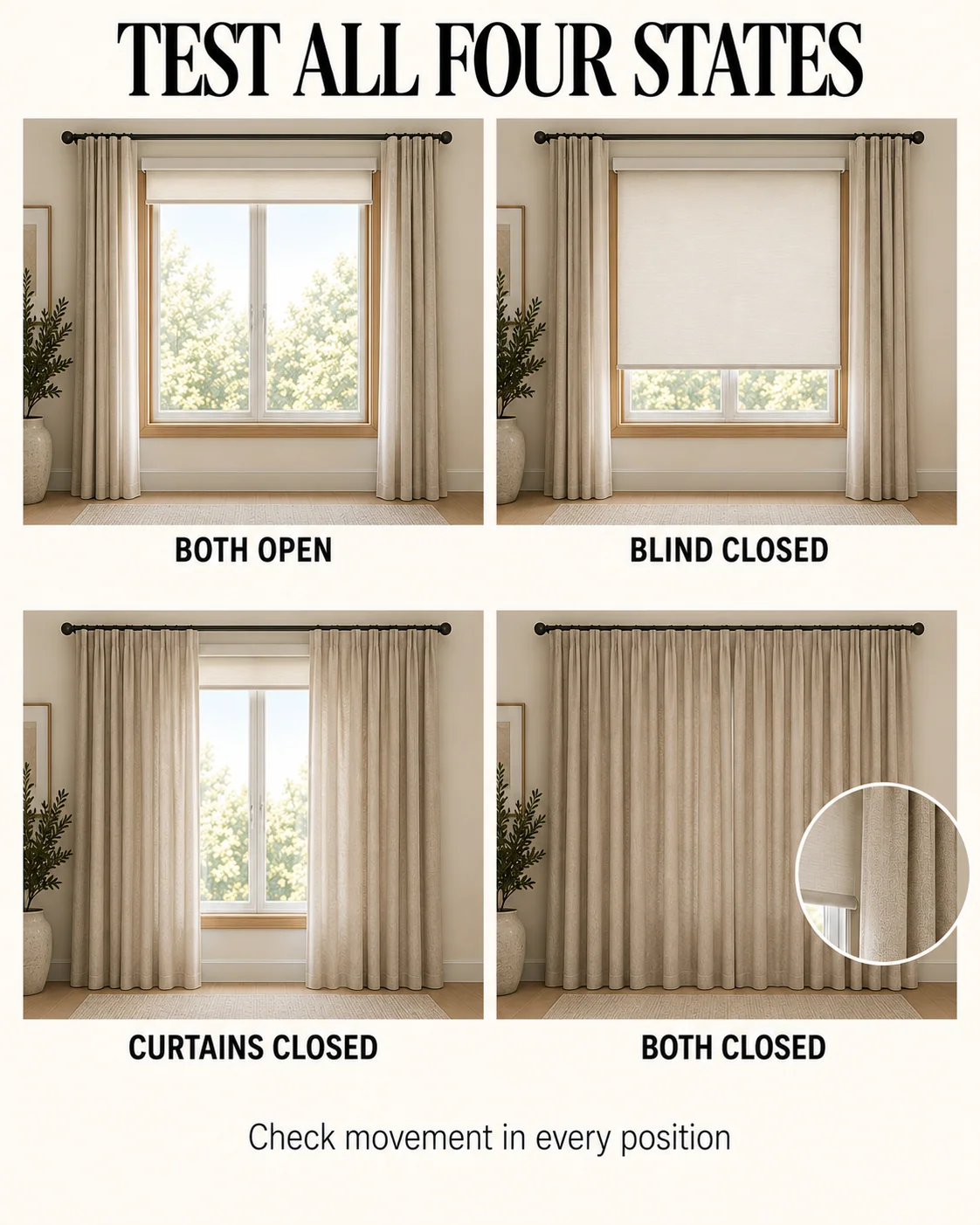
Check the window with both layers open. Then close only the blind, close only the curtains, and finally close both.
At each stage, operate the controls and inspect the contact points. Can the blind move without pulling the curtain? Can the curtain pass the headrail? Can you still reach what you need to reach without disturbing the whole arrangement?
This simple sequence often reveals a problem that is invisible in the fully open “finished room” view.
Check privacy after dark, not just in a bright room
When privacy matters, inspect the actual view through the covering with indoor lights on after dark. Use a safe, accessible outside viewpoint or ask someone to check from one. Do not lean out of a window or use a hazardous position to perform the test.
If a sheer layer does not meet your needs, use the more opaque layer. Also check side gaps and the area between adjacent panels.
You may prefer a soft sheer curtain by day and a closed blind at night. The useful result is the ability to choose, not a promise that one fabric behaves the same way in every condition.
Finish with one visual decision
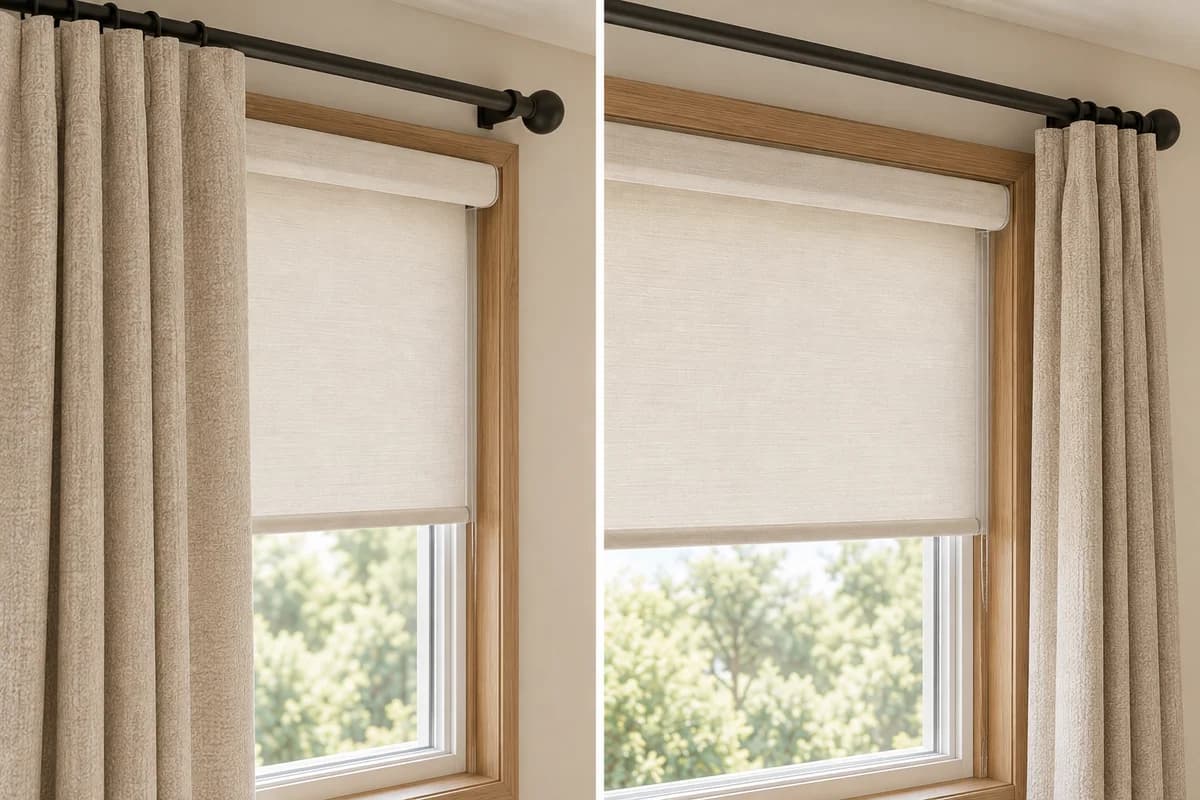
Keep either the blind or the curtain quiet if the window feels visually busy. For example, pair a plain ivory roller blind with softly textured oatmeal curtains and judge the fabric folds, not just the swatches.
Compare the same curtain pulled across and stacked back. Look for free movement and room for the folds before deciding whether the finished effect feels right.
Frequently asked questions
Can I keep existing blinds and add curtains?
Often, yes, if the new hardware has adequate space and both layers can operate independently. Check the blind's projection, controls, window opening and installation requirements before proceeding.
Do sheer curtains provide privacy at night?
Do not assume they do. Test from outside with the indoor lights on, using a safe accessible viewpoint, and use a more opaque layer where privacy is needed.
Do curtains and blinds need to be the same color?
No. Keeping one layer quieter can make the other the visual feature. A neutral blind with curtains in a related room color is one option, not a rule.