Pair wide-leg pants with cropped, shaped, straight or long jackets by controlling where the jacket ends and how much volume it adds.
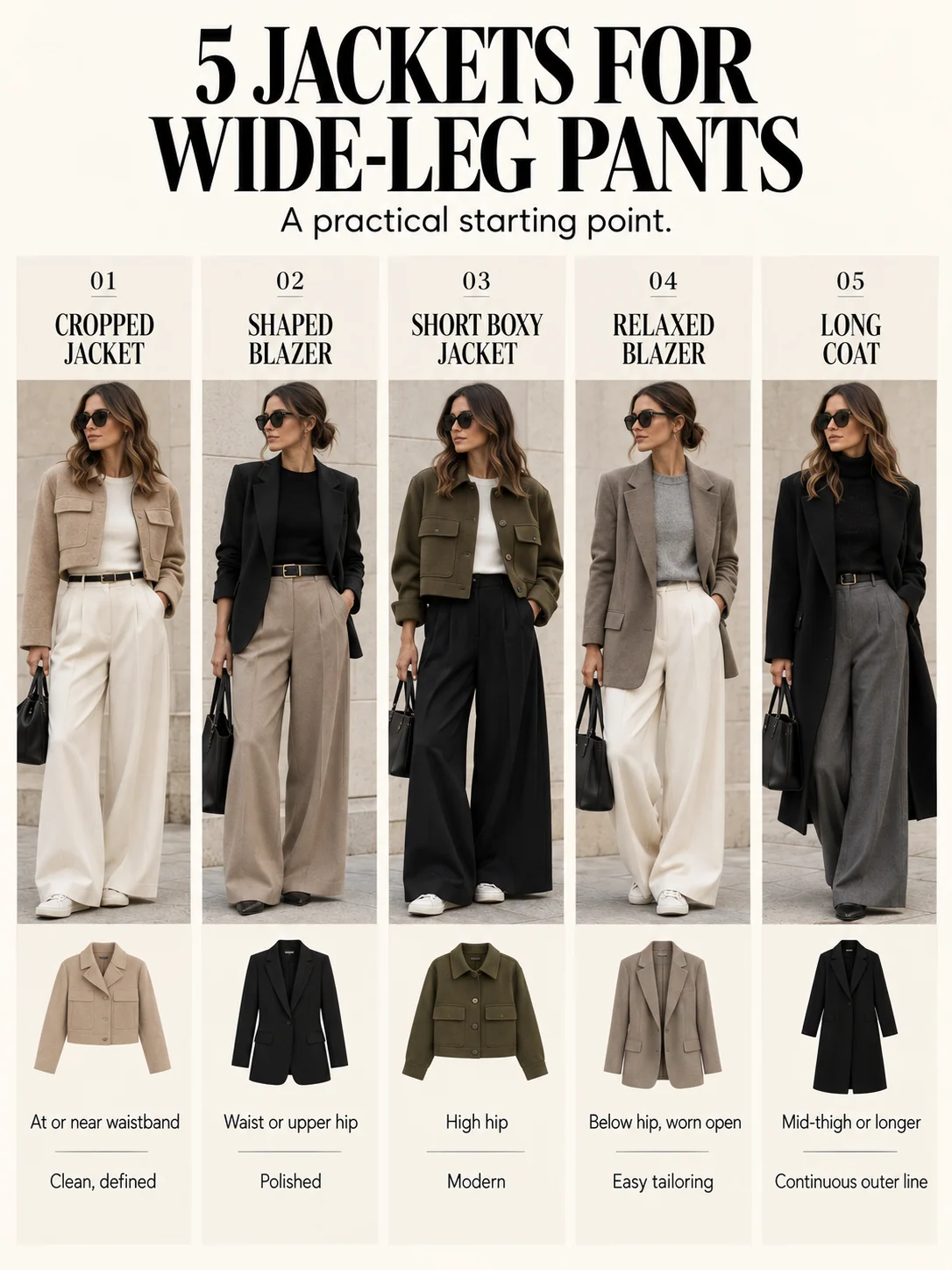
| Starting piece | Best match | Why it works |
|---|---|---|
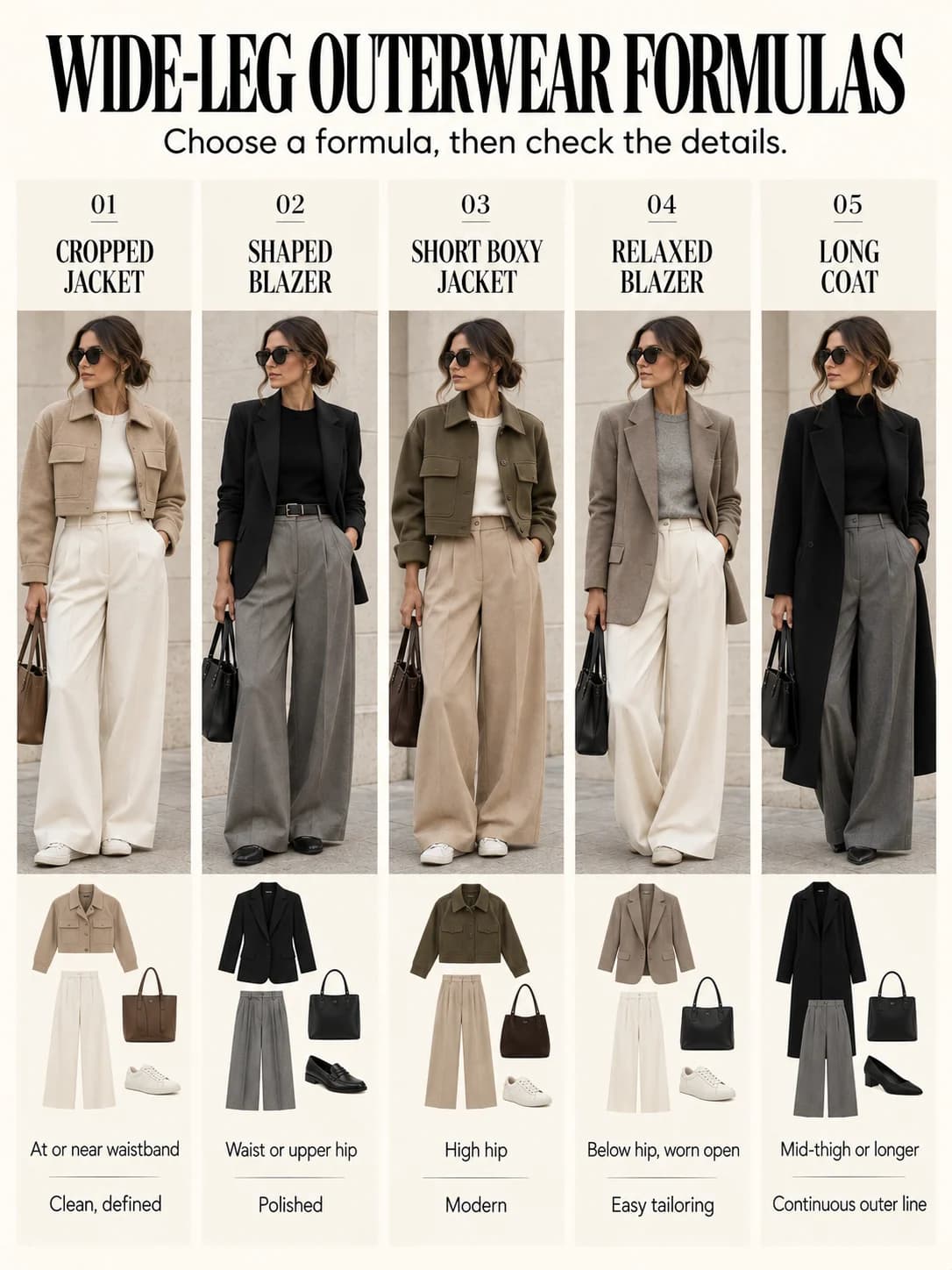
| Cropped jacket | At or near waistband | Clean, defined |
| Shaped blazer | Waist or upper hip | Polished |
| Short boxy jacket | High hip | Modern |
| Relaxed blazer | Below hip, worn open | Easy tailoring |
| Long coat | Mid-thigh or longer | Continuous outer line |
1. Start with the jacket hem
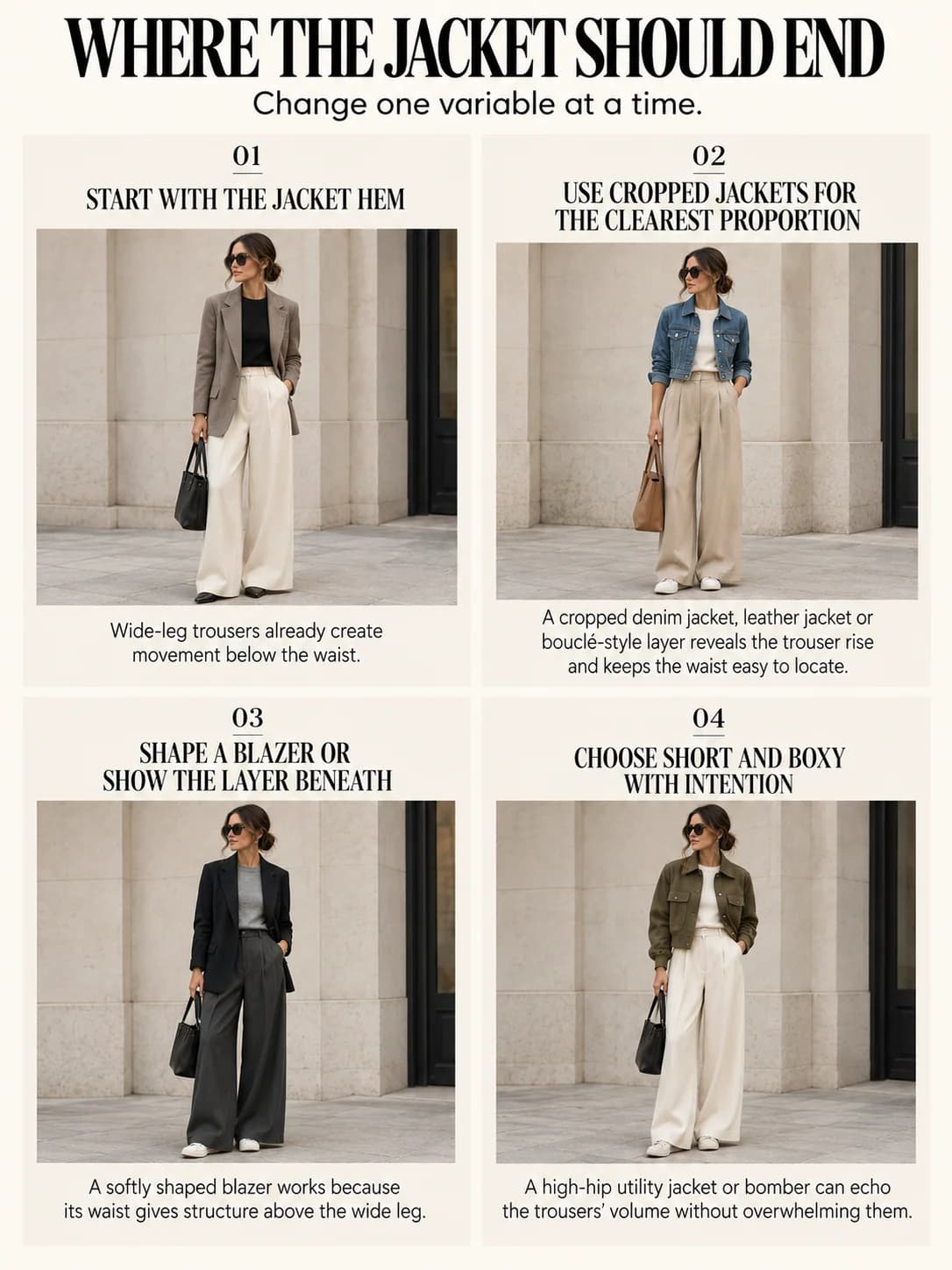
Wide-leg trousers already create movement below the waist. A jacket ending at the waistband makes that volume legible. A jacket ending at the fullest upper-hip point can create a visual traffic jam. Move the hem clearly higher or lower instead of chasing a universal “flattering” length.
2. Use cropped jackets for the clearest proportion
A cropped denim jacket, leather jacket or bouclé-style layer reveals the trouser rise and keeps the waist easy to locate. The jacket does not need to expose skin; it only needs to stop near the waistband.
3. Shape a blazer or show the layer beneath
A softly shaped blazer works because its waist gives structure above the wide leg. An oversized blazer can also work when worn open over a clear inner column—such as a fitted knit and matching trousers—so the eye can still find a vertical line.
4. Choose short and boxy with intention
A high-hip utility jacket or bomber can echo the trousers’ volume without overwhelming them. Keep the jacket hem compact and the shoulders controlled. Repeating a color between jacket and shoe helps the formula feel connected.
5. Let a long coat be truly long
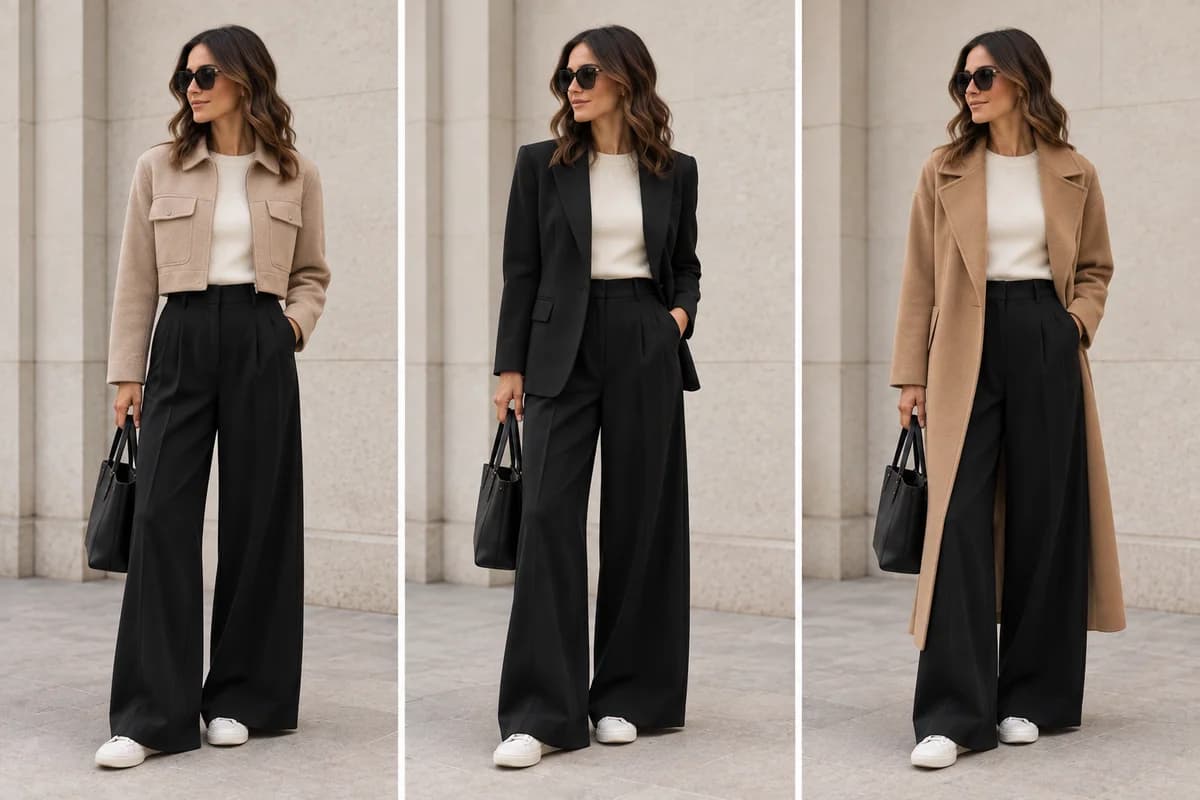
A coat that falls well below the hip creates one decisive outer line. A coat that stops exactly where the trousers are widest is harder to balance. Wear the long coat open when you want the high rise and inner layers to remain visible.
A five-minute mirror test
Photograph the outfit from straight on with your arms relaxed. First check the main transition described above, then look at the outfit as a thumbnail. The leading shape should still be obvious. Next, cover the accessory or layer you are least sure about with your hand. If the outfit becomes clearer, that piece is competing rather than supporting.
Walk, sit and reach before deciding. A formula that only works in one posed position is not useful enough. Check that closures lie flat, layers return to place and the key line remains visible. Finally, change only one element: try the alternative in the first column of the table while keeping every other piece fixed. The better option is the one that makes the relationship easier to read and still feels like you.
Common mistakes to avoid
Do not combine several fixes at once. Moving a hem, changing a shoe and adding a new color may produce a better outfit, but it will not tell you why. Avoid treating “Cropped jacket” as a universal prescription; it is one useful route with the effect “Clean, defined.” The other rows create different, equally valid results.
Also avoid choosing from a cropped mirror view. Shoes, hems and outer layers affect the whole outline. Review the complete look in ordinary light, then make the smallest change that resolves the specific problem.
The final check
Step back and look for one clear relationship: the eye should understand what leads, what supports it and whether the result still works in real use. If something feels off, change one variable at a time instead of replacing everything. That is the fastest way to learn which detail is doing the work.
Frequently asked questions
Can you wear an oversized blazer with wide-leg pants?
Yes. Wear it open over a simpler inner column or choose a blazer with some waist shape so the volumes remain readable.
Do cropped jackets only work with high-rise pants?
No, but they create the clearest transition when the jacket hem and waistband are close.
What coat length works with wide-leg trousers?
A truly long coat—mid-thigh, knee length or longer—usually creates a cleaner line than a coat ending at the fullest part of the hip.